This is just a brief note to say thank you to all the recent subscribers to this Cognitive Republic newsletter (click for details) (Opens in a new window).
Here are recent pieces - a mixture of free to read and subscriber only.
‘The Unfinished Contract — Our Democracies Must Learn or Die (Opens in a new window)’ (1771 words)
Democratic operating systems are glitching everywhere: Let's (not) patch and repair them (Opens in a new window) (2109 words)
Trump at Davos: How Democracies Lose - and Recover - Their Minds (Opens in a new window) (3000 words)
What if our societies were (deliberately) built to learn? (Opens in a new window) (1800 words)
MAGA is an ‘identity-centred’ political form - take it seriously (Opens in a new window) (2900 words)
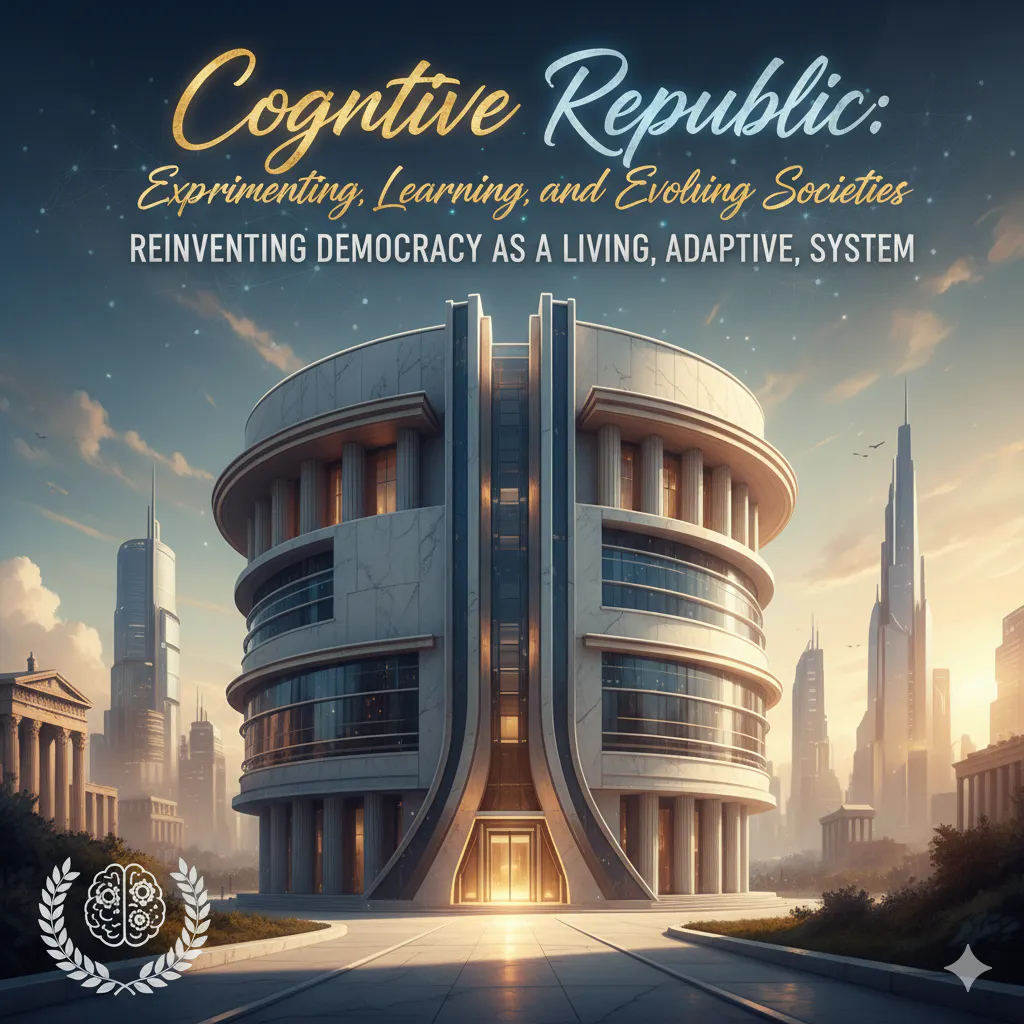
There are many more pieces coming this year. I argue that the to survive and prosper, liberal democracies must reinvent themselves as learning systems, ones continuously experimenting, measuring, and adapting. I call a society oriented in this way the Cognitive Republic. (Opens in a new window)
Please forward this email to anyone you think might be interested.
It seems obvious to me that: democracy depends on shared methods for knowing: evidence standards, dispute resolution, revision norms, and memory; when our shared epistemic infrastructure weakens, rules become rhetorical weapons and legitimacy becomes tribal. In turn, our politics becomes faith-based: “trust me” (strongman) or “trust us” (technocracy).
Liberal democracies are facing polycrises (financial shocks, pandemics, climate volatility, housing shortages, geopolitical coercion) outpacing current state capacity to deal with them. Moreover, trust is declining in our institutions, and a prominent political response is ‘mobilise anger, promise restoration, blame outgroups for failure, repeat’. The result is a legitimacy gap: citizens see elections, but not effective power; process, but not delivery; debate, but not learning.
Fundamentally, I argue that democratic failures are cognitive: our failures are breakdowns in collective cognition rather than single policy mistakes - weaknesses include: attention allocation, learning, prediction, correction, and institutional memory.
I am trying here to think in a new way about reviving our democracies: developing a a new language, a new underpinning philosophy, a new operating system for democracy, by drawing on cognitive science, psychology, neuroscience, and evolutionary biology. This will allow us to rethink ‘adaptive governance’ to rise to the challenges of the 21stC by reinventing democracies as living, adaptive, systems.
This point seems obvious, but the great works of political philosophy, our laws, our democratic procedures tend to ignore foundational insights from psychology and neuroscience that we humans have limited or bounded attention (people can’t monitor everything; institutions must be legible by design); we are hardwired to pay attention to identity and are very sensitive to status (people will only update their beliefs when it’s socially safe to do so, and our politics must therefore reduce any humiliation costs of learning to zero); we engage in motivated reasoning and group reinforcement (so we must build institutions rewarding learning and pluralistic scrutiny, not purity tests); and we are social learners we follow the lead of trusted peers (so our systems need diverse messengers and visible local proof, not elite lectures from on-high).
The upshot: we should never require civic heroism or individual courage to make our democracies work; instead, we need to build systems of civic ergonomics to empower us all.
Currently, there are about c. 6k subscribers to the Cognitive Republic (Opens in a new window). The open rates for each piece, delivered approximately every two weeks, are close to 50% (way above average) - click here to start (Opens in a new window).
Date
March 5, 2026
Topic
Cognitive Republic
0 comments
Would you like to be the first to write a comment?
Become a member of Cognitive Republic and start the conversation.