Transitioning from writing code to writing games is weird. It’s been 3 months and I now, finally, truly, have hit the barrier of sitting down at my desk and working for 8+ hours to make, read, design, play, refine, and revise games, and not feel guilty about doing the very thing I’m supposed to do. It’s weird!
There are some similarities, for sure. I’ll sit around for a little while and turn the problem around in my head. I’ll write (or sometimes just heavy-think… brain-load… something) a new mechanic, maybe a few notes or a whole page, then start running the tests to see how it comes out. When I’m ready, I put it all together, then run the full test suite and loop in other people for review.
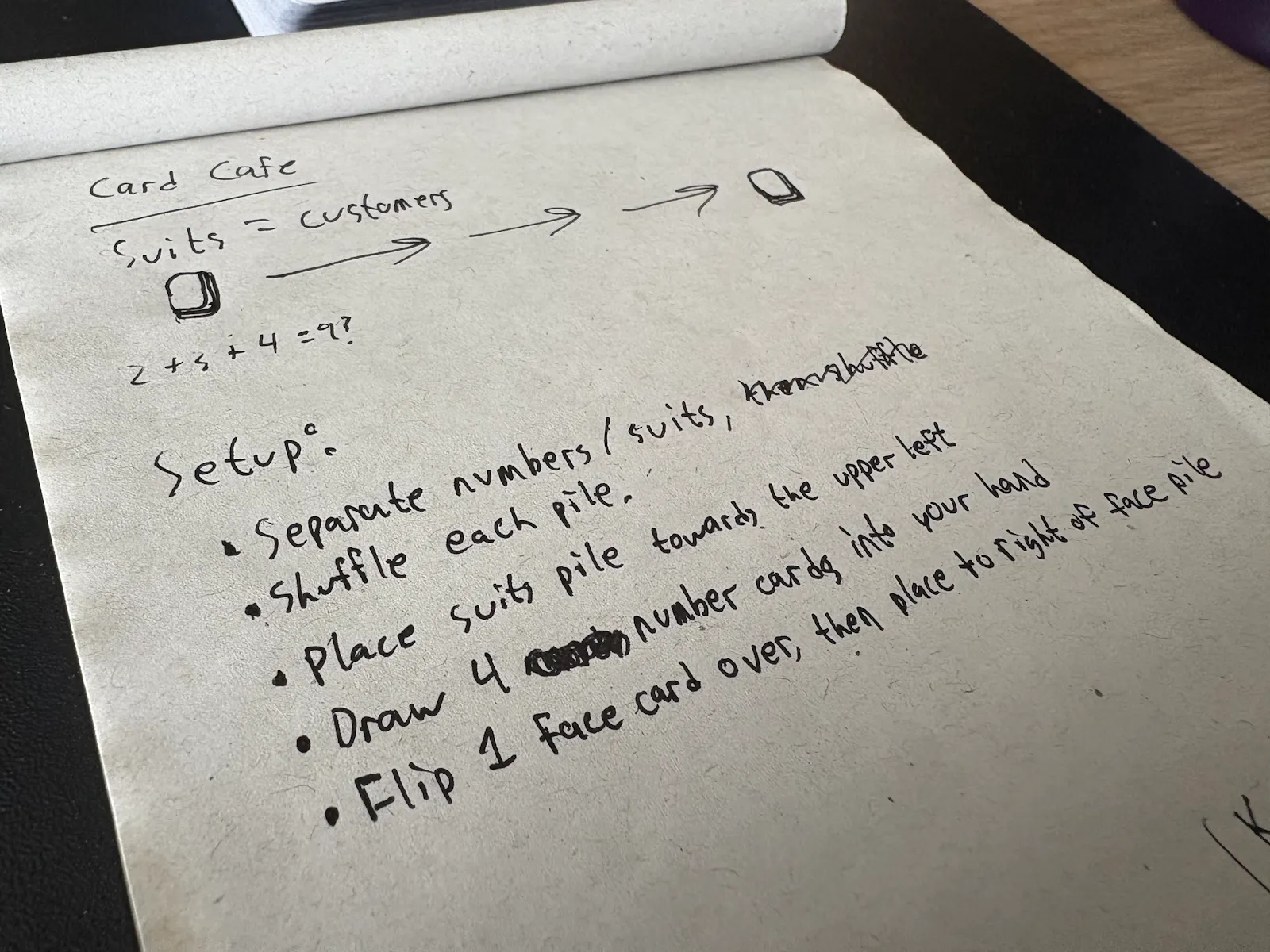
The first draft of this month’s game was originally themed as a Card Cafe, or maybe a Coffee Shop. It was color-coded, fast-paced, and by the end of it, too simple to post. Not everything needs to be an economic engine-builder like Become A Lich, which was fun but Too Dense. There’s definitely a temperature range for how intuitive something is to learn and play, and the first plates of Card Cafe were delicious but too cold to serve.
But the barista used their experience at the Card Cafe, to land a job serving —
A Royal Dinner?
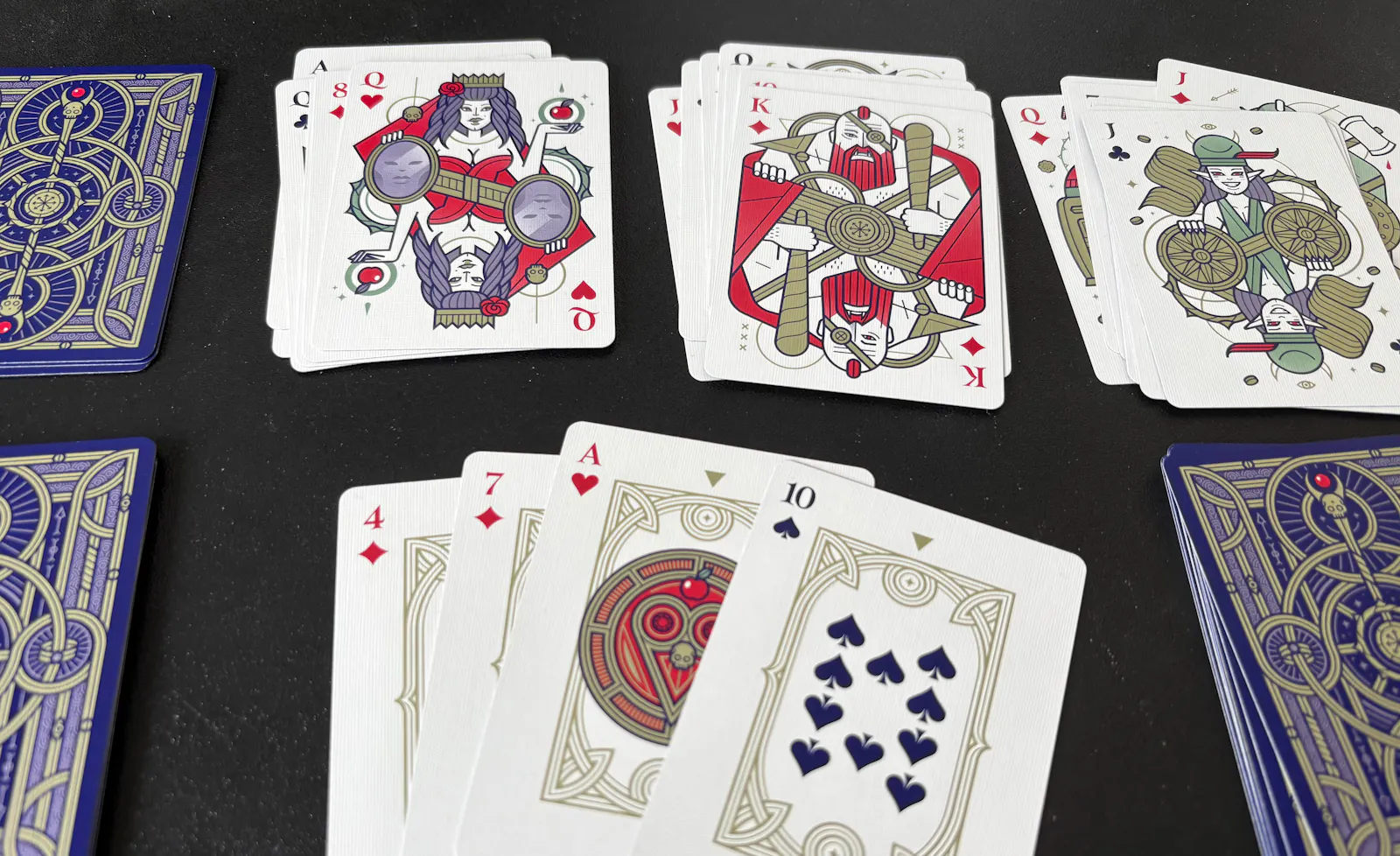
Releasing later this week, in Royal Dinner the player uses playing cards in order to serve food and beverages during a political summit. Each Royal figure has different dietary requirements, and it’s your job to feed all twelve with what you’ve got in the supply. If you run out of cards, you lose.
Can you feed all four Royal Families?
Cards? As art?
Oh, and about those cards. I didn’t know playing cards could be so beautiful, but they are! Sure, most tarot decks are drop-dead gorgeous in their own rights. And a lot of board games these days use cards to incredible effect. Pandemic has been around almost 20 years now, and more recently, the Slay the Spire board game has no shortage of gorgeous card art. But playing cards, as in, a deck of 52+? With that feel-good hand-feel and a handy hand-size meant for holding and not just staring at? No way!
 (Opens in a new window)
This Reddit thread hurt my wallet (Opens in a new window), but it really enlightened me to a whole world of playing props. And the good news is, I have a slew of brand-new playing props to help prop up my inspiration engine for the time to come.
Cards and games that use them have been around for forever, and in recent years, they’ve appeared in TTRPGs, too. Savage Worlds (Opens in a new window) made the rounds a couple years ago and it used a deck of playing cards to handle rotating initiative. In the indie scene, Wretched And Alone (Opens in a new window) and its many derivatives, like the gorgeously soul-crushing Galatea (Opens in a new window), use cards as prompt oracles against a Jenga tumbling-tower backdrop. Cartograph (Opens in a new window) adds jokers as an ambiguously-distant-yet-eventually-certain conclusion mechanic. And of course, Wreck This Deck (Opens in a new window) is famous for physically maiming, staining, etching, and in-all-ways making a deck unique to itself as a physical, lasting artifact of play.
Compared to dice, cards are handy for a number of reasons:
Cards are uniformly available. My local bookstore sells a cheap deck for €2.49. I’ve seen them in grocery stores, 2-for-€5.
Cards can retain information longer than ephemeral dice rolls
Decks can be shaped or divided in countless ways
Time passage is clearly linear (physically defined and presented)
But something I haven’t seen yet, (and maybe someone can point me out to fix this), is a multiplayer TTRPG with playing cards as part of the primary game mechanic. What I mean by that is a game where the main conflict resolution mechanic involves drawing cards, interpreting their values, and moving on with the fiction accordingly. So this is something I’ve been thinking on for a little while now, and going forward, I’m excited to talk a bit more about…
Faewander
(Name pending!)
Inspired after playing a few Ironsworn (Opens in a new window) derivatives, I’ve fallen in love with its basic resolution mechanic. In the original rules, a PC rolls three dice per roll, but many derivatives simplified this into Stats vs. the Challenge Dice.
The concept is simple. Check the Stat you’re testing, add any situational modifiers, and roll 2d10 against it. The Challenge Dice represent the difficulty through the world’s resistance to your action. For success, you want the challenge dice to roll lower than your skill rating. If both dice are lower, you fully succeed. If one is lower and the other is equal or greater, then it’s a mixed result, oftentimes success-at-a-cost. And if both are higher, it’s a total failure.
 (Opens in a new window)
This design is beautiful for a few reasons. First, the rules can clearly spell out conditions for giving bonuses, and bonuses never have to get very high. You don’t have to interrupt play to figure out how many bonuses and which status effects you qualify for. You also don’t need a GM to set the difficulty, making it friendly towards singleplayer and cooperative play. And lastly, you always and immediately know exactly what numbers you need to roll in order to succeed. It’s intuitive how your stats impact your odds. The heuristics are simple.
Coming soon, I’ll be playtesting a game that I’ve so-far codenamed Faewander, which involves using a deck of playing cards, with 1-10 for the draw and with special abilities and effects utilizing the face cards. Stats are themed along the suits to fit an old-world faerie tale aesthetic. A human girl might have decent Guile and Spirit, while a mischievous sorceress might be high in Smile. And talking bears are certainly high in Grit.
But how do the pieces work? How do the cards unfold? Stay tuned for more — and if you’re interested in the early playtest, become a Supporter and join our Discord! I’ll be polling in a Supporters-only channel on Discord in mid-late June and early July. Links at the bottom :)
Caught in the Rain
Alright, this one isn’t mine, but rather a plug for a studio I’ve found personally inspiring, as well as a teaser for an upcoming blog post.
The amazing folks over at Ravensridge recently kickstarted a game called Caught in the Rain (Opens in a new window), a singleplayer mystery detective RPG with strong noir themes that fits into any setting with a mystery.
 (Opens in a new window)
I had so much fun with the playtest. In my first playthrough, my PC was a weakened demon who’d been stuck on Earth and wanted to get back to her home. She learned a lot about the city of Paris, the ancient catacombs, the spirits that wander the graveyards, the vampires that haunt the night, and ancient (for Earth) scriptures, all while evading a sect of Catholic inquisitors seeking to destroy any unholy threat to God’s will. It was wild and dangerous and the results fed directly into a Vampire: the Masquerade game I run on Sundays.
Caught in the Rain successfully delivers upon its core themes. The game is well-illustrated and thoughtfully-composed, the editing and layout was gorgeous even in the preview stages, it combines cards and dice with journaling and world-discovery, and frankly, it’s the kind of game I hope to someday craft myself. Gosh, the hero envy is pretty strong here.
A couple years ago, Ravensridge also made Cartograph (Opens in a new window) (mentioned earlier), which deserves so much praise on its own. I find myself referencing it frequently in forums, and it comes up in basically any conversation about games with lasting physical artifacts.
Go check them out! These guys are incredible. You can pre-order the hardcover here (Opens in a new window), as well as grab the digital copy today from Itch.io (Opens in a new window)!
I’ll also run through a mystery with the full game in early June. I’ll share the best highlights publicly, with a full details on the complete playthrough available to my backers!
Other Projects In The Works
Two months ago I couldn’t imagine having to track production stages of multiple projects. It’s a big adjustment. Conceptually, I knew that any Creative would eventually need this. Every time a Youtuber shows their productivity pipeline, they show footage of a Monday dashboard or Notion database or some other spreadsheet full of statuses. It can’t all be ad-hoc, just-in-time development, especially as pieces get more refined and have more moving pieces to them. But seeing it actually play out is rewarding and fulfilling in a way I couldn’t even imagine before.
So, here’s a sneak peak of some of the projects I’m working on. (I won’t even double-dip and count Faewander! I talked about that already!)
Mage’s Guild of Urban Planners
Originally inspired by Avatar: the Legend of Korra, I spent lots of time this past month working on an Elemental Dice game, where you controlled four primal elements in an urban setting. “Urban magic” isn’t unique to Avatar, though. In Pathfinder 2e there’s a School of Civil Wizardry that wizards can subclass into. The concept isn’t unique to any one setting, because it’s a very natural realization that widespread dissemination of new magic/science/technology/whatever will lead to a fundamental shift of civilization.
And so, the concept of a Mage’s Guild of Urban Planners has been swimming around in my head for a while. The first versions involved running a magic storefront. The later versions were more cartographic in nature, where you would literally plan out a town or city following some certain construction requirements, then use your magic and the available natural resources to stand the whole town up within just a few days.
Alas, I just couldn’t get it to work together in a way that was properly fun in time for release this month. So, this will come around another day.
Untitled Demon Game
I have a thing for succubi. I’m not afraid to admit, hot sexy demon girls live rent free in my head. I want to make a game about it!
Thing is, I’m not looking to make a sexy game that sells because of sex. In fact, I’m decidedly not trying to make this a sexy game. Or at least, not for that purpose. There should be something fun and subversive about a demon game, but selling a game because of “hot sexy demon girls” feels reductive, not to mention typecasty.
Instead, I want to explore what makes demons fearsome. What creates a sin or virtue, and how those definitions create something subversive and tempting.
To sell this game best: in a dark, oppressive society ruled by the Tyranny of Pollution and High Crime, perhaps you could play an eco-demon who seeks to destroy concrete jungles and overthrow capitalism. It’s an uphill battle from the smallest seed sown to the tallest skyscraper toppled, and if you win, you overthrow the Money Demon and become the new Tyrant. A new demon is then attracted out of the need to overthrow you, and the cycle continues.
Timeline Travelers
Lastly — and this comes as a spinoff from a demon-game concept — I’m theorizing a journaling game about journeying through time and space. What if you recovered King Arthur’s sword, used it to battle a crew of space pirates, picked up a belt of plasma grenades, then brought both with you into a square-off against the Wicked Witch of the West and her horde of monkeys?
In a first draft, I imagined having 10 such stories/timelines, and you would roll a d10 and a d100 to figure out which event happens in what timeline. Alas, as fun as it was to set up, the very first playtest fell on its face immediately. Having 10 timelines is too much to load into working-memory. I’ll keep workshopping.
And that’s a wrap!
If you’ve made it this far, you rock, & I love you. And if you didn’t — darn!
Come join the Discord server (Opens in a new window) and share your thoughts! And if you want more of the content I’ve talked about, consider subscribing and sharing.
Every subscription helps this project succeed — especially yours!
Don’t forget! The Faewander TTRPG enters playtest this June, open to the Supporters-only channel on Discord.
Date
May 30, 2025
Topic
Blog


