The realisation
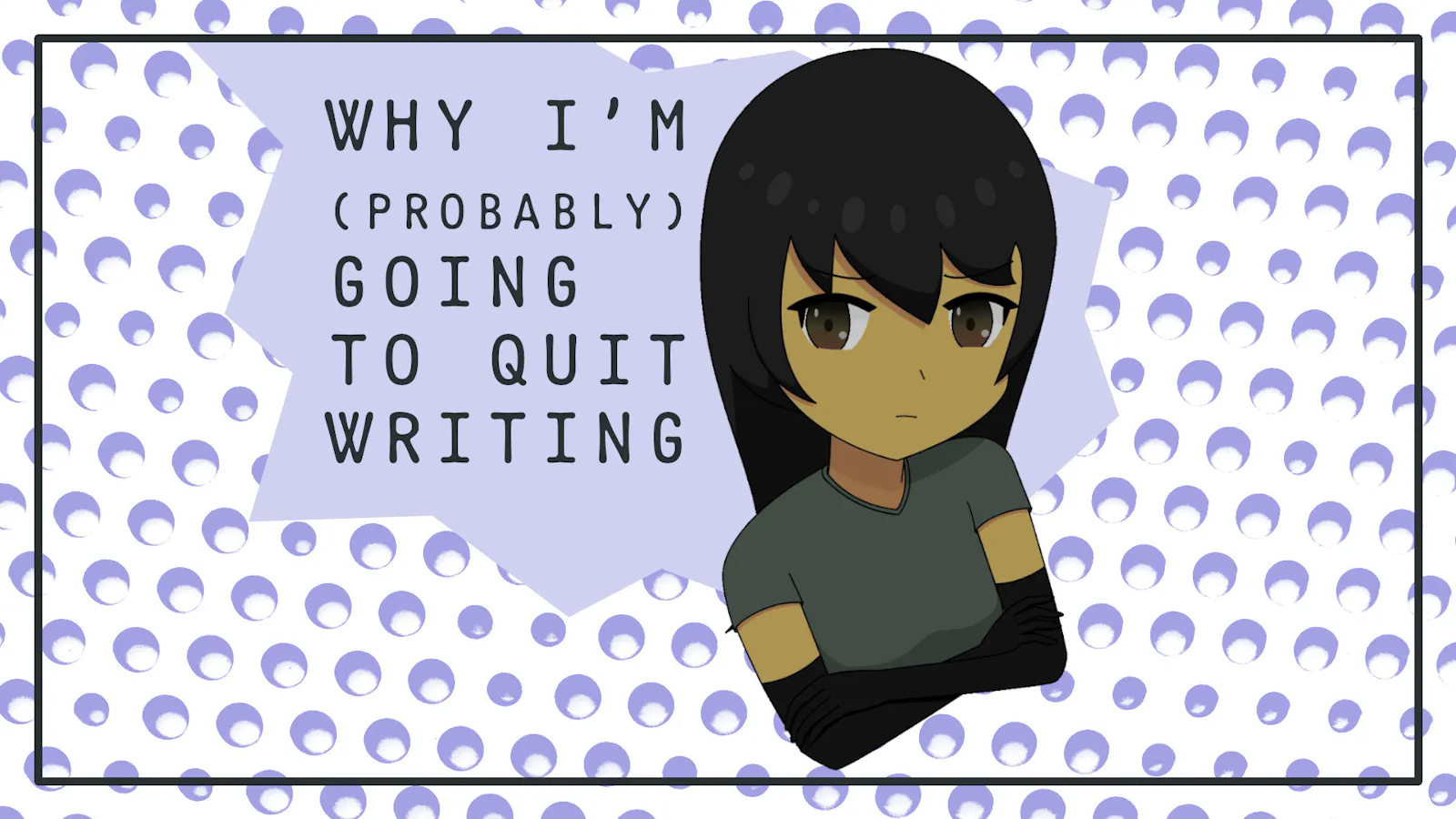
I’m probably going to quit writing contemporary literature (in German).
It’s not that I’ve made a conscious decision about it yet. It’s just that, like when I decided to quit academia, I’ve begun researching other writers who quit writing, how to quit writing, what to do after quitting writing.
My search history looks something like this as of late:
Failed writers
Writers who quit after being published
Successful writers who quit after being published
Writers who started writing later in life
Authors who posthumously became successful
Okay, so the last one is a bit macabre (but that’s not the point). I’ve also decided to let someone coach me through the decision-making process, which, if we’re being entirely honest, definitely translates into: I WANT TO QUIT.
So at the moment I think it’s quite likely that I will give up on writing – or at least, that I will stop writing contemporary fiction in German.
A plethora of reasons
There are many reasons for this: I’m unhappy with the German publishing industry, with the expectations people have of me as a marginalised writer, with the fact that some of the German language writers who are the most popular right now cosplay as people interested in social change when in reality they couldn’t care less – you wouldn’t believe the number of left-wing supposed feminist male writers who, in their actions, are deeply misogynistic (but then again, you also wouldn’t believe the number of authors who are genuinely the sweetest, most amazing people). Racism, the patriarchy, and opportunism are par for the course in any ego-driven industry.
Lack of recognition plays a role, but not in the way you might think. After all, I have won prizes and have been awarded scholarships in the past. I’ve thought about whether I might just be envious of other people’s achievements, but that’s not it, either.
What does play a role is the lack of financial stability that comes with not really caring about recognition, and the level of power we afford to people in the industry who are not always all that deserving. And then there’s the fact that while I’m confident that my writing is quite good, actually, it would be much more suited to the English language publishing industry and discourse.
I’ve also started becoming more involved with offering guidance to other people’s book projects and manuscripts. Personally, I find this more fulfilling, at least as far as contemporary literature is concerned, than the writing process itself.
And last but not least, I’ve come to the realisation over the last year or so that I not only prefer reading genre fiction to reading contemporary literature, although I genuinely do enjoy both. I also prefer writing genre fiction. The writing conventions for genre fiction are slightly different than for contemporary lit, in that such conventions are more rigid on the one hand, and allow for more thematic variation within their formally rigid structures on the other hand.
I don’t want to read family stories or coming-of-age fiction nearly as much as a good fantasy / horror / sci fi novel.
The nail in the coffin: Performative writing (or: the impossibility of being authentic in a highly curated environment)
My main reason for wanting to quit writing contemporary German lit (and non-fiction), however, is how you are required to perform a certain type of writer online and when advertising your works in order to be successful. The aesthetics are what until very recently used to be referred to as hipster culture, i.e. that boho chique drawing on marginalised cultures so often embodied by privileged white people, but by no means limited to them. It’s a performance of authenticity, leveraging (personal and communal) trauma as a marker of trustworthiness regardless of, say, social class. With some authors, I ask myself whether they are actually interested in writing or whether they are more interested in being perceived as a writer or an intellectual. Being perceived as a writer, an intellectual or an intellectual writer (which is the norm for contemporary literature as opposed to genre fiction) necessitates a certain level of performativity.
Now, let me be clear: I don’t mean to make the tired argument that the performativity of modern writing is somehow to blame for its downfall or any such nonsense. I neither believe that there is a lack of quality in modern writing, nor do I think that performativity is necessarily a bad thing (though it can be). We are all performing all the time, it’s human nature.
But the identity of ‘writer’ requires a particular level of performativity, in that, for me at least, it is more removed from the self. There are contemporary novels I love just like there are classics that I love, but I will never feel comfortable in that art and theatre crowd that also includes high brow literature.
I’m a nerdy, campy, geeky person, and even if I write serious contemporary literature, I don’t want to smoke and drink wine while I talk about Adorno and Arendt and Hegelian dialectics. I like reading and utilising these theories, and I appreciate that these wine-drinking, artistic, fashionable authors of contemporary German literature can be very nerdy in their own right. But most of them can’t really be geeky.
While I feel obligated to point out that I know and love many contemporary writers who smoke and drink wine and are seriously amazing people, I notice time and time again that I don’t want to be part of this particular crowd as a whole when parts of it scoff at genre fiction or turn up their noses when I mention anime and manga. And I’m not really sure, as mentioned before, whether some of these contemporary authors’ brand of writing is really what they love writing, or what they think they have to write for others to take them seriously.
As a marginalised writer, I am hyper-aware of which fiction has the potential of lifting me into certain social circles, into the eschalots of academia, which type of fiction makes me seem smart, valuable, and worthy to cultural elites. And it’s not the fantasy trilogy or the horror novel I feel passionate about, but the family saga, the community tragedy, the intricate poetry spanning generations (stories that need to be told, yes, but that I want to tell in my own way).
The straw that broke the camel’s back for was the fact that in serious literature and media it is now en vogue to draw on nerdy and geeky aesthetics. It’s okay for everyone to love One Piece now, but do they really love One Piece as a piece of (radical) media or are they more interested in its political and cultural significance in recent political uprisings? Do you love Sailor Moon, or do you love Sailor Moon via drag, that is to say, are you perhaps trying to align yourself with a certain idea of queer aestheticism?
Of course, I do realise the irony of the fact that I, as someone who’s always been outspoken against gatekeeping, am being a bit of a gatekeeper here. You should like whatever you want to like for whatever reason – but to me, the fact that you would have looked down on the things you only started liking once it became aesthetically okay for you to do so signals a lack of genuine interest.
In a highly curated and performative environment – and arts, theatre and (classical and contemporary) literature are more performative than other areas because they always have an imagined audience in mind – authenticity becomes nearly impossible. And so does genuine enthusiasm, which is viewed as cringe, as perhaps too authentic.
The reason I’ve stuck with contemporary fiction for so long is probably that I felt certain topics, politics or sociological musings wouldn’t be possible in genre fiction. I don’t know how I came to that conclusion. Socioeconomic topics are at least as pronounced in sci fi and fantasy as they are in contemporary literature, after all.
People sometimes say that genre fiction is hyper-capitalistic, and that does seem to be the case on the side of some readers, at least. However, I would argue that contemporary literature in its performance, regardless of bohemian ideals, more closely aligns itself with the bourgeoisie than genre fiction does, while being no less capitalistic. We can perhaps best see this in the way celebrities around the world nowadays use books as fashion accessories and superficial signifiers: Aside from some of the classics (including classics of speculative fiction such as Dracula or Frankenstein, for example), the books touted are almost always contemporary literature.
Letting my genre fiction flag fly
I still really, really love a lot of contemporary (German) fiction. But I’m not as passionate about contemporary lit as I am passionate about genre fiction, manga and video game narratives.
And while I think I can support writers across genres, including authors of contemporary fiction, and would love to continue guiding others in their writing processes, or perhaps work in the traditional publishing industry, I want to shift my focus as an author from contemporary, well-respected fiction and poetry to writing what I have always loved most: speculative fiction.
I might not win any prestigious prizes, and earning money is at least as difficult in the speculative fiction sphere as it is in contemporary literature. But I want to at least try. The first couple of books are already in the works. And if you’re interested in discussing your (contemporary or genre) fiction project with me, I have a couple of upcoming free offers. Consider subscribing to my Substack as a free member or to my newsletter on Steady to stay up to date.
Date
May 24, 2026
0 comments
Would you like to be the first to write a comment?
Become a member of DiesDas and the Written Word and start the conversation.


