March 2024
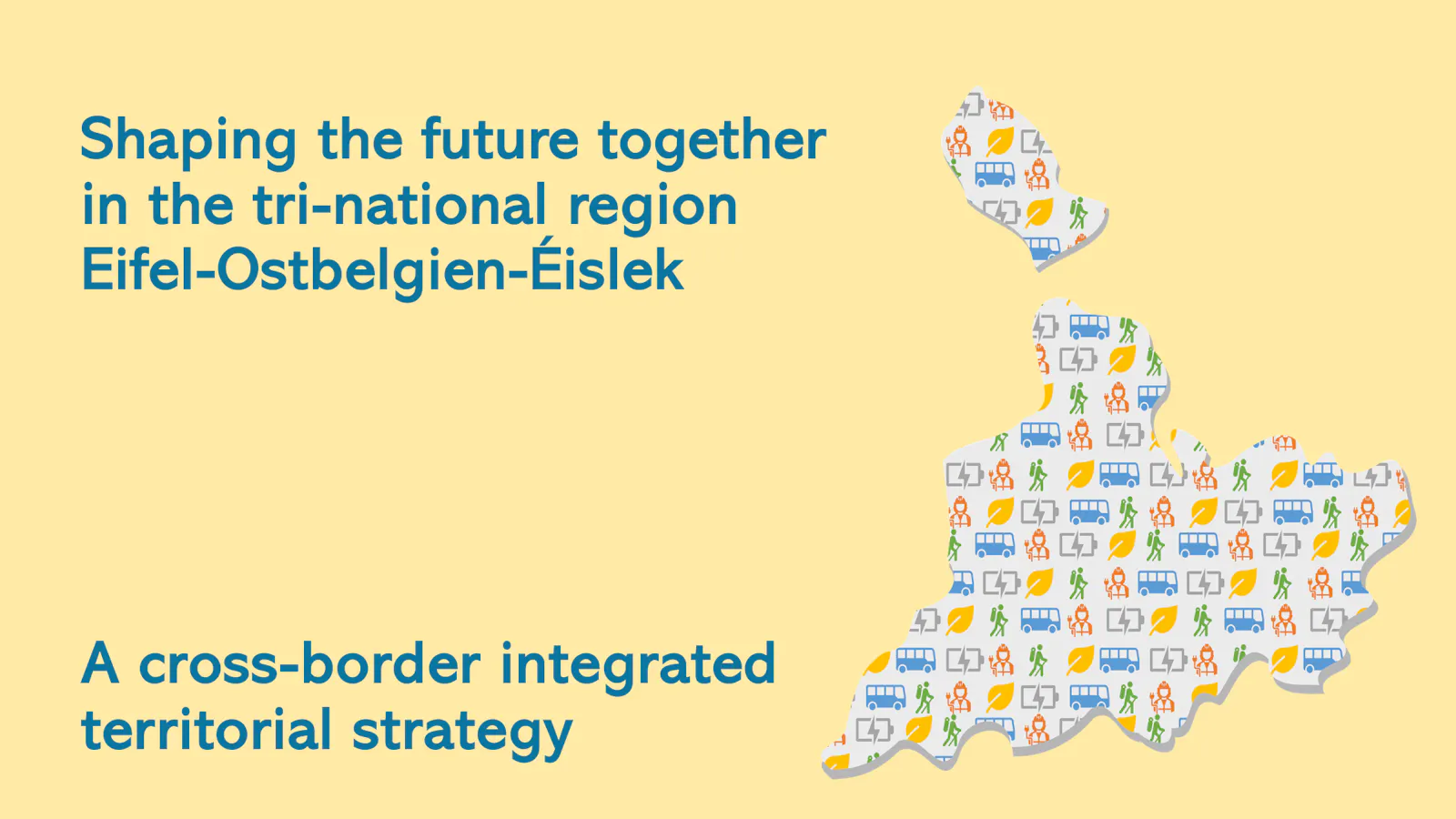
Integrated territorial strategies are an important tool to address today´s complex development challenges. As discussed in an earlier blog post on territorial strategies (Opens in a new window), finding the appropriate territorial focus for a strategy is essential. This often entails adopting a functional area approach which is closely linked to the objectives of integrated territorial strategies, as explored in another blog post (Opens in a new window). In border regions, such functional areas may very well stretch beyond national borders and call for cross-border territorial strategies.
Lately, several cross-border territorial strategies have been elaborated along Luxembourg’s borders with Belgium, France and Germany. One of them concerns the Belgian-Luxembourgish-German border region Eifel-Ostbelgien-Éislek.
Eifel-Ostbelgien-Éislek
In the context of the Interreg Programme for the Greater Region, the functional cross-border region Eifel-Ostbelgien-Éislek has been identified as an area where long-standing collaborations can be taken to a new level. It builds on a long history of cross-border cooperation between the German-speaking Community of Belgium, Luxembourg and the German state of Rhineland-Palatinate in this region.
With the new strategy, this collaboration shall be further stimulated. The strategy has been elaborated in a co-creative and participative process, designed and facilitated by Spatial Foresight, drawing on insights and priorities of key players in the region. The process involved representatives from the municipal, regional and ministerial level, as well as from nature parks and LEADER action groups. They came from a wide range of different policy spheres including spatial development, environment, nature conservation, water management, tourism, culture, forestry and agricultural.
The region prides itself of having a unique blend of cultural diversity, natural beauty, and historical significance, making it a rich tapestry of European heritage. This unique area spans across 16 municipalities or administrative units, comprising nine from the German-speaking Community of Belgium (Ostbelgien), four from the northern part of Luxembourg (Éislek), and three associations of municipalities in Rhineland-Palatinate, Germany (Eifel). Covering nearly 2,300 square kilometres, it is home to about 156,000 inhabitants.
We love living here!
In November 2023, stakeholders in this region agreed on a strategy to intensify cross-border cooperation to shape the future together. The strategy aims to unite the regions of Eifel, Ostbelgien and Éislek through innovative cross-border cooperation, enhancing tourism, culture, and sustainability for generations to come.
The strategy at hand is not a plan. It's a vision for a future where borders blur in the pursuit of common goals. The motto of the strategy is that the cross-border region Eifel-Ostbelgien-Éislek is exceptionally liveable, attractive, innovative, resilient, and forward-looking. In short, people love living there. It sets out to ensure this also for future generation. The ultimate objective is that daily interactions, connections, and cooperation across national borders make the region borderless, a quality cherished and aimed to be preserved and deepened for future generations.
Key priorities of the strategy are tourism, culture, nature conservation, mobility, the labour market, social services, and energy:
Tourism & culture: a gateway to cultural diversity.Tourism is more than just an economic engine in the region. It's a gateway to cultural exchange and mutual understanding. The strategy aims to enhance the region's appeal by promoting its natural beauty, historical sites, and cultural offers. Efforts will focus on sustainable tourism practices that respect and preserve the local environment and heritage, making Eifel-Ostbelgien-Éislek a must-visit destination not just for eco-conscious and culturally curious travellers. Culture in Eifel-Ostbelgien-Éislek is as varied as its landscape. The strategy seeks to celebrate this diversity through support for local arts, languages, and traditions. By fostering a vibrant cultural scene, the regions aim to strengthen their common identity and promote cultural tourism, enriching the experience for visitors and locals alike. Today tourist and cultural offers in the region only connected selectively or integrate across the borders occasionally. In short, the strategy points to a future, where an interconnected tourist and cultural infrastructure and its marketing strengthen the common identity of the region and its further development.
Nature: guardians of green. As custodians of stunning natural landscapes, the strategy emphasises nature conservation. Initiatives will focus on protecting biodiversity, promoting sustainable land use, and encouraging eco-friendly practices among communities and businesses. These efforts aim to ensure the region's natural heritage and beauty are preserved for future generations. Also here, more can be done to join efforts between the regions, especially as nature does not care about national borders. In essence, the strategy envisages a region that offers good conditions for the cross-border development of a sustainable, climate-resilient, natural habitat.
Mobility: bridging distances and connecting hearts. Mobility is crucial in a region where borders are crossed daily for work, study, and leisure. The strategy outlines ambitions to improve cross-border transport links, making travel within the region more accessible, efficient, and sustainable. This not only aids in economic development but also fosters a sense of unity among the region’s inhabitants. The vision put forward in the strategy is a region which offers demand-oriented, cross-border, multimodal mobility including alternative forms of propulsion and corresponding digital and structural infrastructures.
Labour market and social services: fostering employment and opportunity. Addressing the labour market, the strategy aims to create more opportunities for cross-border employment, training, and entrepreneurship. By aligning educational systems and recognising qualifications across borders, the regions can overcome barriers to employment, driving economic growth and innovation. Services of general interest are key to a region's quality of life. The strategy proposes initiatives to enhance access to healthcare, education, and social support across borders, ensuring all residents of Eifel-Ostbelgien-Éislek benefit from high standards of care and support, regardless in which part of the region they are. Ultimately, the strategy strives for simplified cross-border cooperation in the areas of services of general interest. Further integration in e.g. in education, civil protection and the labour market is seen as possibility to build on the strength of the region.
Energy: powering the future sustainably. In the face of global climate challenges, the strategy includes a forward-thinking approach to energy production and consumption. Emphasising renewable energy sources and energy efficiency, the region aims to lead by example in the transition towards a sustainable, low-carbon future. In essence, the strategy envisages a region that is a pioneer in energy transition, developing and implementing joint and innovative projects with the involvement of relevant stakeholders in society.
The Eifel-Ostbelgien-Éislek strategy stands as a beacon of what can be achieved when regions come together for a common purpose. By focusing on shared goals and leveraging their unique strengths, these regions are paving the way for a future where cooperation and sustainability go hand in hand. In crafting a future that honours diversity, champions sustainability, and fosters unity, Eifel-Ostbelgien-Éislek embodies the spirit of European cooperation. It is a showcase of the power of collective action and a reminder that together, we can shape a world that is richer, greener, and more inclusive.
Another aspect entailed by the strategy is the envisaged cross-border governance structure, designed to ensure collaborative decision-making and broad stakeholder participation. It underlines the commitment to a unified approach in realising the strategy's objectives. The exact format of this will be discussed and shaped in spring 2024.
For more information, please consult the full version of the strategy (in German) (Opens in a new window).
by Kai Böhme, Jean Claude Zeimet, Kirsti Hagemann
https://steadyhq.com/en/spatialforesight/posts/1a18b189-fdf9-4a75-9eb0-e9e162bfa02e (Opens in a new window)
Date
March 1, 2024
Topic
Territories
0 comments
Would you like to be the first to write a comment?
Become a member of spatialforesight and start the conversation.