April 2023
In today's rapidly changing world, it's increasingly important for to be prepared for unexpected disruptive events. These events could include natural disasters, economic downturns, wars, cyberattacks, social unrest or pandemics, and they can have significant and long-lasting impacts.
Realising that disruptive events are not just potential wild cards but may actually occur, has increased the talk about resilience. In the current debates, various types of resilience are mixed. To better understand different types of resilience and prepare for unexpected future events, it might be worthwhile to differentiate a few types of resilience.
The ‘Resilience Hypercube’
A place’s resilience to external shocks, but also global trends and societal transitions depends on a variety of vulnerabilities and capabilities. These variations are related to different dimensions of resilience, different governance levels and territorial types. We propose to bring these variations together in a ‘Resilience Hypercube’. It illustrates the multitude of facets of resilience and consequently also different approaches to prepare to unexpected future events.
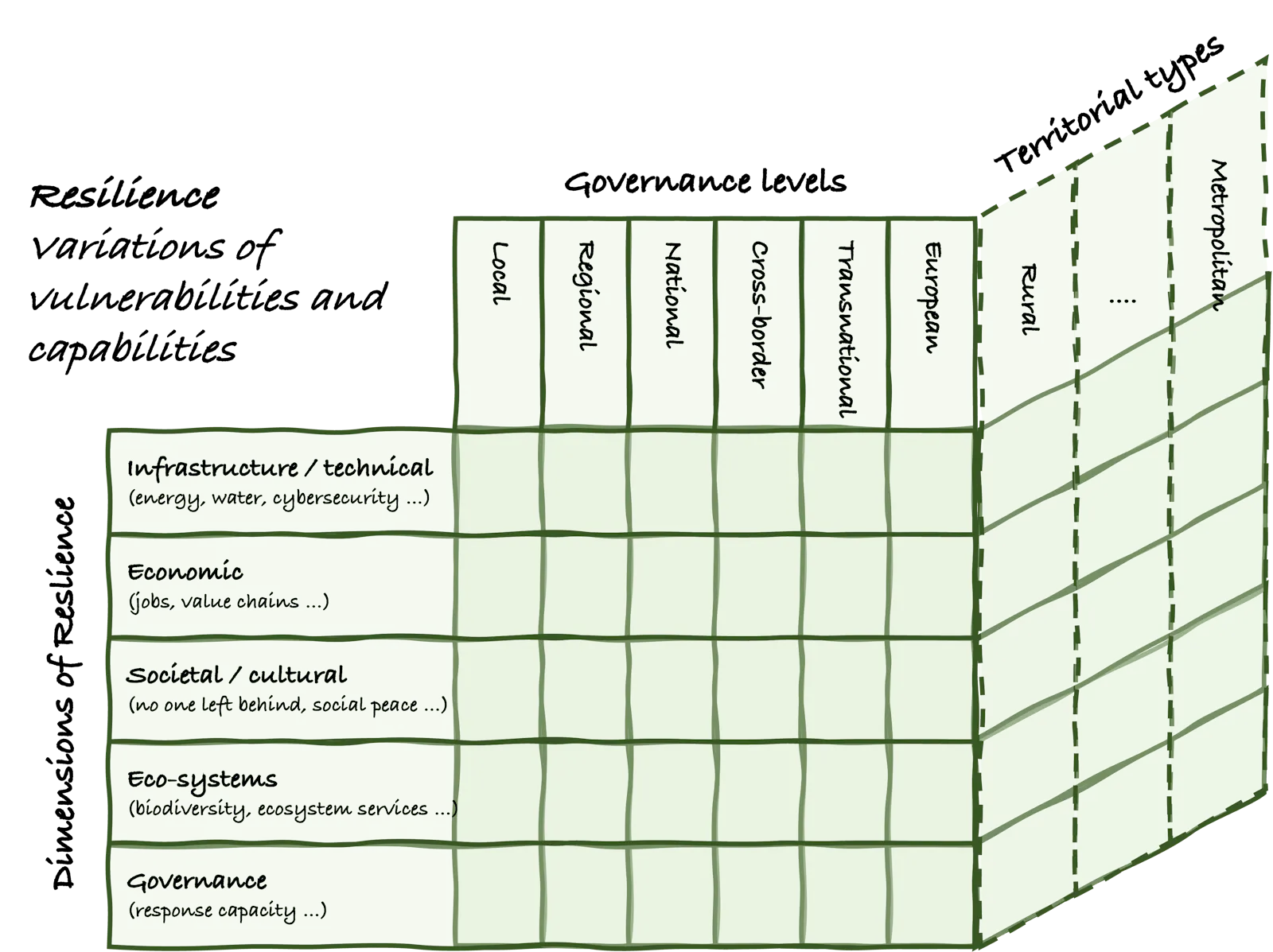
The key point is: While many resilience debates start from certain types of disruptive events and see how to become more resilient to these. The ‘Resilience Hypercube’ looks at different types of vulnerabilities to disruptions – regardless which ones – and thus defines different dimension of resilience to be considered regardless the next type of disruption expected. Indeed, one of the main points of disruptive events, is that we often do not see them coming until it is too late.
There are at least six different dimensions of resilience, i.e. thematic fields where resilience in terms of vulnerabilities and also capabilities is debated:
Infrastructure / technical resilience. The vulnerability of critical infrastructure – e.g. electricity, water and transport systems or cybersecurity – is essential for the function of our societies. Disruptive events which may directly affect critical infrastructure include extreme whether events, terror attacks, cyberwars, wars, and solar storms.
Economic resilience. The vulnerabilities and capabilities of our economic system – e.g. in terms of labour markets, reliable/flexible value and supply chains, access to resources, financial backbone – are essential for our socio-economic resilience. Economic resilience concerns e.g. the preparedness for disruptive innovations, major structural transitions, major disruptions of supply chains, or suddenly increasing commodity prices.
Social / cultural resilience. Our societal and cultural vulnerabilities and capabilities – e.g. in terms of social piece, inclusiveness, solidarity, trust, responsibility, collaboration, shared values, no one left behind – are essential for the functioning of our day-to-day life. Our socioeconomic resilience may be affected by disruptive social innovations, major transitions, migration waves, external threats etc.
Ecosystem resilience. Ecosystem vulnerabilities and capabilities – e.g. in terms of the functioning of terrestrial and maritime, local and global ecosystems and our global climate system – are essential for our livelihood. Disruptive events which may directly affect the ecosystem resilience include increasing loss of biodiversity, climate change effects, droughts, ‘industrial accidents’, etc.
Governance resilience. The vulnerabilities and capabilities of our democratic decision making systems – e.g. in terms of reliability, accountability, flexibility/adaptability, stewardship, willingness to change – are essential for ensuring that decision making processes continue to function also in cases of unexpected and disruptive events. Such events may include pandemics, terror or cyber-attacks, major disruptions of social, economic or environmental systems, wars etc.
Governance levels and types of territories
Resilience, in the sense of capacities to react concerns different levels of decision making. It is a concern at all levels of governance and certainly a multi-level governance issue. Therefore, it is important to be clear about the governance level at which resilience is addressed. All the above five dimension of resilience can address shocks of different geographical magnitude and require action at different governance levels. This ranges from the very local level to the national, cross-border, transnational and European level. The exact delineation corresponds to the division of labour and power in the specific national or international context. In many cases local and regional players need to respond to disruptions of water infrastructure (e.g. water or energy supply), of local economic structures (e.g. collapse of a locally important economic sector), of social structure (e.g. in or out-migration wave), of a local ecosystem (e.g. pollution of a local water system), or of local decision making systems (e.g. cyberattack on local administration). National and European players are mainly in charge of providing the necessary framework conditions which allow others to respond and prevent disruptive events from hitting local and regional societies and economies. However, the exact responsibilities vary depending on the disruptive event and the location in question.
Last but not least, resilience is also related to different territorial types. The exposure and vulnerability to some disruptive events, mega trends or transitions depends also on the geographical context. The pandemic has e.g. illustrated that densely metropolitan areas are differently affected than rural areas. Sea level rise means something else to coastal regions than to mountain regions etc.
In short to better understand resilience we need to differentiate between different types of resilience, different levels of decision making and different types of territories. This will allow for a more nuanced understanding of different levels of resilience in terms of place specific vulnerabilities and capabilities. On that basis responses of how to increase resilience can be developed.
Long-term approach
As pointed out in a previous blog post (Opens in a new window), resilience relies heavily on territorial governance capacities, including knowledge management, self-organisation, willingness to adapt and try to understand intrinsically complex coupled social–ecological–economic systems. It also requires decision-making in which costs and benefits are separated by very long time-lags and look at global collective goods that go beyond the scope of unilateral ‘single-best efforts’ of any player.
by Kai Böhme
https://steadyhq.com/en/spatialforesight/posts/75c41b20-24f2-4593-8b08-532d1c9fb857 (Opens in a new window)
Date
April 22, 2023
Topic
Resilience & transition
0 comments
Would you like to be the first to write a comment?
Become a member of spatialforesight and start the conversation.