December 2025
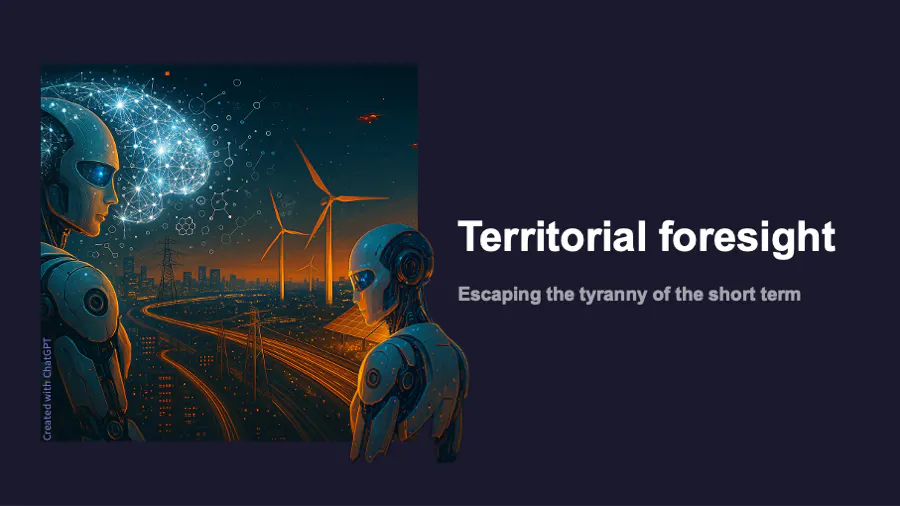
We live in a world of transition. In this complex environment, the role of public and private decision-makers is not merely to respond to crises as they arise. Rather, it is to make decisions today that will remain viable across multiple, overlapping and uncertain futures. Yet this is precisely where Europe’s governance machinery is weakest.
Unless we change how we think about time, space and uncertainty, Europe risks drifting through its transitions rather than navigating them. The stakes are high: territorial cohesion, competitiveness, resilience and intergenerational fairness all depend on our ability to escape the tyranny of the short term.
The tragedy of time horizons
This tension, or the 'tragedy of time horizons', is the real starting point for territorial foresight. The future is not an abstract notion in debates about territorial development. It sits in the background of every policy decision, silently shaping whether an investment, infrastructure plan or regulatory choice will be a future-proof asset or a burden for those who come after us. Election cycles reshuffle priorities every few years. EU programming periods follow a neat seven-year rhythm. Local and regional development plans are reviewed more often than the infrastructure investments they enable. The infrastructures we construct will most likely shape mobility, energy, and land use in 40 or even 70 years. The houses we build now will still define the built environment in 2080 or 2100.
Yet, most policy frameworks operate on rhythms that bear little resemblance to how structural changes unfold. For decades, strategic planning assumed a world in which change was gradual, manageable and reasonably predictable. Forecasts, expert analyses, and trend reports provided an acceptable basis for future-oriented decisions. But the past fifteen years have exposed the fragility of this belief. The financial crisis, migration dynamics, pandemics, energy shocks, supply chain fragmentation, accelerating climate impacts, and rapid technological breakthroughs have fundamentally altered the rhythm of change. We now live in a world where disruptions are not exceptions, but the background condition for policymaking.
This mismatch means that policymakers routinely make decisions whose consequences lie far outside the time frames in which those decisions are politically assessed. Consider the commonplace response to labour and housing shortages. Building more homes and attracting more workers seems a reasonable answer to immediate bottlenecks. But demographic prospects, such as shrinking and ageing populations in many regions, suggests that such ‘solutions’ might risk producing hangovers in the long-run: empty housing stock, stranded infrastructures, fiscal pressures, and mismatched investments.
The problem is that our systems reward short-term action, even when long-term thinking would be wiser. This is why well-intentioned initiatives often age poorly. The future is treated as a distant backdrop, rather than the context in which today’s decisions will play out.
The difficulty to engage with uncertainty
Thinking long-term time horizons comes with uncertainty, which makes many people uncomfortable. But the real issue is not the presence of uncertainty, but our relationship with it.
Many policy processes still approach strategy formation as if uncertainty could be neutralised through more evidence or better forecasts. The deeper challenge, however, is cognitive. Institutions and individuals alike cling to familiar assumptions, resist unfamiliar scenarios, and avoid possibilities that feel ‘too uncomfortable’ or politically inconvenient. This cognitive inertia is arguably one of the most underestimated obstacles in territorial development.
Foresight aims to disarm this inertia, by engaging with the future in a structured way, combining future fact-finding, lateral thinking and a deliberate willingness to confront uncertainties. It does not promise certainty, but it promotes the ability to imagine, interpret, and work with multiple futures. Rather than solving uncertainty, it helps people become more confident in navigating it.
Crucially, foresight does not ask policymakers to embrace fantasy. It invites them to imagine possibilities that may seem unusual today, but could become plausible tomorrow. Paradoxically, the more ‘ridiculous’ a scenario initially feels, the more useful it can be, as it reveals where our blind spots are.
Territorial foresight bringing place into future thinking
The starting point of foresight is to explore what kinds of change or disruption might plausibly shape Europe’s future. This typically involves examining trends or weak signals which may drive change. These drivers rarely evolve in isolation. They interact, reinforce, or contradict each other, creating complex patterns of opportunity and vulnerability for different places (e.g. municiaplities, regions, countries).
But foresight does not stop at identifying change. It asks what these changes may mean? This is where impacts on society, the economy, the environment, political dynamics, or technological systems come into view. Impacts may be slow-burning or abrupt, desirable or deeply uncomfortable, predictable or surprising. Importantly, they are rarely evenly distributed. Some places may gain from a technological shift that threatens others; some societies may adapt quickly to demographic ageing, while others struggle; some local economies may flourish under global reconfiguration, while others find themselves exposed.
This brings us to the territorial dimension. Territorial foresight asks how the magnitude, direction and relevance of change differ between places. It confronts the simple but often neglected reality that Europe’s transitions are profoundly spatial. They produce varied impacts across different types of places. Adding this spatial layer is what makes territorial foresight a particularly powerful tool for policy-making.
In practice, territorial foresight tends to crystallise into three formats.
Territorial scenarios, which explore several plausible future pathways rather than settling on a single expected one. Scenarios invite places to stress-test their assumptions against different trajectories, not to predict, but to widen the imagination of what might.
Territorial visions, which articulate desirable long-term directions for a territory and help player align their ambitions. Visions work as both navigation tools and collective motivation.
Territorial Impact Assessments, which investigate how particular trends, shocks or policy agendas would play out across different places. These assessments help reveal who stands to gain, who may be at risk, and what kinds of spatially sensitive interventions are needed.
In which ever format, working with territorial foresight is not always easy. Many processes encounter inertia. Thinking about ‘uncomfortable futures’ feels threatening. Imagining disruptions tests political stamina. Acknowledging unknowns undermines the security of established routines. As a result, players often cling to what they know or to narratives that reflect what they hope for, rather than what might plausibly occur.
Over the years, we have experimented with a wide range of formats to navigate these mental barriers. One recurring insight is that people open up more readily when they are allowed to explore the future playfully. Structured role plays, for example, allow participants to experience alternative futures without political risk. By deliberately stepping into different roles, perspectives and ways of thinking, participants are required to act differently and to understand and make sense of viewpoints that they would otherwise dismiss or overlook. When placed in imagined situations and forced to negotiate under uncertainty or make decisions from unfamiliar positions, they begin to grasp how individual choices reverberate through wider systems. Much like pulling on one strand of a mobile, an intervention in one part of the system sets the whole structure in motion, triggering adaptations elsewhere as it seeks a new balance. This combination of shifting perspectives and systemic awareness fosters a level of openness that is rarely achieved in conventional workshops. In fact, some of our most productive territorial foresight moments have emerged from these playful settings, where participants suddenly see the future not as a threat to their preferred plans, but as a landscape of possibilities that demands curiosity and creativity.
Territorial foresight, then, is not merely an analytical toolkit. It is a mindset and a process that helps territories think beyond habitual horizons. It encourages them to test assumptions, explore possibilities, recognise spatial differences, and navigate uncertainty with more confidence. And it creates the space — sometimes serious, sometimes playful — for collective learning about the futures places may face.
What territorial foresight can help with
When territorial foresight is integrated into strategic processes, it changes more than the content of strategies, programmes, and plans. It changes the culture of decision making itself. It expands the cognitive and policy space for thinking ahead.
Territorial foresight strengthens the link between structural transitions and territorial outcomes. Demographic change, digitalisation, decarbonisation, or shifting global trade patterns do not distribute themselves evenly across space. Different futures will benefit some places and challenge others. Foresight helps reveal these territorial differentiations early, long before traditional indicators catch up.
Territorial foresight disrupts the linear logic that dominates many policy contexts. Instead of assuming that the future will resemble a slightly modified version of the present, foresight engages with the possibility that thresholds, tipping points, or technological leaps could alter development trajectories entirely. This matters particularly in fields where long-term investments risk locking territories into patterns that may not match future demands.
Territorial foresight fosters anticipatory governance. It encourages us to view strategies not as rigid blueprints, but as living frameworks that can evolve as new evidence emerges. This is especially crucial in transitions that stretch over decades. No place can afford to fix its course without the possibility of adjustment. Foresight introduces mechanisms that keep strategies open, reflective, and flexible.
Territorial foresight changes how players interact. Techniques such as scenario discussions, role-play, workshops or Delphi dialogues create environments where stakeholders can explore unfamiliar perspectives without political cost. This helps overcome resistance to uncomfortable ideas and strengthens shared ownership of long-term visions. Territorial foresight is not just analytical. It is social. It reshapes how people think together about the future.
Territorial foresight offers a pathway towards this new way of governing transitions. It enables policymakers to confront uncomfortable futures, expand their strategic imagination, and make decisions that align with the long-term well-being of both current and future generations.
Ultimately, it helps territories reclaim agency over their futures rather than being swept along by external forces or short-term pressures.
Europe cannot afford to drift into the future. It must choose its pathways deliberately. Territorial foresight is one of the most promising tools we have to make that possible.
by Kai Böhme
 (Opens in a new window)
Date
December 17, 2025
Topic
Scenarios & visions
0 comments
Would you like to be the first to write a comment?
Become a member of spatialforesight and start the conversation.