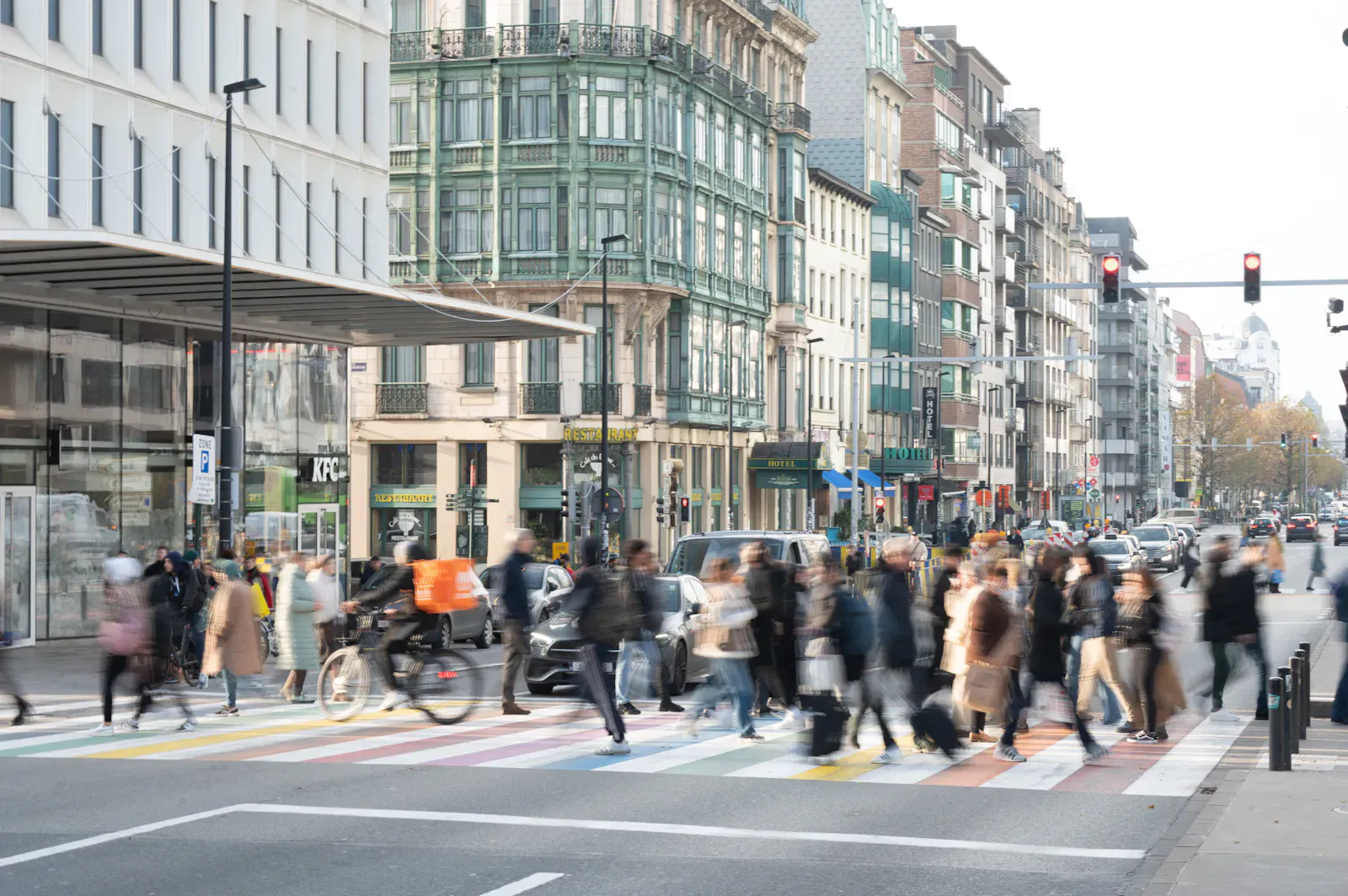
A week ago, more than 150 people demonstrated again in Hamburg against planned job cuts at the delivery service Lieferando. ‘The demonstration was quite a success,’ said Vincent Orth, secretary of the Food, Beverages, and Catering Union (NGG), in an interview with me. ‘It was important for the employees to feel solidarity from the city.’ According to Orth, expressions of support came from the SPD, the Greens and the Left Party. The company plans to cut 2,000 jobs nationwide by the end of the year. Most of the employees affected are in Hamburg, where 500 jobs will be lost.
The union's protest is directed in particular against plans for a so-called shadow fleet: the outsourcing of jobs and their takeover by fleet partners such as Fleetlery GmbH. The Hamburg-based delivery-as-a-service provider, as it describes itself, has been placing workers nationwide for delivery platforms such as Uber Eats since 2023. In future, the company will also work for Lieferando. The NGG criticizes that this will lead to uncertain working hours and precarious conditions for the drivers, many of whom are migrants. The union also accuses the company of working time violations and minimum wage fraud. Independent research by taz, RBB and by myself supports the allegations. The company did not respond to repeated inquiries.
Hamburg authorities confirm criticism
In addition, a response from the Hamburg Senate to a written inquiry from Left Party MPs Kay Jäger and David Stoop, which is available exclusively to me, now confirms that the company is disregarding basic occupational safety standards. During an inspection in May, the responsible Hamburg supervisory authority found that Fleetlery had ‘no suitable occupational safety organization.’ According to the Federal Institute for Occupational Safety and Health, this includes all measures that ensure safety and health at work. Companies are required to do this by law. The Senate did not provide any specific information on other allegations, such as illegal employment or minimum wage fraud, partly because no information was available or for data protection reasons.
‘Our inquiry to the Hamburg Senate has revealed that occupational safety at Fleetlery is apparently in a poor state,’ explains Kay Jäger, trade union policy spokesperson for the Left Party in the Hamburg Parliament. But that is not enough. ‘Checks on compliance with the minimum wage were not carried out at all during the period in question,’ criticizes Jäger. ‘The Senate and customs authorities have an urgent duty to ensure that the law is upheld, even in the jungle of delivery services and their subcontractors,’ demands the Left Party politician, also referring to ‘questionable recruitment processes via WhatsApp’ by the Hamburg-based company.
Negotiations for a social plan and collective agreement
Lieferando justifies the planned job cuts and outsourcing by saying that competitive conditions and the market are changing rapidly and customers expect reliable service and short delivery times. Such cooperation with fleet partners and subcontractors is common practice in the industry, the company explains.
Lieferando intends to negotiate a social plan for employees who are to lose their jobs and complete the process by early 2026 at the latest.
The NGG, however, is pushing for the redundancies to be withdrawn and for collective bargaining, for example for a minimum wage of £15. The company has rejected the demand. To build pressure, the NGG protested again in Hamburg over the weekend. Employees in Dortmund had already downed tools the previous week as part of a nationwide wave of strikes.
Union criticizes union busting
The union also accuses Lieferando of using so-called union busting methods – the deliberate dismantling of union works councils. ‘Wherever we have strong works councils that don't put up with everything, the site is completely closed down,’ explains NGG trade unionist Mark Baumeister, head of the hospitality department. Under the Works Constitution Act, works councils actually enjoy special protection against dismissal. However, there are still gaps in purely digital and algorithm-controlled work processes, meaning that works council elections can be contested by companies. Although there have been some initial labour court rulings, these have not yet created legal certainty, says Baumeister.
The Hamburg Senate is concerned about developments in the delivery industry. It is committed to improving working standards and ensuring compliance with minimum wages. In the Bundesrat, the city has also co-initiated a reform of co-determination in the workplace, which is also intended to strengthen platform workers. However, details remain confidential.
In addition to a reform of the Works Constitution Act, the NGG is calling on the federal government to swiftly implement the EU Platform Directive, which would make companies liable for labour law violations by their subcontractors. The directive must be transposed into national law by the end of 2026. Until then, a permanent employment requirement modelled on the meat industry and digital access rights for trade unions are to improve working conditions and co-determination rights in the sector.
This article was first published in German in the daily newspaper nd.Der Tag (S'ouvre dans une nouvelle fenêtre)
Date
19/08/2025
Sujet
Trade Unions
0 commentaire
Vous voulez être le·la premier·ère à écrire un commentaire ?
Devenez membre de NEWS.HINTERGRÜNDE.ANALYSEN et lancez la conversation.


