January 2026
In preparation for the forthcoming EU Strategic Foresight Report, the European Commission has invited reflections on how the European Union (EU) can shape its long-term role in an increasingly uncertain and rapidly changing world. We, at Spatial Foresight, responded to that invitation, drawing on our recent foresight and scenario work across different European territories, such as our work with:
scenarios for the EU’s north-eastern external border regions (ESPON CHANEBO) summarised in a recent blog post (S'ouvre dans une nouvelle fenêtre),
scenarios for the Danube and Adriatic–Ionian macro-regions (ESPON TEVI2050) summarised in blog posts on two distinct scenarios (S'ouvre dans une nouvelle fenêtre),
scenarios for East Belgium (WFG - Economic and regional development in East Belgium),
a think piece on future challenges in the Danube region (Austrian EUSDR presidency) (reflected in a blog post series on transformative change (S'ouvre dans une nouvelle fenêtre)), and
a series of forward-looking blog posts on positive futures for Europe (S'ouvre dans une nouvelle fenêtre).
This was combined with our long-lasting experience with EU territorial development and policy-making.
Our contribution considers how the EU can shape its long-term role in an increasingly uncertain and contested world. Rather than offering fixed answers or searching for completely new solutions, it explores how much of Europe’s strategic potential already lies within: embedded it its territories, in its governance practices and societal capacities. Recognising and mobilising these inherited strengths can expand the EU’s strategic positioning.
We approached this by reflecting on the two guiding questions of the call. In reply to these questions, we first, explore which areas of leverage, particularly those remaining underused, could strengthen EU’s strategic autonomy and global role. Second, we reflect on the narratives about the EU that could help connect its strategic role and its people’s realities, in times of doubt and uncertainty.
Which areas of leverage (especially those that are new or so far unexploited) could help the EU shape its long-term role in the world?
When thinking about the EU’s long-term role in the world, the question about possible leverage areas is not only about power in a traditional sense, but also about how the EU can turn its existing capacities and ways of working into a meaningful and impactful influence. These sources of leverage are diverse. They may concern a range of geopolitical dimensions (or a combination of them), such as: geography and the environment, military capabilities, the economy, technology, science and innovation, culture and identity, governance and politics, statecraft and diplomacy. While traditional leverage (for example, the economic power of the Single Market) remains essential, much of EU’s future influence may depend on recognising and activating the less visible, and often underused, forms of leverage.
A key yet still underutilised means of strengthening the EU’s strategic autonomy and global role lies in its territorial diversity. In a context characterised by polycrises, nonlinear change and deep uncertainty, this diversity is a strength and can provide resilience. It provides multiple transition pathways and redundancy in critical systems, as well as the capacity to adapt strategies to different geographical, socio-economic and geopolitical contexts. However, much of this potential remains untapped due to sectoral approaches and spatially blind policies that restrict the EU’s long-term strategic action, and a lack of communication that reaches people and cushions misinformation.
Three fields of leverage can help to better utilise EU’s territorial diversity:
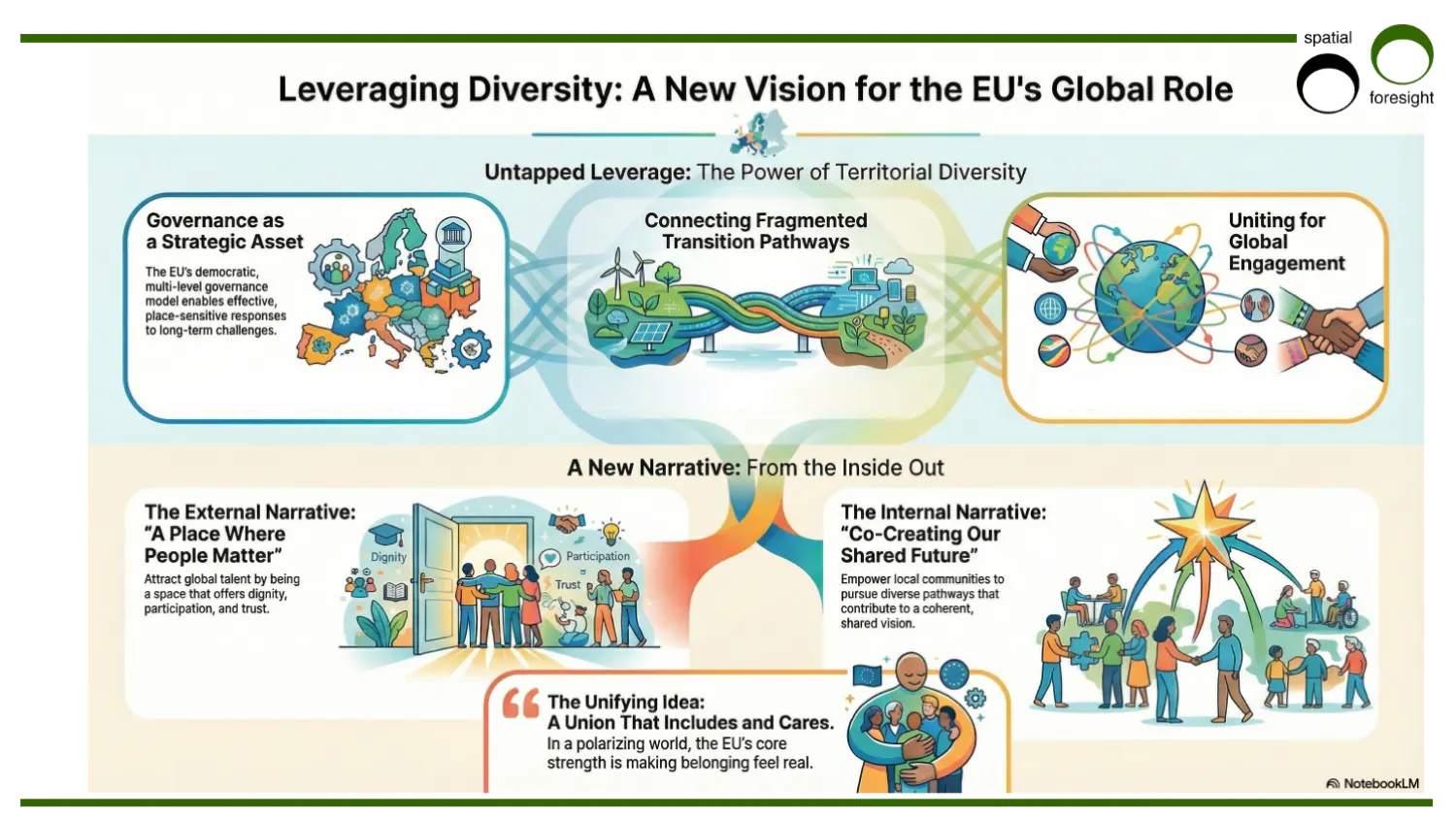
Governance leverage. The EU’s open, democratic, rule-based governance model is a key source of long-term influence and legitimacy. Its strategic value increases when combined with trust-based, multi-level governance, which enables anticipatory and place-sensitive decision-making. Such governance arrangements are particularly well suited to addressing challenges and developments where the costs and benefits are separated by long time horizons and spatial spillovers, such as climate adaptation, demographic change, infrastructure transitions, and security-related investments. Territorial cooperation frameworks and strategies are proven settings for testing anticipatory governance, policy learning and collective risk management.
Thematic leverage. Europe’s diverse territorial assets support many transition domains, such as the green and digital transitions, nature-based solutions, water and food security, ecosystem services, sustainable mobility and innovation. Better utilising Europe’s territorial diversity can also be a means to increase autonomy and reduce interdependencies in strategic industries. However, transition pathways are often fragmented as economic players and policy systems remain largely organised within national and sectoral boundaries. Place-based, mission-oriented European approaches can help to connect dispersed initiatives, align investments and create coherent transition pathways that strengthen systemic resilience while maintaining social cohesion, which is a critical enabling condition for long-term competitiveness and societal well-being.
Geographical leverage. The EU’s territorial diversity, combined with strong long-standing multilateral migration, creates dense and varied interfaces with almost all regions of the world. Compared to more centralised national states, the EU’s multi-level governance enables culturally and place-sensitive engagement with neighbouring regions and global partners, including those in the Eastern Neighbourhood and the Mediterranean. However, the EU has so far failed to leverage this potential, as this would require its citizens, member states and regions to share a joint vision. One mission on which they can all come together and contribute their capacities and global links. Without such alignment, opportunities for differentiated diplomacy, resilience-building and strategic partnerships risk remaining underutilised.
Strengthening the EU’s long-term role in the world will depend not only on instruments and capacities, but also on its ability to mobilise territorial diversity through anticipatory, place-based governance and shared strategic missions, i.e. a shared vision of the future of the EU territory. This can increase the EU’s strategic flexibility, improve resilience, and facilitate various, place-sensitive transition pathways in an increasingly uncertain global environment while drawing on Europe’s territorial diversity.
Which narratives about the European Union can help the EU shape its long-term global role?
How the EU is perceived globally is shaped largely by the stories told and by what it stands for. Different narratives have defined the EU for decades, be that as a standard-setting economic power or as a peace project. As old certainties fade and new dynamics emerge, new narratives may be put forward playing a crucial role in how the EU is understood, trusted and able to act in the world in the future.
In Pixar’s Inside Out we are reminded that identity does not emerge from selecting the right emotion, but from learning how different feelings coexist, change and shape each other over time. What defines this story is not control over the right decision, but deeper connection. The EU, in many ways, faces similar points.
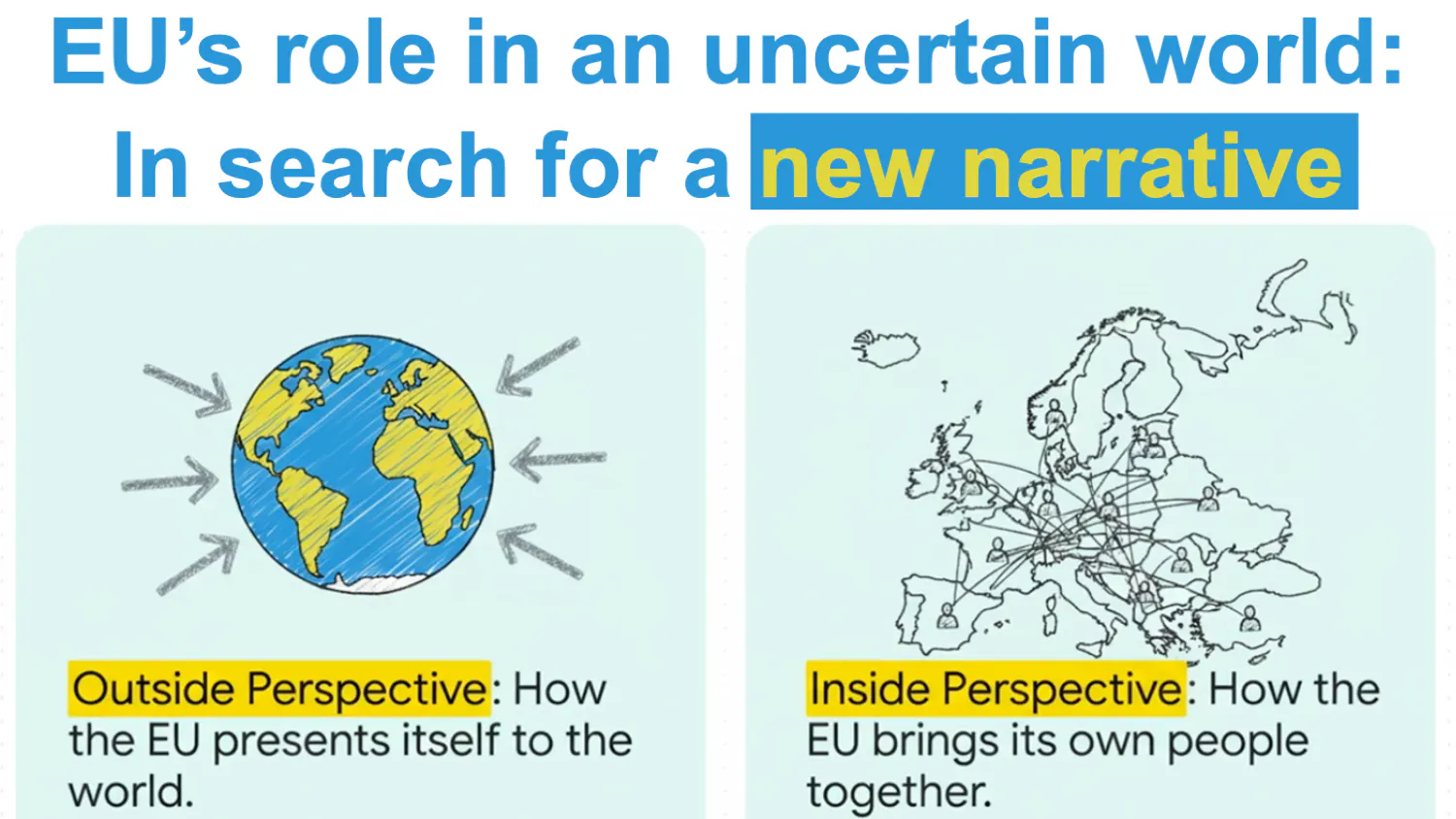
A narrative about the EU operates in two ways. It acts as a narrative that the EU uses to present itself to the world, and as a shared narrative that brings people in the EU together.
How EU shapes the future – the Outside perspective. From an external perspective, a compelling narrative for the EU is that of a place where people genuinely matter, not merely as factors of production or subjects to be governed, but as active contributors to a shared societal development. In a world facing demographic decline, skills shortages and intensifying global competition for talent, the EU’s long-term attractiveness will increasingly depend on its capacity to attract talent by offering dignity, participation and trust. The EU is a space where democracy and diversity are continuously renewed, and where the rule of law and participation are actively upheld at a time when democratic norms are under pressure globally. By empowering people and communities to engage at local and regional levels and to shape Europe, the EU fosters shared ownership and responsibility. Framed in this way, the EU can position itself as a steward of shared futures: not by claiming to predict what lies ahead, but by creating the conditions for societies to anticipate change, manage uncertainty and deliberately shape preferable futures through anticipatory governance and place-based policymaking. This people-centred, future-oriented narrative enhances the EU’s global credibility and attractiveness in an increasingly authoritarian and polarised world.
How EU’s future takes shape – the inside perspective. Internally, this narrative is an invitation for people across the EU to come together, be involved, shape and take ownership around a shared, yet open, vision of their future. Rather than seeking uniform solutions, the EU can together with its citizens develop and provide a shared frame within which regions, cities and communities pursue differentiated transition pathways while remaining coherent as a whole. By openly exploring multiple territorial futures and acknowledging uncertainty, the EU can strengthen preparedness, transparency and collective learning together with its citizens. This reinforces the EU as a union capable of governing complexity through trust, territorial diversity and proactive, multi-level action. Anchored in civic engagement, civil society participation and inclusive visioning processes, such a narrative brings the EU closer to people’s everyday life, connecting local action and deliberation with global responsibility. It takes the EU to the townhalls and marketplaces, and from there to the world. In doing so, it strengthens social cohesion, democratic legitimacy and the EU’s capacity to navigate long-term transitions in an uncertain world.
Such a shared inside out narrative does not aim at perfection. When everything around us points at polarisation and exclusion, when demographic change reorders priorities and growing competition overshadows values, EU’s strength lies in being a place where individuals feel they matter, where belonging becomes real. The EU can stand for a union that includes, cares and brings together its citizens through trust and shared responsibility.
By Kai Böhme and Maria Toptsidou
 (S'ouvre dans une nouvelle fenêtre)
Date
20/01/2026
Sujet
Scenarios & visions
0 commentaire
Vous voulez être le·la premier·ère à écrire un commentaire ?
Devenez membre de spatialforesight et lancez la conversation.