May 2023
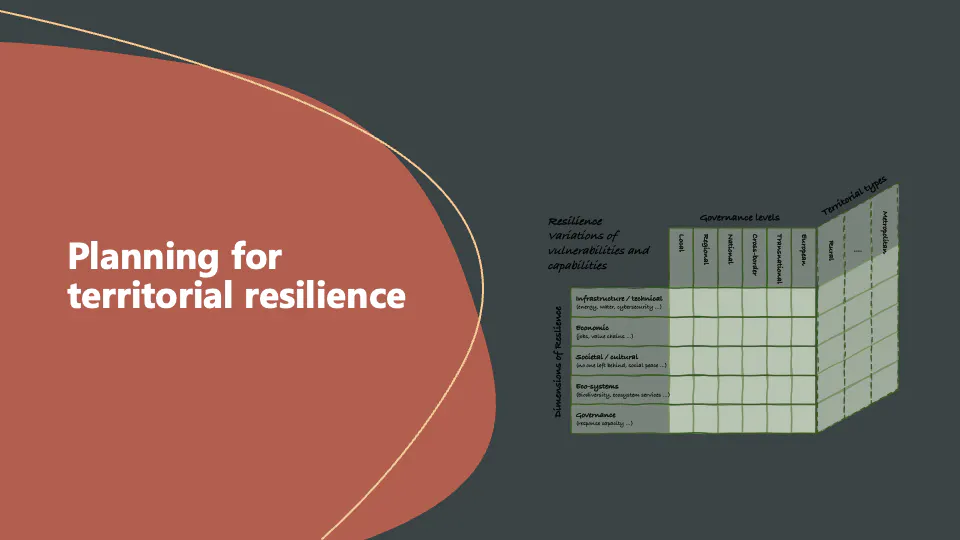
The last blog post (S'ouvre dans une nouvelle fenêtre) focused on understanding different types of resilience to be better prepare for unexpected events. It differentiated between infrastructure / technical, economic, social / cultural, ecosystem and governance resilience and different levels of governance and in different types of territories.
These types of resilience rely heavily on territorial governance capacities, including knowledge management, self-organisation, willingness to adapt and try to understand intrinsically complex coupled social–ecological–economic systems. It also requires decision-making in which costs and benefits are separated by very long time-lags and look at global collective goods that go beyond the scope of unilateral ‘single-best efforts’ of any player.
Still, the question remains how to plan for resilience in different types of places.
Improving regional preparedness
Identifying the most relevant areas of potential sources of regional vulnerability is a critical step in building resilience in regions. Some steps that can be taken to identify these areas include:
Conduct a risk assessment. A comprehensive risk assessment can help to identify potential sources of vulnerability in a region. This can include assessing risks from natural disasters, economic downturns, pandemics, and other potential sources of disruption. The ESPON tool to territorial impact assessment (S'ouvre dans une nouvelle fenêtre) can be a first step for assessing a regional vulnerabilities and risks.
Engage stakeholders. Engaging stakeholders, to draw on the tacit knowledge of public authorities from various policy fields, business and civil society representatives, can help to identify areas of vulnerability that may not be immediately obvious. Stakeholders can provide valuable insights into the unique challenges and risks faced by the region.
Analyse historical data. Analysing historical data, such as data on past natural disasters, economic trends, and social indicators, can help to identify areas of vulnerability that are most likely to be impacted by unexpected events.
Consider potential cascading effects. It's important to consider potential cascading effects, or the impact of one event on other systems and infrastructure. For example, a natural disaster may impact transportation networks, which can have cascading effects on the local economy. Tools such as the ‘future wheel’ can help to think about cascading effects in a structured way.
In conclusion, identifying the most relevant areas of potential sources of regional vulnerability is an important step in building resilience in regions. By conducting a risk assessment, engaging stakeholders, analysing historical data, considering potential cascading effects, and regularly reviewing and updating information, regions can better understand and prepare for potential sources of disruption.
Policy support to regions
To support regions in getting better prepared, national policies play a critical role in helping regions become more resilient. Some ways that policy can support regional resilience include:
Encourage risk assessment. Policies can encourage regions to conduct regular risk assessments to identify potential sources of vulnerability and prioritise areas for improvement. This information can then be used to develop and implement effective resilience strategies.
Promote infrastructure investment. Policies can promote investment in resilient infrastructure, e.g. by doubling crucial infrastructure. This may include improved transportation, digital and energy networks, robust communication systems, and emergency management systems. These investments can help to reduce the impact of unexpected events on communities and the economy.
Support community preparedness. Policies can support community preparedness by providing funding for emergency management systems, training programmes, and emergency response plans. This can help communities to respond effectively to unexpected events and reduce the impact on residents.
Foster sustainable development. Policies can promote sustainable development, which can help regions to become more resilient over the long term. This includes promoting policies and programmes that encourage sustainable land use, protect the natural environment, and promote renewable energy. This may also include diversifying the regional economy to reduce the impact of unexpected events. By having a mix of industries and businesses, regions can weather economic downturns and recover more quickly.
Encourage collaboration and coordination. Policies can encourage collaboration and coordination between different levels of government, businesses, and communities. This can help to leverage the strengths of each group, share information and resources, and create more effective resilience strategies.
Encourage interregional partnerships. Building partnerships between regions – including partnerships across national borders – can also help to increasing resilience. By working together, regions can share information and resources, leverage each other's strengths, and create more effective and efficient solutions.
In conclusion, policies play a critical role in helping regions become more resilient to unexpected events. By encouraging risk assessment, promoting infrastructure investment, supporting community preparedness, fostering sustainable development, encouraging collaboration and coordination, and encouraging monitoring and evaluation, policy can support regional resilience and create a more secure future for all.
Sense of direction
The above points, however, require also certain governance capabilities at all levels of governments. This includes the capacity to navigate under uncertainty and the willingness to change. As outlined in an earlier blog post (S'ouvre dans une nouvelle fenêtre) this also requires a shared sense of direction, including shared visioning and institutional change. In more detail this requires the ability for explicit and inclusive vision building processes, substantial and ambitious legislative and organisational changes, political ambition and long-term political commitment, and resources for multiple socio-technical pathways. To achieve this intermediating and orchestrating at different levels is necessary.
by Kai Böhme
https://steadyhq.com/en/spatialforesight/posts/75c41b20-24f2-4593-8b08-532d1c9fb857 (S'ouvre dans une nouvelle fenêtre)https://steadyhq.com/en/spatialforesight/posts/4106f538-31ef-48eb-8758-efc53282d24a (S'ouvre dans une nouvelle fenêtre)
Date
05/05/2023
Sujet
Resilience & transition
0 commentaire
Vous voulez être le·la premier·ère à écrire un commentaire ?
Devenez membre de spatialforesight et lancez la conversation.