A postcard from Europe in 2045
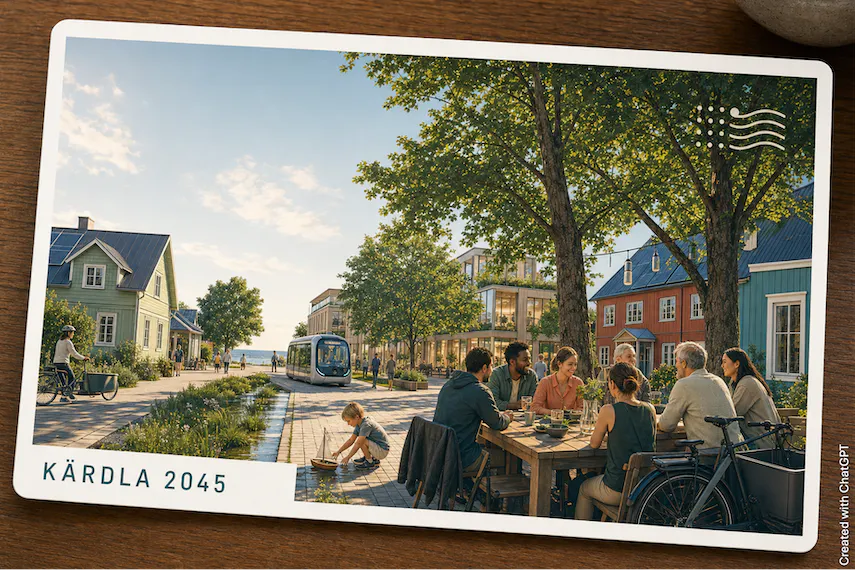
July 2026
A postcard from 2045? It seems rather unlikely.
By then, even the messaging services we use today may appear vintage. Why would anyone buy a picture card, search for a pen and entrust a few handwritten lines to the postal system, if that still exists?
But perhaps postcards will return, just as vinyl records did. Not because they are convenient, but because they are not. Choosing a card, writing by hand and waiting for it to arrive makes the message feel different. A postcard carries a small piece of a place with it. It says: We are here. We thought of you.
Let us imagine that one arrives in the summer of 2045. Admittedly, this is a rather long postcard. Perhaps by then postcards will be a little larger, and the sender had more to share than could fit into a few hurried lines.
—-—————————————————————-
Kärdla, 27 July 2045
Dear friends,
You will smile when you see where we are. We have returned to Hiiumaa.
My husband remembered the little wooden houses immediately. I remembered the light, the woods, and the feeling that the sea was never far away. Some things have changed, but Kärdla still feels like Kärdla.
It is warm, warmer than when we came all those years ago. Life moves differently during the hottest hours now. Shops open early, the square becomes quiet after lunch, and people return in the evening. There are sails stretched between the trees, drinking-water fountains everywhere and long, shaded tables in the centre.
We spent this morning cycling through the woods to a more distant part of the coast. The old road has become a green route connecting several villages. A small electric bus travels the same way, collecting people wherever they happen to be waiting. Apparently, islanders can use it freely. Visitors pay a little extra.
The old school now contains a health centre, workshops, guest rooms and somewhere people simply call “the common kitchen”. We went in because my husband wanted coffee. We stayed for lunch.
We shared a table with a young couple who moved here from Tallinn and an older woman who grew up on the island, left for Finland and returned after retirement. A seasonal worker from Albania joined us later. He comes every summer but now also teaches remotely at a vocational school in Durrës.
The conversation began with the weather, moved to island life and somehow ended with whether Europe had become too dependent on machines. Nobody agreed.
The older woman said the island used to lose its young people. The young couple said that it still does; only now some return. Our Albanian companion thought it was easier to belong to two places than to explain to others which one was really home.
We had intended to catch the bus back to the harbour. We missed it and stayed for another coffee.
Nobody looked at a screen to find out what we should do next.
This evening there is music by the water. Tomorrow we take thKärdlay, unless the wind changes again.
It is strange: Kärdla seems better connected than before, yet somehow less hurried.
Wish you were here.
—-—————————————————————-
I read the postcard again.
What stays with me is not any spectacular invention. There are no flying cars, gleaming new cities or miraculous solutions. Even the small bus seems less important than the fact that missing it did not ruin the day.
Perhaps that is what makes the postcard feel both hopeful and slightly unfamiliar. Its Europe is advanced, but not obsessed with speed. Technology is present, although mostly in the background. It helps a small island maintain transport, healthcare and connections to other places. It does not decide how people spend every moment.
Instead, the postcard lingers on things that are difficult to measure: shade on a hot day, a table that anyone may join, time for another coffee and a conversation that wanders beyond its starting point.
I wonder whether such encounters will become rarer. More and more of life is organised around what we already like, whom we already know and what a system thinks will interest us. We can move efficiently between selected people, places and opinions without being interrupted by much that is unfamiliar.
Yet the postcard describes another possibility. People who had not planned to meet share a table because the place gives them a reason to be there. They do not discover that they secretly agree. They simply remain together long enough to become more than categories to one another: islander, newcomer, seasonal worker, urban couple, tourist.
Maybe that is also part of what cohesion means.
We often think of cohesion through distances and differences: between richer and poorer regions, centres and peripheries, growing and shrinking places. We ask whether people can reach jobs and services and whether every region can participate in Europe’s future. These questions matter enormously.
But perhaps people also long for another kind of proximity: to feel connected without having to be alike; to encounter someone outside their usual circle; to live in places where strangers do not remain abstractions.
That does not happen simply because people are told to be open-minded. It needs places where they can linger without paying for the privilege. It needs libraries, markets, ferries, pools, public squares and common tables. It needs enough time for conversations with no obvious purpose.
Perhaps this postcard from 2045 tells us less about the future than about what we miss or fear losing, today: time, attention, belonging, surprise and confidence that even a small place can still have a future.
And perhaps postcards returned for the same reason. Not from nostalgia for paper, but because people still wanted to hold a fragment of another person’s world and receive the simplest possible message:
We are here. We thought of you, what will you put on a post card from 2045 this summer?
by Kai Böhme
 (S'ouvre dans une nouvelle fenêtre)
Date
24/07/2026
Sujet
Scenarios & visions
0 commentaire
Vous voulez être le·la premier·ère à écrire un commentaire ?
Devenez membre de spatialforesight et lancez la conversation.