April 2026
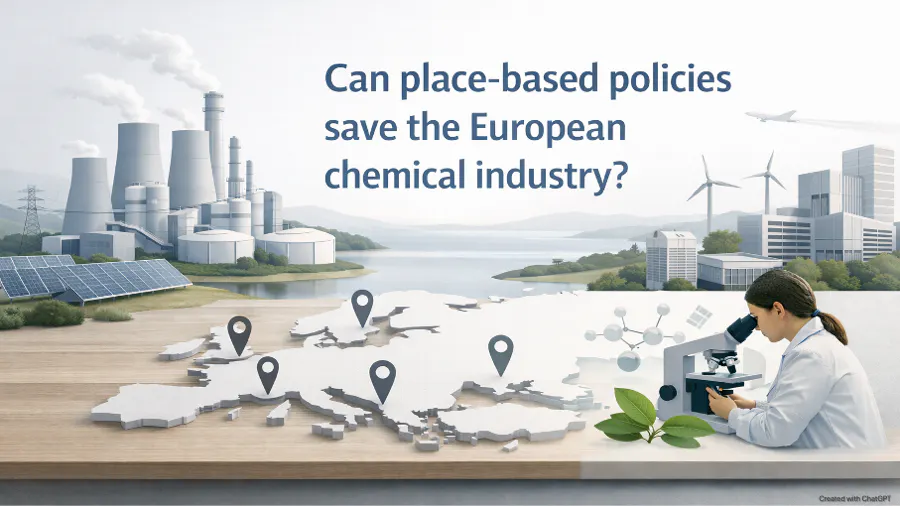
Europe’s chemical industry – often described as the “industry of industries” – is a cornerstone of the European economy and an essential supplier to numerous manufacturing sectors. As of 2024, it accounts for around 6% of the value added and 4% of employment in EU manufacturing and includes more than 31,000 enterprises across the EU. Despite its technological strength and global innovation capacity, the sector is currently facing unprecedented pressures that are raising concerns about its mid- to long-term competitiveness and resilience.
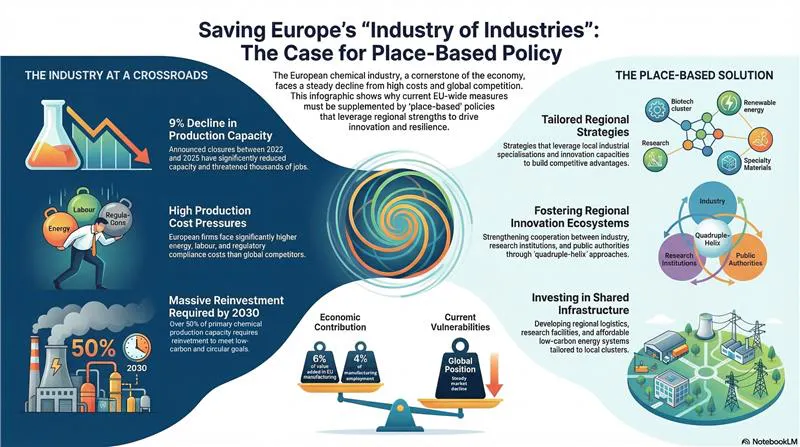
The EU chemicals sector has experienced a steady and significant decline in its global market share over the past two decades, while competition from countries such as China and the United States has intensified. At the same time, production costs in the EU – particularly for energy, labour and regulatory compliance – remain significantly higher than in competing regions around the globe. As a result, just between 2022 and 2025 the chemical production capacity declined by around 9%, with effects for more than 100,000 direct and indirect jobs. New plant closures have been announced end of 2025 and early 2026.
In view of these recent developments and increasing pressures, the European Committee of the Regions (CoR) published a report on a place-based approach to strengthening the EU chemical industry in regions and cities (S'ouvre dans une nouvelle fenêtre), to add the regional perspective to the overall discussion. It highlights, that given the sector’s strong territorial dimension – where chemical production is often concentrated in specific industrial regions and clusters – changes in the industry have direct implications for regional economies, employment and local development. Based on this report, the below presents some key reflections.
The key challenges for the European chemical industry
There are ten areas to focus on for better understanding the sector's key challenges:
Increasing international competition. Growing global overcapacity and strong expansion of producers in countries such as China are eroding the EU’s market share and undermining the competitiveness of European chemical producers.
High production costs. European chemical companies face significantly higher production costs than competitors, particularly due to energy prices, labour costs, regulatory compliance expenses and logistics costs.
Enterprise structure dominated by SMEs. The strong presence of SMEs limits the sector’s capacity to invest in innovation, digitalisation, workforce training and large-scale transformation of production processes.
Innovation gap and commercialisation challenges. Although the EU chemicals sector remains a global leader in research, development and patent activity, a key challenge lies in translating scientific advances and R&D results into innovative products and large-scale market applications that can strengthen industrial competitiveness.
Regulatory complexity and compliance costs. Extensive EU regulations related to health, safety and environmental protection increase administrative burdens and investment costs for companies, especially for smaller firms.
High costs for pollution remediation and green transition. Cleaning up contaminated sites and shifting chemical production towards low-carbon technologies require high levels of investment and may not always promise to obtain sustainable solutions that meet international competitiveness.
Skills shortages and demographic pressures. An ageing workforce and insufficient numbers of graduates in STEM fields risk creating labour shortages and skills gaps in the coming years.
Infrastructure and energy transition challenges. The decarbonisation of the sector depends on the development of new energy infrastructure, affordable low-carbon electricity and hydrogen supply systems, which are not yet fully in place.
Dependence on external raw materials and inputs. The sector is increasingly exposed to strategic dependencies because many chemical feedstocks and key inputs are imported from outside the EU, raising concerns about supply security and the resilience of European industrial value chains.
Simultaneity of pressures. The combined impact of all aforementioned challenges creates cumulative pressure on companies, increasing the likelihood of additional plant closures and further weakening regional industrial ecosystems.
What has been done so far
Several policy initiatives have been introduced at EU level to support the competitiveness and resilience of the chemicals industry. In particular, the European Chemicals Industry Action Plan (S'ouvre dans une nouvelle fenêtre), adopted by the European Commission in 2025, addresses the sector’s challenges through a mix of short-term measures and longer-term structural reforms. This includes reducing cost pressures, simplifying administrative procedures and revising regulatory frameworks to improve investment certainty. The plan also promotes investments in low-carbon technologies and industrial decarbonisation, while strengthening the sector’s strategic resilience through the Critical Chemicals Alliance (S'ouvre dans une nouvelle fenêtre). The latter focuses on identifying critical production sites and molecules, addressing trade distortions and supporting infrastructure modernisation. More broadly, the Action Plan is aligned with wider EU strategies – such as the Clean Industrial Deal, the Action Plan for Affordable Energy and the Critical Raw Materials Act, to name only a few. It relies on coordinated action between EU institutions, Member States and local and regional authorities, together with existing EU funding instruments to support innovation, decarbonisation and industrial transformation.
Why further action is needed
Despite the measures already introduced at EU level, further policy action is needed because several key structural challenges affecting the chemicals industry remain only partially addressed. In particular, the current policy framework does not sufficiently tackle issues such as the long-term availability of skilled labour, the impacts of demographic change, persistent trade disadvantages arising from imports produced under less stringent standards, and the need for a clearer and more systematic simplification of the regulatory framework. In addition, fragmentation between EU, national and regional policies, insufficient investment in infrastructure and energy systems for decarbonisation, and limited coordination in place-based innovation strategies continue to constrain the sector’s transformation and competitiveness. This indicates that stronger and more coordinated policy interventions are needed.
Why place-based approaches could help
This is where place-based policy making comes into play (see also an earlier blog post on place-based policy making (S'ouvre dans une nouvelle fenêtre)). In this context, place-based policies refer to strategies that consider the specific economic structures, industrial specialisations and innovation capacities of individual regions, whether they have a concentration of chemical production or could obtain comparative advantages due to changing framework conditions (e.g. availability of renewable energy). The chemical industry is strongly clustered in particular regions and often not only depending on international trade relations but also embedded in local industrial ecosystems. Therefore, local and regional authorities can support transformation by fostering regional innovation ecosystems, strengthening cooperation between industry, research institutions and public authorities, and investing in shared infrastructure. Examples are shared logistics systems, research facilities and collaborative workspaces. By building on regional strengths and facilitating long-term cooperation among stakeholders, place-based approaches can help reduce barriers to innovation, support the green and digital transitions, and strengthen the competitiveness and resilience of Europe’s chemical industry.
The study argues furthermore that place-based policies should focus on strengthening regional industrial ecosystems and enabling the green and digital transformation of chemical production, building on the specific strengths of regions. Key actions include developing regional strategies that integrate industrial policy with energy, innovation and skills policies. This includes supporting regional clusters and value chains, and strengthening cooperation between companies, research institutions and public authorities through multi-level governance. In addition, local and regional authorities can facilitate the transition by investing in shared infrastructure (see above) improving access to EU funding for decarbonisation and innovation projects and promoting partnerships with educational institutions to ensure the availability of skilled labour. Through these territorially tailored measures, place-based policies can help chemical regions adapt to new framework conditions, strengthen competitiveness and support a sustainable industrial transition.
How do place-based approaches and other policies complement each other?
In conclusion, safeguarding the future of the European chemical industry requires a combination of EU-wide framework policies and targeted place-based approaches. EU-level initiatives are essential to address structural challenges affecting the sector, including regulatory frameworks, trade conditions, energy markets and access to finance. Furthermore, they should create a coherent policy environment that supports investment and innovation, including the commercialisation of innovative ideas. This can e.g. concern the transition to climate-neutral production, for which the business case is not always obvious.
At the same time, many of the industry’s strengths and vulnerabilities are deeply rooted in specific regional ecosystems, where chemical clusters, infrastructure, research institutions and skilled labour are concentrated. For this reason, local and regional authorities play a crucial role in facilitating cooperation between stakeholders, supporting regional innovation systems and implementing strategies that reflect territorial needs and capabilities.
Overall, strengthening EU industrial ecosystems and accelerating the green and digital transition through coordinated multi-level governance and place-based policies offers one important element for a realistic pathway to maintain competitiveness while achieving EU sustainability objectives. This will also require efforts at EU level to reduce policy fragmentation.
by Sabine Zillmer
 (S'ouvre dans une nouvelle fenêtre)
Date
08/04/2026
Sujet
Resilience & transition
0 commentaire
Vous voulez être le·la premier·ère à écrire un commentaire ?
Devenez membre de spatialforesight et lancez la conversation.