March 2026
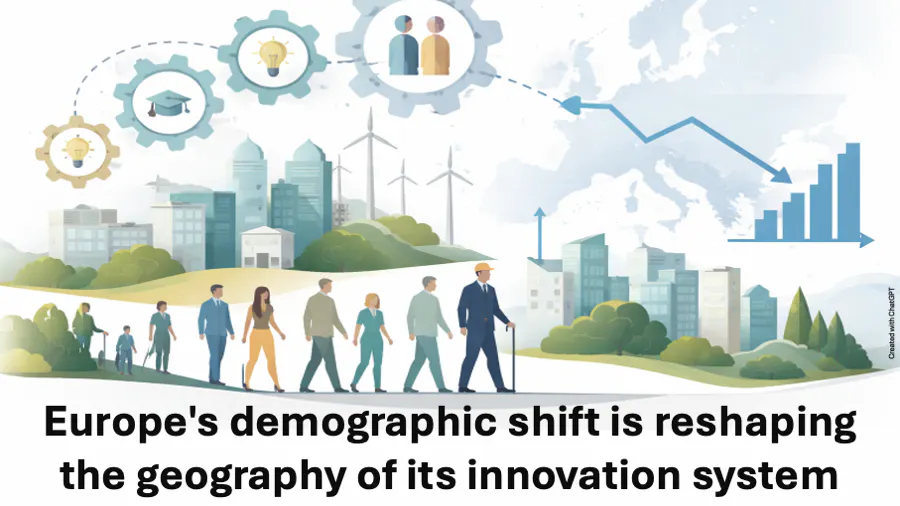
Europe’s demographic shift is no longer a slow-moving background trend. It is a structural transformation that is reorganising labour markets, public finance, service provision, and regional trajectories. By mid-century, the EU’s working-age population will have shrunk considerably, dependency ratios will have worsened, and labour’s contribution to growth will be under sustained pressure. This is not only a macroeconomic challenge. It is a territorial restructuring of Europe’s research and innovation geography.
For decades, Europe’s research and innovation (R&I) model has been based on two implicit assumptions: a steady influx of young, highly educated talent, and the state's fiscal capacity to increase investment. Both assumptions are eroding simultaneously.
The real question is not whether demographic change will affect Europe’s innovation system. Rather, it is whether R&I policy recognises that demography is not only shrinking Europe, but also reshaping its innovation system, and its geography.
Four territorial fault lines
In a recent publication, the JRC presented four contrasting scenarios for Europe’s innovation capacity in light of demographic changes expected by 2050 (see the full report (S'ouvre dans une nouvelle fenêtre)). In one scenario, fiscal pressure and weakened public institutions lead to corporate ascendancy, where private actors dominate research and innovation (R&I) agendas. In another scenario, inclusion and purpose drive socially oriented innovation, but this comes at the cost of slower momentum and funding instability. A third scenario, 'splinters and stratification', describes a Europe that is fragmented along geopolitical lines and focused on technological self-defence. The fourth scenario, 'Hybrid Hubs', imagines a resilient, regionally distributed system built around strategic autonomy and human-AI synergy. In each of these scenarios, demographic pressure interacts with territorial differentiation in distinct ways; amplifying divergence, centralisation or distributed resilience.
These scenarios are not predictions. They are stress tests which become even more pertinent when viewed through a territorial lens, considering the implications for different types of territories and bearing in mind the recent ESPON (S'ouvre dans une nouvelle fenêtre)NoStaGeo findings on the need to consider non-standard geographies more (see the earlier blog post (S'ouvre dans une nouvelle fenêtre)).
Across all four JRC scenarios, demographic pressure acts as a multiplier of systemic tensions. When viewed through a territorial lens, demographic pressure reveals four structural fault lines.
The human capital model no longer aligns with functional demand
The traditional 'pipeline' logic of educating young cohorts to replace retiring ones is no longer viable in a shrinking society. Longer careers, fewer new recruits and faster technological cycles all undermine linear education models.
However, the problem is not just quantitative. Skills shortages are also geographically uneven. Regions that are already experiencing youth migration struggle to maintain a critical mass of universities, vocational training centres, and research infrastructures. Patterns of brain drain and brain gain risk further polarising Europe’s innovation landscape.
Meanwhile, sectors such as healthcare, water management and energy transition are facing a growing shortage of skilled professionals in regions that are most exposed to demographic decline.
A cyclical model of human capital, embedding upskilling and reskilling throughout 40–50-year careers, is becoming a structural necessity. Lifelong learning is no longer an optional extra in social policy. It is the infrastructure that enables territorial resilience.
Fiscal squeeze meets uneven territorial pressure
Ageing societies are reallocating public budgets. Pensions, healthcare and long-term care absorb an increasingly large proportion of expenditure. Discretionary spending, including on fundamental research, becomes politically vulnerable.
However, fiscal pressure is also spatially differentiated. Local and regional authorities with stagnating or declining populations often have to deal with rising service costs and limited revenue bases. They must invest in resilience - inlcuding health infrastructure, digitalisation and climate adaptation – despite tight constraints.
In this context, the protection of curiosity-driven research cannot be justified in abstract terms alone. If R&I funding is perceived as being detached from uneven territorial pressures, political support will weaken. Conversely, if research capacity is visibly linked to solving concrete territorial challenges such as health access, adapting to an ageing population and ensuring functional infrastructure, its legitimacy will be strengthened.
The issue is not only how much Europe invests in R&I. It is also about ensuring that long-term scientific capacity is protected from demographic volatility and short-term political cycles.
Spatial concentration leads to systemic fragility
R&I excellence is increasingly concentrated in a limited number of metropolitan 'superstar hubs'. In the short term, this concentration may appear efficient. However, in the long term, in a demographically shrinking Europe, this could prove to be fragile.
Peripheral regions risk losing population, institutional capacity, educational infrastructure, and innovation networks. Once critical mass erodes, it becomes difficult to regain it. Territorial divergence may become entrenched.
Meanwhile, metropolitan concentration generates its own pressures, such as land competition, environmental stress, increased demand for water and socio-economic segregation. Over-concentration can amplify vulnerability rather than reduce it.
Strategic autonomy cannot depend on just a few nodes. In a context of geopolitical uncertainty and fragile supply chains, distributed resilience is not inefficient. It is a means of managing risk.
Automation requires territorially grounded legitimacy
With fewer workers, automation and digitalisation are essential. Telemedicine, AI-supported logistics, digital twins for infrastructure, and advanced manufacturing systems will be essential for maintaining productivity.
However, digital solutions can both bridge and widen territorial divides. For example, telemedicine could provide access to remote regions, but it could also accelerate the withdrawal of physical services. Digital infrastructure may enhance efficiency or centralise power and capacity in regions that are already dominant.
Legitimacy is not abstract. It is territorially grounded. If communities perceive digitalisation as retrenchment rather than empowerment, there will be a backlash; and with it, regulatory hesitation and political fragmentation.
Innovation cannot progress faster than democratic consent permits. Trust is not external to R&D performance; it is an input into it.
A governance tension: functional areas versus accountability
Demographic pressure exposes a deeper institutional dilemma. Many of the challenges triggered by an ageing population – such as healthcare catchment areas, commuting zones, cross-border labour markets and river basins – operate in functional territories that do not align with administrative borders. Effective adaptation requires coordination across these functional geographies.
However, democratic accountability remains anchored in municipalities, regions, and Member States.
R&I policy sits at the intersection of these logics. It must facilitate problem-solving across functional territories while remaining accountable within administrative ones. Without institutional innovation in governance architecture, demographic pressure could push Europe towards either reactive centralisation or a fragmented patchwork of solutions.
From defensive adaptation to territorial redesign: four mandates
If the fault lines described above risk fragmentation and erosion, the following mandates outline how pathways to stabilise Europe’s innovation system. JRC highlights four cross-cutting mandates that emerge as robust strategic responses across demographic scenarios.
The protection mandate. This involves establishing durable safeguards for fundamental research. Legislative funding floors or long-term commitments are necessary to insulate curiosity-driven science from fiscal crowding-out. Strategic autonomy depends on knowledge that is not yet commercially viable.
The adaptation mandate. Institutionalise lifelong learning and professional mobility as systemic infrastructure. Research sabbaticals, reskilling frameworks, and cross-sector mobility schemes should be aligned with functional labour market geographies rather than national averages.
The cohesion mandate. Develop distributed R&I infrastructures, such as regional innovation campuses, cross-border research networks, and digital platforms, to encourage talent to settle outside of established hubs. Trading some short-term efficiency for long-term territorial resilience may be essential.
The trust mandate. Participatory governance and agile regulatory networks should be embedded into innovation systems. Earning a 'social licence to automate' requires transparency, inclusion, and sensitive implementation tailored to the local area.
These mandates are mutually reinforcing. Strategic autonomy requires territorial cohesion. Skills renewal requires institutional trust. Applied innovation depends on protected basic research.
Demography as catalyst
Demographic decline does not necessarily lead to economic or scientific decline. However, without structural reform, it risks incremental erosion and territorial fragmentation.
The demographic shift is not merely a constraint. Rather, it is a stress test; and potentially a catalyst. It forces Europe to reconsider how knowledge is generated, funded, and distributed across the continent. It challenges the assumption that innovation systems can remain blind to territory in a continent with such uneven distribution.
The central policy question is no longer how to shield innovation from demographic decline. Rather, it is whether Europe can design an innovation system that enables its metropolitan and rural areas, both growing and shrinking, to function, adapt, and remain cohesive under demographic pressure.
Demography is not destiny. However, it is re-territorialising Europe and its research and innovation geography. The choice is between drifting towards concentration without cohesion and digitalisation without legitimacy, or deliberately redesigning a territorially grounded, resilient innovation model that is fit for an ageing continent.
by Kai Böhme
 (S'ouvre dans une nouvelle fenêtre)
Date
16/03/2026
Sujet
Scenarios & visions
0 commentaire
Vous voulez être le·la premier·ère à écrire un commentaire ?
Devenez membre de spatialforesight et lancez la conversation.