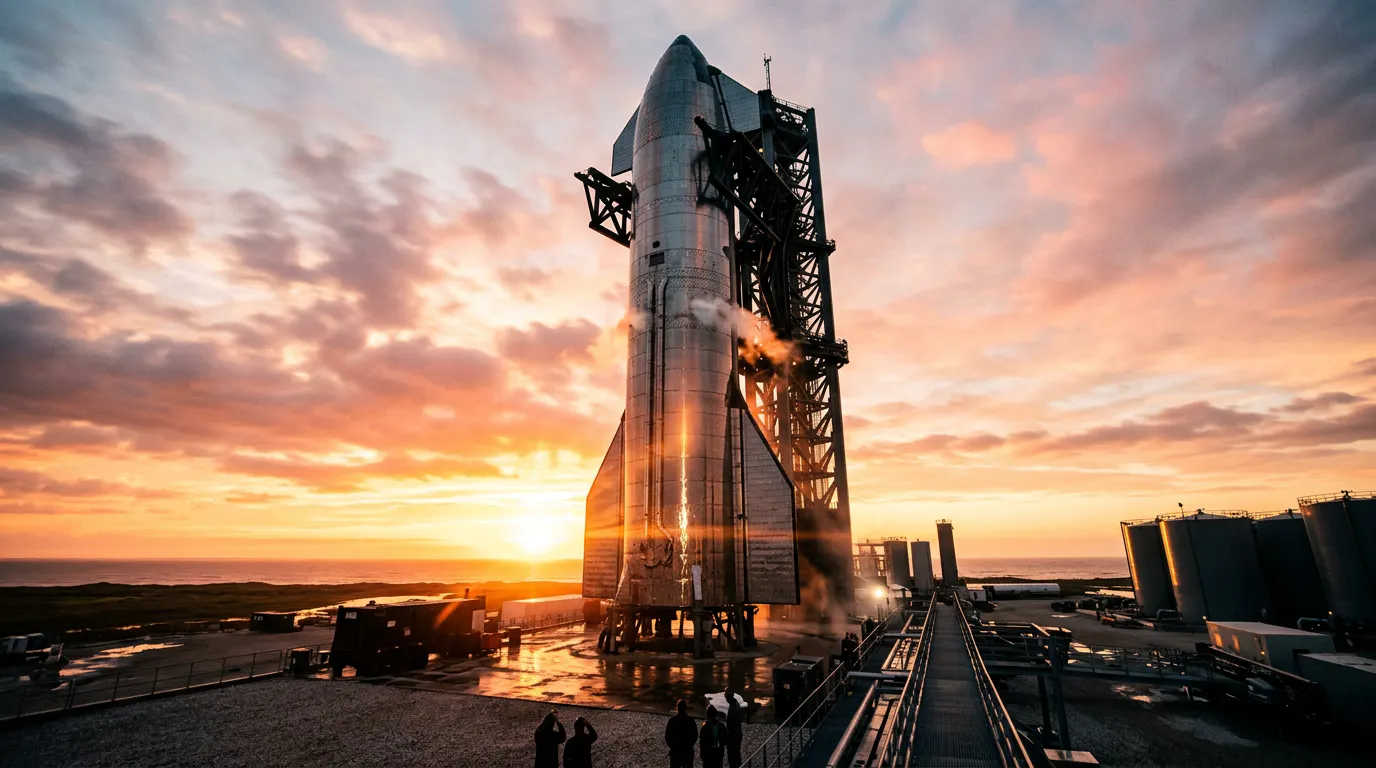
Today, June 12, 2026, SpaceX starts trading on the Nasdaq. Ticker: SPCX. Fixed price: $135 per share. Implied value: roughly $1.77 trillion. Target raise: $75 billion. That makes it the largest IPO ever. It tops Saudi Aramco's 2019 debut.
The headlines are giddy. Demand was 4x the supply. Retail buyers get an oddly large 30% share.
I spent the weekend inside the S-1. I found real engineering talent and solid revenue growth. I also found a spending path that should make any calm investor pause before clicking "Buy." Let's walk through it — block by block, number by number.
The IPO Setup — What's Normal, What's Not, and Why It Matters
Let's start with the plumbing. Most IPOs use a price range — say, $120 to $140. That range shifts based on demand during the roadshow. SpaceX skipped that step. It locked the price at $135 before the roadshow even opened on June 4.
That's rare. Here's why it matters.
Fixed Price → No Price Discovery → Banks Control the Story
In a normal IPO, book-building lets the market speak. Big investors signal what they'd pay. The final price reflects total demand at each level. SpaceX said: no, thanks. We set the price.
Per CNBC, this let SpaceX start placing shares sooner than usual. Orders closed a day early — Wednesday, June 11. That gave banks all of Thursday to plan who gets what. The price was locked that same evening.
Here's the timeline, simplified:
S-1 Filed (May 20) → Roadshow Opens (June 4) → Fixed Price Set ($135) → Books Close Early (June 11) → Shares Placed (June 12) → First Trade (June 12)
Compare that to a standard IPO:
S-1 Filed → Roadshow (2 weeks) → Price Range Set → Demand Gauged → Price Adjusted → Shares Placed → First Trade
SpaceX cut the timeline and removed the price adjustment step. That's confidence. Or it's control. Depends on how you see it.
The Retail Share Question
CNBC reports SpaceX is aiming for 30% retail — roughly $22.5 billion in shares. Normal retail share in IPOs is 5% to 10%, per Fidelity's data. The filing lists Schwab, Fidelity, Robinhood, SoFi, and E-Trade (Morgan Stanley) as platforms.
Let me be direct. A 3x-normal retail share is not kindness. It's a design choice. Here's the logic:
High Retail Share → Spread-Out Ownership → Less Grouped Voting Power → Musk's Dual-Class Control Stays Safe
Which brings us to who runs the show.
The Dual-Class Setup
The S-1 confirms Elon Musk will keep about 82.4% of votes after the IPO. He holds Class B shares. Those carry ten votes each. Public buyers get Class A shares — one vote each.
In plain terms: you can buy SPCX today. You can own a slice of the profits. You cannot shape the company's path. Ever.
This isn't new in tech. Google did it. Meta did it. Snap gave public holders zero votes. But at $1.77 trillion, the gap between your money at risk and your say in how it's used is worth noting.
All-Primary Deal: Where the Cash Goes
The IPO is all-primary. Every dollar raised goes to SpaceX. No insiders are selling. Lock-up rules apply after listing.
That's a good sign in one narrow sense. Insiders aren't cashing out at the top. But it also means the company needs this money. Badly. We'll see why in Block 2.
The Demand Frenzy
Several sources confirm demand topped supply by more than 4x. That sounds great. It is great — as a demand signal. But high demand doesn't prove fair price. It proves interest.
Pets.com (S'ouvre dans une nouvelle fenêtre) was in high demand. WeWork's first attempt drew huge crowds before it fell apart. Demand tracks hype, not value.
Quick Reference: SpaceX IPO Fact Sheet
• Ticker: SPCX (Nasdaq and Nasdaq Texas)
• Price: $135/share (fixed)
• Shares offered: 555.6 million
• Gross raise: ~$75 billion
• Implied value: ~$1.75–$1.77 trillion
• Structure: All-primary (no insider sales)
• Retail target: ~30% of shares
• Voting control: Musk keeps ~82.4% via Class B
• Lock-up: Existing holders face restrictions
The setup is clean. The pace is fast. The control is total. Now let's look at what the money is really funding.
Looking Under the Hood — Revenue, Capex, and the AI Pivot the S-1 Reveals
Here's where things get interesting. And by interesting, I mean the kind where you open a filing expecting rockets and find an AI company wearing a spacesuit.
Revenue: Real Growth, Real Numbers
The S-1 shows $18.67 billion in 2025 revenue. That's 33% growth year over year. By any measure, that's strong. Starlink is scaling. Launch services lead the market. The contracts are real.
But here's the math on price:
$1.77 Trillion Value ÷ $18.67 Billion Revenue = ~95–107x Trailing Revenue
Sources differ slightly based on which value they use ($1.75T vs. $2T). The range is 95x to 107x. For context:
• Nvidia at its 2024 peak traded around 35–40x trailing revenue
• Microsoft trades at roughly 13x
• Even Palantir at its most hyped rarely topped 50x
At 107x revenue, SpaceX is priced for a future that must be nearly perfect. Not good. Perfect.
The xAI Merger: February 2026
In February 2026, SpaceX absorbed xAI — Musk's AI lab — at a combined deal value of $1.25 trillion. This is the single most important fact in the S-1. Most coverage buries it below the rocket photos.
After the merger, SpaceX is no longer just a launch and satellite firm. It spans:
Launch Services → Satellite Internet (Starlink) → AI Compute (xAI) → AI Apps
The S-1's stated total market is $28.5 trillion. Of that, $22.7 trillion is tied to AI. Let me repeat: 80% of SpaceX's claimed market is AI, not space.
Market Breakdown (per S-1):
• AI apps and compute: $22.7T (79.6%)
• Space and satellite services: $5.8T (20.4%)
You're not buying a rocket company at $135 per share. You're buying an AI bet wrapped in a rocket brand.
Capex: The Number That Should Make You Pause
Total capex in 2025: $20.7 billion. That's up from $4.4 billion in 2023. In two years, capex nearly grew 5x.
2023 Capex: $4.4B → 2024 Capex: [growth] → 2025 Capex: $20.7B → Q1 2026 Alone: $10.1B
Q1 2026 capex was $10.1 billion. In one quarter. On a yearly basis, that's a $40 billion run rate.
Where is it going? The S-1 is clear. The AI segment used 76% of total capex in 2025 — up from 10% in 2023. Of the $20.7 billion spent, $12.7 billion went straight to AI.
Capex Shift:
• 2023: AI = 10% of capex → ~$440M
• 2025: AI = 76% of capex → ~$12.7B
• S-1 use-of-funds priority #1: "Expansion of AI compute infrastructure"
The filing lists AI compute ahead of rockets and satellites in its use-of-funds section. That's not subtle. That's the company telling you where the $75 billion goes.
The Cash Burn Problem
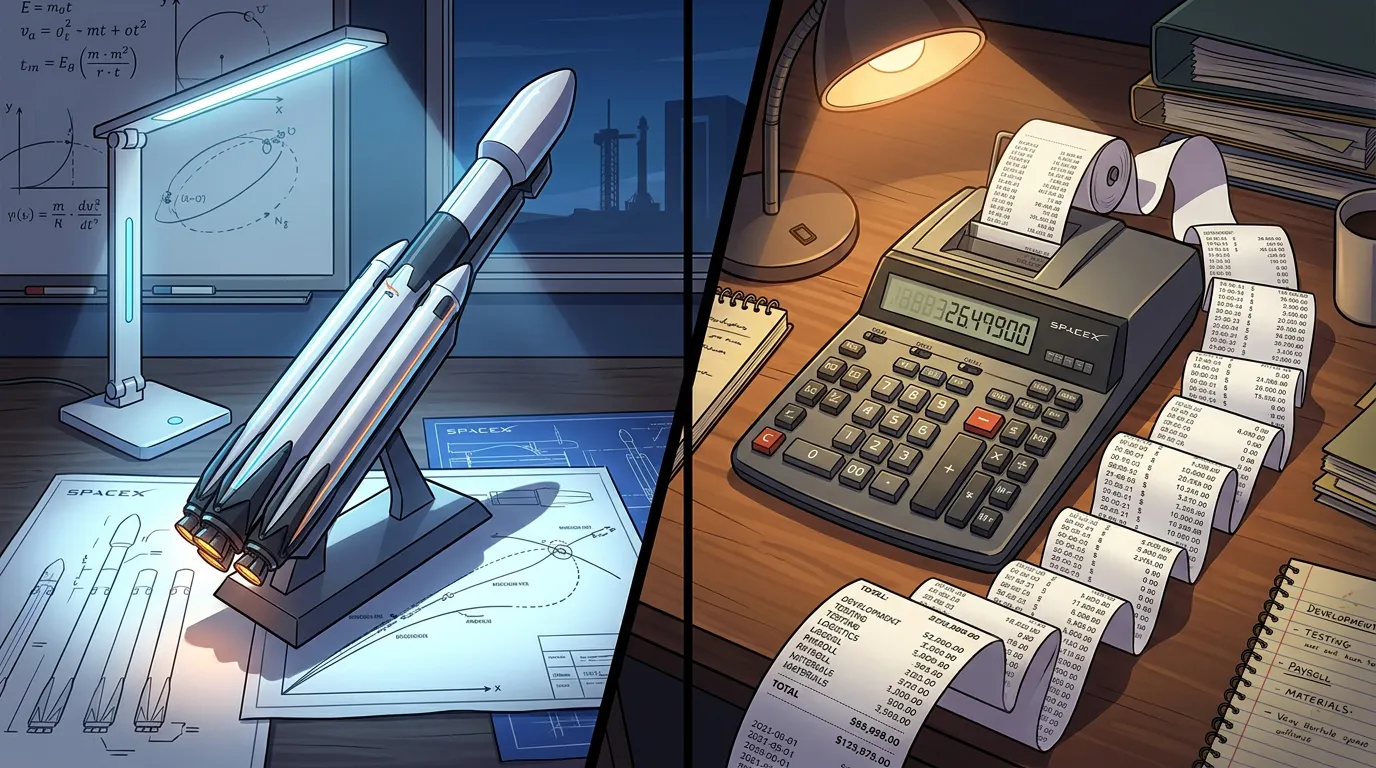
Here's where the numbers get ugly.
• 2025 operating cash flow: $6.8 billion
• 2025 capex: $20.7 billion
• Ratio: Capex ran at roughly 3x operating cash flow
That's a $13.9 billion gap in one year. The company covered part of it from its balance sheet. Cash dropped from $24.7 billion to $15.9 billion in one quarter — a fall of $8.8 billion.
And in March 2026, SpaceX took a $20 billion bridge loan. That loan comes due in September 2027. Fifteen months from now.
Cash Flow Chain:
$6.8B Cash Flow – $20.7B Capex = –$13.9B Free Cash Flow → Bridge Loan ($20B, due Sept 2027) → IPO Raise ($75B) → Pay Down or Refinance
The IPO isn't optional for SpaceX. It's a funding event. The $75 billion covers the bridge loan, funds the AI buildout, and buys runway. That's not a knock — it's what IPOs are for. But it reframes the story. This isn't "SpaceX graces public markets." It's "SpaceX needs public markets."
The Operating Loss
Total operating loss in 2025: $2.6 billion. The S-1 pins the entire loss on the xAI merger. The legacy space business seems to run at a profit. The AI segment is the cost center.
Space Segment: Profitable → xAI Segment: –$2.6B Loss → Combined: –$2.6B
Morningstar this week called SpaceX "significantly overvalued." They hinted that better entry points may come after trading starts. That's a polite way of saying: wait
Hype vs. Reality — What a $135 Share Actually Buys You
Let's run the Hype vs. Reality test on SPCX. This is what we do here. Strip the brand. Strip the Musk aura. Look at what the numbers say.
Hype: "The Largest IPO in History"
Reality: True. At $75 billion, it tops Saudi Aramco's $29.4 billion 2019 debut. But Aramco was profitable, cash-rich, and paid dividends at listing. SpaceX is burning cash, carrying a bridge loan, and posted a $2.6 billion operating loss.
IPO size ≠ investment quality. They're different things.
Hype: "4x Oversubscribed — Massive Demand"
Reality: Also true. But high demand measures fame, not true worth. The dot-com era taught us this. Strong demand at a fixed price means the price was set to spark buzz — or the brand is strong enough to override analysis.
Demand Signal → Fame Metric → Not a Value Metric
Hype: "$28.5 Trillion Total Market"
Reality: The S-1 claims a $28.5T market, with $22.7T in AI. For reference, global GDP is roughly $110 trillion. SpaceX is saying its market is about 26% of all global output.
Market size figures in S-1 filings are dreams by design. They're not lies. They're also not forecasts. They're the ceiling if everything goes right and no rival exists. Treat them that way.
S-1 Market ($28.5T) → Actual 2025 Revenue ($18.67B) → Current Share: 0.065%
At current revenue, SpaceX has captured 0.065% of its stated market. The gap between dream and reality is roughly the size of the Pacific Ocean.
Hype: "Elon Musk, Visionary Leader"
Reality: Musk's track record is truly rare. Tesla. SpaceX. Starlink. He builds things that work. But he also runs Tesla, leads xAI (now inside SpaceX), owns X (formerly Twitter), and stays involved in Neuralink and The Boring Company.
The S-1 itself flags key-person risk. If Musk's focus splits — or if legal, political, or health events step in — the whole thesis weakens. This is not fear-mongering. It's in the filing.
Hype: "Retail Gets 30% — Open Access"
Reality: Retail gets 30% of shares with 0% say in how things run. Class A shares carry one vote each. Musk's Class B shares carry ten votes each. He keeps 82.4% of voting power.
Your $135 Buys: Profit Exposure (Yes) + Governance Rights (No)
This is the standard Silicon Valley dual-class playbook. It works until it doesn't. When it fails — see Snap's post-IPO governance woes — retail has no recourse.
The Price Sanity Check
Let me build a simple reverse-DCF model. What does $1.77 trillion imply about future results?
Rough inputs for context:
• Target return: 10% per year over 10 years
• Exit multiple: 25x earnings (generous for a mature firm)
• Needed 2036 net income to justify today's price: ~$70 billion
For context, Nvidia's trailing net income is roughly $63 billion. Nvidia is the most profitable AI company on Earth. It has 75%+ gross margins on a mature product.
SpaceX would need to match or beat Nvidia's current profits within a decade. Starting from a $2.6 billion operating loss. While spending $40 billion per year on capex.
Required Path:
–$2.6B Operating Loss (2025) → ~$70B Net Income (2036) → Needs ~35% Net Margins on ~$200B Revenue
Is it possible? With Musk, I've learned never to say never. Is it likely enough to justify $135 per share today? That's a different question.
Kira's Tracker Note
I am not buying SPCX at open. I’m adding it to my watchlist. My target entry is below $100. That would imply roughly $1.3 trillion in market cap — still a rich price but with more room for error. If the stock runs to $200 on day one, I’ll watch. If it drops back in Q3, I’ll look again.
Utility Block: Pre-IPO Checklist for Any Large Tech Debut

Before buying any IPO at scale, run this checklist:
• ☐ Read the S-1 use-of-funds section. Where does the money actually go?
• ☐ Calculate price-to-revenue. Is it above 50x? Use extreme caution.
• ☐ Check the voting setup. Do you have real say or just profit exposure?
• ☐ Find the cash flow gap. Is capex above operating cash flow? By how much?
• ☐ Look for bridge loans or debt due within 24 months.
• ☐ Read the risk factors section. All of it. Especially key-person risk.
• ☐ Check insider lock-up end dates. Mark them on your calendar.
• ☐ Compare the stated market size to actual revenue. If share is below 1%, the market size is a dream, not a plan.
• ☐ Wait 90 days. The first earnings report post-IPO reveals more than any roadshow.
• ☐ Size the position at ≤2% of your portfolio. IPOs are volatile. Protect your capital.
The Bottom Line — What to Do With All of This
SpaceX is a remarkable engineering company. Starlink works. Falcon 9 is the most reliable launch vehicle ever built. Starship is pushing limits that matter for all of us.
None of that means SPCX at $135 is a good buy today.
The S-1 tells a clear story if you read it without the Musk filter. This is a company pivoting hard into AI, burning cash fast, carrying a $20 billion bridge loan, and asking public markets for $75 billion to fund the next phase.
Engineering Feat → ≠ → Smart Buy at Any Price
At 107x trailing revenue, you're paying for a decade of near-perfect results. The market is pricing in success that hasn't happened yet. And it's in a field (AI compute) where SpaceX has no public track record. It faces Nvidia, Microsoft, Google, and Amazon as dug-in rivals.
My take: watch, don't chase. Let the first quarterly report as a public company tell you what the roadshow wouldn't. Let lock-up ends create natural selling pressure. Let the price find reality.
The best buys I've made were the ones where I waited 90 days after everyone else rushed in.
Feedback Loop: Rate Today’s Ledger
We strip away the hype to focus purely on market plumbing and capital flows, but we want to ensure our analytical depth matches your portfolio needs.
Hit reply to this email right now and type a single number (1, 2, 3, or 4) to share your rating:
1 — Highly valuable: This level of structural macro analysis is exactly why I subscribe.
2 — Informative, but needs more execution: Strong perspective, but I want to see specific tickers or tactical setups included next time.
3 — Disagree with the premise: The breakdown feels overly pessimistic and underestimates the long-term strategic monopoly of the asset.
4 — Solid read: A well-balanced perspective to chew on. Keeping a cool head and waiting for the next drop.
Want to expand on your vote?
Don't stop at just a number. If you have a counter-thesis, a specific question, or want to challenge our logic, type it directly into your reply. We read every single response, and the sharpest macro insights from our community will be featured and deconstructed in our next brief.
Date
12/06/2026


