Wrestling with a history that is complicated, inspiring, frustrating, uplifting, and horrifying. A continuity of conflict, 1776-2026
By Thomas Zimmer, July 5, 2026
Before we start, let me remind you that I have launched a version of this newsletter in German. Same content, same analysis – only in German. If that is of interest to you, head over to Demokratie Americana (Si apre in una nuova finestra) (where all pieces should be available within a few hours of publication on here). Please help me spread the word!
Also: Please support Democracy Americana!
Democracy Americana is my main source of income as an independent writer. If you are reading the free version of this newsletter, I sincerely appreciate your time and effort engaging with my work. Please share it widely to help me reach new readers.
And if you can, please consider becoming a paid member. You will gain access to special benefits – including many additional essays and the chance to download the audio versions of all my pieces in podcast form.
Most importantly, Democracy Americana is a publication solely funded by readers. I need your support to continue this work. Thank you!
Not ready yet for a paid membership? You can subscribe to the free version of the newsletter:
“American history is longer, larger, more various, more beautiful, and more terrible than anything anyone has ever said about it.”
I have used this quote several times before in my writing. I think about it a lot. It is from a speech James Baldwin delivered in October 1963, titled “A Talk to Teachers” (Si apre in una nuova finestra). Baldwin was born in Harlem in 1924. His mother had fled the Jim Crow South. Baldwin himself left America as a young man in the late 1940s to flee the racist discrimination he experienced. For most of his adult life, France would remain his base; but often he returned to the United States to take part in the Black freedom struggle. Baldwin was a novelist and a poet, but also a political intellectual and civil rights activist. And he was a forceful, magnetic speaker. His perspective on U.S. history is among the most profoundly true and insightful things anyone has ever said about the United States. Anyone who works and thinks about America’s past, present, and future should adopt it as a guiding paradigm. And I believe it can also help us navigate this acutely perilous political moment in which we find ourselves right now. More various, more beautiful, more terrible. We need to grapple with all of these conflicting dimensions.
When big anniversaries came around, Americans at various points in the country’s history were asked to do a little bit of that grappling, perhaps; but mostly, they were invited to come together and celebrate the nation and its origins. In the past, such anniversaries tended to produce an outpouring of patriotic sentiment even after moments of immense strive – or perhaps precisely because these occasions seemed to justify papering over the cracks and the crises. That was an attractive proposition at least to those who were fortunate enough not to have their lives and livelihoods acutely threatened by the conflicts that continued to shape life in America.
In 1876, for instance, the United States celebrated its centennial a little over a decade after the most devastating war in the country’s history – a war fought within, against those who had betrayed the Union in service of what they believed was their right to enslave fellow human beings. As the celebrations took off, the South was officially still under military occupation. The attempt to impose biracial democracy in the former Confederacy was met with unspeakable levels of white supremacist violence. Out west, the U.S. army was fighting a brutal war to drive Native Americans off their land. And yet, at least white people in the North and the South displayed a patriotic spirit of reconciliation – eager to look forward, excited about the future. From May through November 1876, Philadelphia hosted the world’s fair and called it the Centennial Exposition (Si apre in una nuova finestra): About ten million people, roughly twenty percent of the population, came to embrace the technological marvels on display.
In 1976, the United States was coming off a period of escalating political violence and assassinations, riots, mass protest. The nation had just suffered a humiliating defeat in Vietnam, struggling to understand the destructions and war crimes America had inflicted upon a far-away land, all in the name of defending freedom, somehow – sacrificing tens of thousands of their own young men in the process. Watergate was still casting a dark shadow over American politics, Nixon’s many abuses of presidential power had shaken the belief in the political institutions and the stability of the rule of law. And yet, America’s bicentennial – perhaps the largest celebration in the nation’s history – once again sparked a spirit of reconciliation. “We have inherited a great tradition,” President Gerald Ford declared (Si apre in una nuova finestra), “but it is our job - older and younger people joining together - to see to it that when our ancestors (according to the National Archives, Ford really seems to have said “ancestors” and not “descendants” here? Hm.) meet here 100 years from now, they can say that what was done here on this date was the kick-off for a new century of unity, and progress, at home as well as abroad.” History as a call to unify around the shared American project and look towards the future in optimism.
This time around, however, in 2026 it is not working. America’s semiquincentennial is a bizarre spectacle, entirely overshadowed by the delusions and the authoritarian desires of a fundamentally ridiculous and profoundly dangerous man. Trump is utterly incapable of unifying, except around shared grievances directed at some “Other.” He spent the Fourth of July raging against enemies (Si apre in una nuova finestra) real and imagined. Otherwise, he is mostly occupied with imposing vain projects of self-aggrandizement on the nation: His ballroom, the triumphal arch he wants to erect – a self-monumentalization fundamentally incompatible with a democratic Republic.
Most Americans don’t want to celebrate. Not with Trump, certainly. His “Great American State Fair” on the National Mall, a vehicle for deranged MAGA propaganda (Si apre in una nuova finestra), has not been well attended, to put it mildly. And overall, the mood is not very patriotic, at least not by American standards. The percentage of people who say they are “extremely or very proud” to be an American has fallen, according to Gallup (Si apre in una nuova finestra), from 85 twenty years ago to 53; if we isolate for people who say they are “extremely proud,” it has cratered from 59 percent in 2006 to merely 33 percent today.
And therein lies, potentially, one of the silver linings of the Trump era. What the country needs now is not some anniversary-induced nostalgia or unity based on willful ignorance. It needs a serious reckoning as the basis for what might hopefully be a new reconstruction. At the Quarter Millennium, Donald Trump is the President of the United States. And whatever else is true about the most powerful nation on earth, this fact alone forces a reckoning.
Contested ideals and the origins of a national struggle
Why does America celebrate its birthday on the Fourth of July 1776?
It wasn’t until the Treaty of Paris in September 1783 that Britain officially recognized the United States as an independent and sovereign nation. But fair enough, no need to wait around for permission from the King of England.
Famously, John Adams initially assumed July 2 would be the day celebrated as the key moment in America’s history, as he wrote in a letter to his wife, Abigail. That day, the Second Continental Congress had adopted a “Resolution for Independence,” deciding that the American colonies would indeed break away from the British Crown and henceforth exist as “free and Independent States.”
We probably shouldn’t make too much of that difference between July 2 and 4: On the Fourth, the final version of the Declaration was adopted by the Continental Congress – and, crucially, announced to the public. Since this was all about “the people” asserting their right to independence, it makes sense to focus on July 4. But it is noteworthy that this also focuses our attention on the Declaration itself, as opposed to the mere fact of the colonies deciding to secede – and that means: on the text and the ideas expressed therein.
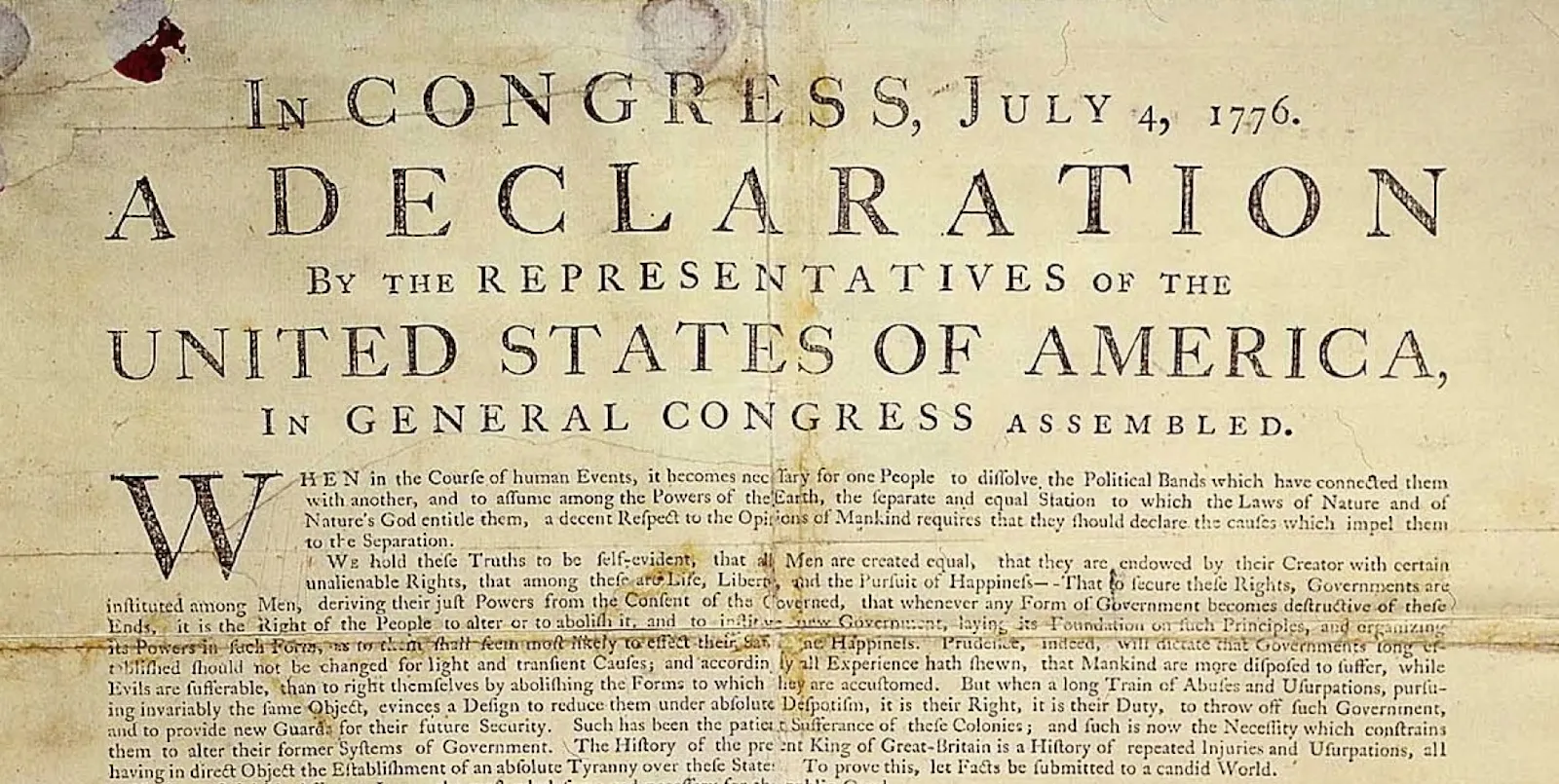
The Declaration of Independence, drafted by Thomas Jefferson, has three distinct parts. The most famous passage comes in the second paragraph of the opening section:
“We hold these Truths to be self-evident, that all Men are created equal, that they are endowed by their Creator with certain unalienable Rights, that among these are Life, Liberty and the Pursuit of Happiness – That to secure these Rights, Governments are instituted among Men, deriving their just Powers from the Consent of the Governed, that whenever any Form of Government becomes destructive of these Ends, it is the Right of the People to alter or to abolish it, and to institute new Government, laying its Foundation on such Principles, and organizing its Powers in such Form, as to them shall seem most likely to effect their Safety and Happiness.”
This first part of the Declaration serves to establish a general justification for why, when people are confronted with a tyrannical government, they have the right to overthrow that government by revolutionary means. In this context, we must read Jefferson’s assertion of a “self-evident” truth that “all men are created equal” as the affirmation of an abstract principle: He is referring to some imagined natural state that predated government. This was not intended as a radical call for political and social equality in the here and now, but as a theoretical argument for why, based on that natural state, only certain forms of government should be considered legitimate, while others are in violation of that abstract principle. Once he had established that framework, Jefferson proceeded to make the case, in part two of the Declaration, that the American colonists were indeed facing such a form of illegitimate tyranny. And since he felt the need to provide evidence, he listed 27 grievances against the King.
Having established that tyranny is illegitimate, and that the colonists were facing tyranny, Jefferson comes to what is presented as an inevitable conclusion in part three. He declares independence:
“We, therefore, the Representatives of the united States of America, in General Congress, Assembled, appealing to the Supreme Judge of the world for the rectitude of our intentions, do, in the Name, and by Authority of the good People of these Colonies, solemnly publish and declare, That these United Colonies are, and of Right ought to be Free and Independent States.”
It’s a fine piece of political writing and argument. But whatever Jefferson’s exact intention may have been, once the Declaration was published, the meaning of these words and assertions was immediately contested. It turns out there was little that was “self-evident” about the ideas in the Declaration – at least not when it came to the question of what role, exactly, they should play in shaping the political and social reality of this young nation, who they should apply to and who would remain excluded. It is one of the key characteristics in U.S. history: Since the moment the country was founded, these questions – and thereby: the idea of “America” itself – has been endlessly, relentlessly contested. 250 years of continuous conflict. And for two-and-a-half centuries, all political movements of consequence in the United States – those fighting for emancipation and equality as well as those devoted to upholding white domination – have claimed the mantel of the Revolution, have insisted to be striving to realize America’s founding ideals.
This piece is free to read for everyone.
But recently, only paywalled pieces have generated new memberships and thereby revenue. I am hoping we can buck the trend so that I can keep publishing free essays like this one regularly. That is crucial for the long-term viability of this publication, as it is the only way to achieve visibility and thereby reach new readers.
Please help me by supporting Democracy Americana with a membership:
Emancipation and equality now!
When I say the meaning of the ideas and ideals contained within the Declaration, and the role they should play in American life, was endlessly and immediately contested, I am not just talking about abstract debates between intellectuals and political elites. Those excluded from the promise of equal status and participation read Jefferson’s words not just as a statement of lofty principles, but as a call to action, an emancipatory agenda to be enacted.
Last week, Jamelle Bouie, America’s most incisive columnist, wrote about (Si apre in una nuova finestra) how Black Americans – free and enslaved - immediately seized upon the emancipatory potential of the Declaration. In a piece that I found incredibly moving and inspiring, Bouie demonstrated how Black people used the language of the Declaration, presented their cause in the idiom of the Revolution; how they referred to these ideas, invoked and wielded them as an instrument. As Bouie puts it: “The Declaration worked as both an indictment and a promise.”
The Declaration as indictment and promise: Throughout U.S. history, we find exactly this dynamic in the freedom struggle of any group for which American democracy existed as a promise only, but not as a reality. “When the architects of our republic wrote the magnificent words of the Constitution and the Declaration of Independence,” Martin Luther Kind declared in what came to be known as his “I have a dream” speech (Si apre in una nuova finestra), delivered in August 1963 in front of the Lincoln Memorial in Washington, DC, “they were signing a promissory note to which every American was to fall heir. This note was a promise that all men, yes, black men as well as white men, would be guaranteed the ‘unalienable Rights’ of ‘Life, Liberty and the pursuit of Happiness.’” It was finally time, King insisted, for America to make good on that noble promise:
“It is obvious today that America has defaulted on this promissory note, insofar as her citizens of color are concerned. But we refuse to believe that the bank of justice is bankrupt. We refuse to believe that there are insufficient funds in the great vaults of opportunity of this nation. And so, we’ve come to cash this check, a check that will give us upon demand the riches of freedom and the security of justice.”
Martin Luther King spoke almost exactly one hundred years after Abraham Lincoln had codified this reading of the Declaration’s most famous passage – a call to action, and not merely some abstract principle of government – in his Gettysburg address (Si apre in una nuova finestra). On November 19, 1863, Lincoln delivered his speech on the fields where the largest battle of the Civil War had been fought from July 1-3, 1863 – a major turning point, as it ended Robert E. Lee’s second invasion of the North. “Four score and seven years ago,” the President famously declared, “our fathers brought forth on this continent a new nation, conceived in liberty, and dedicated to the proposition that all men are created equal.”
Lincoln demanded “that this nation, under God, shall have a new birth of freedom.” That is exactly what the Reconstruction amendments to the Constitution after the end of the Civil War were supposed to achieve. The 13th Amendment, ratified in December 1865, abolished slavery. The 14th Amendment, adopted in July 1868, established birthright citizenship, formal equality before the law, and the principal of nondiscrimination. The 15th Amendment, ratified in February 1870, barred the federal government and the states from denying a citizen’s right to vote “on account of race, color, or previous condition of servitude.”
It is hard to overstate the significance of what happened here. The nation was fundamentally reconceptualized. The Reconstruction Amendments changed the nature of the constitution – the document itself, but also the political and social regime it prescribed – so profoundly that the historian Eric Foner has called it a “Second Founding.” (Si apre in una nuova finestra) This attempt to transform a nation built on racial hierarchy into a biracial democracy was nothing short of revolutionary. And that is exactly how the framers behind these amendments saw it. They explicitly intended regime change: From a regime grounded in slavery to a regime grounded in equality.
White male freedom vs “all men are created equal”
Thomas Jefferson, who wrote the revolutionary egalitarian promise into what quickly became one of the nation’s sacred texts, did not himself live up to these ideals. During his life, he enslaved more than 600 people. Some of his fellow Founding Fathers were committed abolitionists. He was very much not. While he felt conflicted about the institution of slavery and believed it should eventually be abolished, he did not take any significant steps towards that end as one of America’s most powerful political leaders, nor did he free the people he himself held in bondage. The contrast between ideal and reality was always stark.
Against those who invoked the Declaration as a promise of emancipation, those who were devoted to upholding white domination also claimed the Founding, interpreting and weaponizing it in opposition to the idea of equality. In Dred Scott v. Sandford, for instance, the Supreme Court ruled in 1857 that Black people, whether free or enslaved, were not and could never be citizens because they were inferior and they didn’t have the necessary hereditary connection. But what about “all men are created equal”? As Chief Justice Roger Taney declared in his decision (Si apre in una nuova finestra):
“The general words above quoted would seem to embrace the whole human family, and if they were used in a similar instrument at this day would be so understood. But it is too clear for dispute, that the enslaved African race were not intended to be included, and formed no part of the people who framed and adopted this declaration.”
Just a few years after Taney’s shameful ruling, those who committed treason against the nation and seceded from the Union to defend what they believed to be their “right” to enslave others also claimed to represent the true legacy of the American Revolution. Had the Declaration not clearly established the right to overthrow tyranny – the tyranny of the North, in this case? According to Southern secessionists, it was Lincoln’s government that lacked the “consent of the governed” and had therefore lost all legitimacy; the Confederacy would therefore carry on the revolutionary heritage!
The Confederacy was vanquished on the battlefield – but the ideas that animated it, the quest to order society along strict hierarchies, was unfortunately not. After a little more than a decade, America’s first attempt at biracial democracy during the Reconstruction era was drowned in ostensibly “race-neutral” laws and almost unimaginable excesses of white reactionary violence.
The level of biracial equality and democratic participation the South experienced during Reconstruction would not be reached again until almost a full century later.
Throughout U.S. history, any attempt at leveling existing hierarchies of race, gender, religion, and wealth has inevitably led to a massive countermobilization orchestrated by the forces of reaction. And those who spearheaded that countermobilization have often claimed that it was not their refusal to accept egalitarian democracy that was a betrayal of the founding ideals. It was those who pledged to take the idea that “alle men are created equal” seriously who supposedly defied real American values. Some even went so far as to assert that Abraham Lincoln, because he attempted to recenter the American experiment around the idea of equality, was the big bad guy in U.S. history. In 1966, for instance, Frank S. Meyer, a prominent conservative intellectual, explained why he believed it was this exact moment at the end of the Civil War when the nation took the wrong turn, away from “freedom,” as he defined it, and towards “equality”: “The freedom of the individual person from government, not the equality of individual persons, is the central theme of our constitutional arrangements.” Meyer had been instrumental in bringing together self-declared libertarians, traditionalists, and reactionaries in a new Conservative Movement, uniting them all under the banner of anti-liberalism. He continued to explain in National Review, the flagship publication of the Conservative Movement: “Freedom and equality are opposites; the freer men are the freer they are to demonstrate their inequality, and any political or social attempt – like those so frequent in the twentieth century – to enforce equality – leads inevitably to the restrictions and the eventual destruction of freedom.” Meyer’s concern for “freedom of the individual person from government” obviously did not extent to the millions of people who had to endure slavery. Just like Roger Taney a century earlier, he simply didn’t regard them as citizens or members of the body politic.
To be fair, Meyer’s hostility towards Lincoln was far from the consensual position among mainstream conservative intellectuals at the time. However, there certainly is a very strong tradition on the Right of conceptualizing liberty/freedom on the one hand and equality on the other as ideas that are inherently in tension with each other – and of siding decisively against equality. There is a fairly straight line from such ideas to venture capitalist Peter Thiel in early 2009 (Si apre in una nuova finestra), shortly after Barack Obama had entered the White House, proclaiming: “I no longer believe that freedom and democracy are compatible.” He meant his own freedom and that of his fellow tech barons to do as they please.
Proponents of an ethno-religious nationalism that was unwilling to conceive of “America” as anything but a land dominated by white Christians have always claimed to be defending freedom and liberty. Their overriding concern was the liberty of certain “deserving” or “virtuous” individuals to be more, have more; their allegiance was to a particular form of “freedom” – the white male freedom to take the land and curtail the liberties of others.
Every form of domination in American history has been justified in the name of this “freedom.” The loudest and most influential defenders of Native American dispossession, slavery, and racial segregation have always presented themselves as champions of freedom from government tyranny or federal overreach.
Those who fought against de-segregation and civil rights in the 1950s and 60s made the same claims. In his inaugural address (Si apre in una nuova finestra) as governor of Alabama in January 1963, George Wallace vowed to defend “segregation now, segregation tomorrow, and segregation forever” not because of racism, no! But to defend the “freedom” of the South and its true people. “Let us rise to the call of freedom-loving blood that is in us,” Wallace declared, “and send our answer to the tyranny that clanks its chains upon the South.” Yet again it was time to take a stand and “sound the drum for freedom.” It is a particular kind of freedom Wallace was concerned with: The freedom of white people to dominate and rule, and to curtail the freedom of others.
Just a few days after returning to power in January 2025, Donald Trump established, per executive order, the White House Task Force on Celebrating America’s 250th Birthday. It is separate from the non-partisan Semiquincentennial Commission that Congress set up in 2016. The task force is entirely a vehicle for Trump’s MAGA delusions - he insists it be called “Freedom 250.” Considering that it stands in that long tradition of white freedom to dominate, the name actually fits.
Without your support, I will not be able to continue this work. Please know that I am immensely grateful for your generosity!
Blood and soil nationalism
MAGA is entirely opposed to the egalitarian aspiration. That is what defines Trumpism as a political project: The promise to roll back the achievements of the Second Reconstruction that was codified in the civil rights legislation of the 1960s; to undo whatever racial and social progress towards a fairer, more egalitarian America has been achieved over the past century, to reconceptualize national identity and drastically narrow the boundaries of who gets to belong. This is the Right’s defining project: To vanquish the very idea that America should aspire to be a nation defined by equal citizenship in a pluralistic, multiracial society.
In fact, MAGA is not content with merely interpreting the founding ideas in a decidedly anti-egalitarian way – they reject the notion of America as a credal nation entirely, fully embracing an aggressive form of blood-and-soil nationalism instead.
Frankly, to their credit, they couldn’t possibly be more open and explicit about it either. Remember when JD Vance introduced himself to the Republican convention as the vice-presidential nominee in July 2024 with a speech (Si apre in una nuova finestra) that had exactly this as its central claim: That America was not defined by ideas. It was the “homeland,” as Vance called it repeatedly, for those who are bound to it by ancestry, across many generations, whose blood and bones, quite literally, are tied to the soil. While Vance agreed that “America was indeed founded on brilliant ideas,” he only counted the rule of law and religious liberty amongst those – while not mentioning equality at all. In fact, he specifically rejected the notion of America as defined by a unifying creed: “America is not just an idea. It is a group of people with a shared history and a common future.”
Who is part of this group of people? That is decided by the right kind of ancestry and blood, as determined by the Right. Vance traced his own history back many generations to the mid-nineteenth century as proof that he belonged among those who are one with the “homeland” they inherited. “They love this country,” Vance proclaimed, “not only because it’s a good idea, but because in their bones they know that this is their home.” These “real Americans” have become one with the land – a Volk inseparable from their homeland.
What, to MAGA, is the American Revolution?
Their rejection of America’s civic, credal nationalism notwithstanding, the MAGA Right still very much claims the legacy of the Founding for themselves. To the extent there is more behind this than just a kind of rah-rah patriotism that demands to dominate all the national symbols, what they find attractive is the revolutionary gesture. They no longer consider themselves “conservatives”: There is nothing left to conserve, the Trumpist Right is convinced, as “leftist,” “woke,” “globalist” forces have long taken over all the institutions and power centers of America life and destroyed whatever was good and noble about the nation. In this situation, only a comprehensive “counterrevolution” may suffice. “We are in the process of the second American Revolution, which will remain bloodless if the left allows it to be,” Heritage Foundation president Kevin Robert infamously threatened (Si apre in una nuova finestra) two years ago, on July 4, 2024. The MAGA Right views the legacy of the Revolution as license to rage against their enemies.
Furthermore, MAGA leaders are engaged in a concerted effort to mandate a retelling of U.S. history in which the Revolution is celebrated as the origin point of white Christian conquest. Last September, for instance, Eric Schmitt, the Republican Senator from Missouri, delivered a remarkable speech (Si apre in una nuova finestra) at the National Conservatism conference, titled: “What is an American?” These annual “NatCons” serve as a gathering of all the different intellectual factions and self-proclaimed thinkers on the Right who share an ethno-nationalist vision for America as well as a commitment to intellectualize Trumpism. Schmitt opened by raging against the “fundamentally post-American ruling class” that had been in charge of the country for too long and, as Schmitt saw it, included the Republican establishment as well neoconservative circles with a misguided devotion to spreading democracy abroad. They were all, the senator explained, engaged in a project to destroy the nation from within. What had facilitated their assault was the notion that America was just an idea which, according to Schmitt, turned America into “a vehicle for global liberalism”:
“We were told that the entire meaning of America boiled down to a few lines in a poem on the Statue of Liberty, and five words about equality in the Declaration of Independence. Any other aspect of American identity was deemed to be illegitimate and immoral, poisoned by the evils of our ancestors. The true meaning of America, they said, was liberalism, multiculturalism and endless immigration.”
Against such insidious notions, Schmitt presented a definition of America based on “Western heritage” – and a very narrow conception of who gets to claim it:
“The Continental Army soldiers dying of frostbite at Valley Forge, the Pilgrims struggling to survive in the hard winter soil of Plymouth, the pioneers striking out from Missouri for the wild and dangerous frontier, the outnumbered Kentucky settlers repelling wave after wave of Indian war band attacks from behind their stockade walls … They fought, they bled, they struggled, they died for us. They built this country for us. America, in all its glory, is their gift to us, handed down across the generations. It belongs to us. It’s our birthright, our heritage, our destiny.”
Go through all the groups Schmitt lists who “built this country for us” and think about who is not included, whose descendants are therefore not among “Us” and do not belong in this version of America: Native Americans, who Schmitt explicitly names as the savage enemy; enslaved Blacks, struggling for freedom; immigrants of color from all over the world, believing in the dream that if they worked hard, they might build a better life for themselves and their children.
This is not particularly subtle, is it?
Who gets to be a patriot?
What is the correct response to such aggressive, retrograde, violent, exclusionary “patriotism”? Should all those who want better for America renounce the aspirational tradition of egalitarian pluralism as pointless, superficial, and purely hypocritical? I believe that would be wrong and counterproductive. The MAGA Right claims that “real America” was only ever intended to be, only ever existed, and therefore must continue to exist as a white Christian ethno-state. Let us not help them perpetuate the idea that the injustices of the past and present, which they idolize as a manifestation of the “natural order,” represent the one true essence of the nation.
Too long have rightwingers been allowed to drape their grievances and bigotries in the nation’s collective symbols, to call on the patriotic mythology of the nation in order to pretend that their desire to dominate is somehow an expression of the timeless essence of the nation. The American “Left,” very broadly defined, has struggled to contest this terrain. I count myself among those who are – rightfully, I believe! – wary of any political project that wraps itself in the flag, of anything that could, perhaps even unwittingly, help sanitize the nation’s history and legitimize the destructive forces of nationalism. But this reluctance, the tendency to abdicate and surrender the field of patriotism to the Right has allowed a bunch of ethno-nationalist extremists to present themselves as the guardians of the national mythos.
Their claim to be the sole representatives of “authentic” Americanism has no historical basis. There is indeed an American tradition of egalitarian pluralism that puts their vicious, exclusionary domination fantasies to shame.
More various, more beautiful, and more terrible
Sometimes, when the situation seems particularly bleak and frustrating, I’m trying to cling to the idea that perhaps this is at least clarifying. Trump, because he is so outrageous, has made it obvious beyond serious contestation that there is no – nor has there ever been – a democratic consensus in the United States, that we must discard whatever vestiges of a triumphalist exceptionalism may still exist in our minds, that there is no reason whatsoever to indulge the complacency that comes with assuming we are on some inevitable trajectory towards progress.
Trump is, in this sense only, doing us a favor: He has pushed the door towards a more sincere reckoning wide open. The goal should not be to go from a willfully naïve exceptionalism that glorifies American history as 250 years of stable democratic consensus to denouncing every invocation of democracy and equality as an insidious lie. The goal should be to understand U.S. history as defined by a continuity of conflict over the nation’s identity, ideals, and boundaries. That doesn’t just allow for a much more plausible interpretation. It also generates a far more inspiring story, as it shifts our focus to those who fought and struggled, often at great personal sacrifice, to finally achieve a land that is truly dedicated to the proposition that all people are created equal.
“American history,” remember, “is longer, larger, more various, more beautiful, and more terrible than anything anyone has ever said about it.”
Thank you for reading - and please know that I am deeply grateful for your support and your generosity!
Democracy Americana is my main source of income as an independent writer. Want to support my work? Consider becoming a paid member:
Data
05/07/2026
0 commenti
Vuoi essere la prima persona a commentare?
Abbonati a Democracy Americana e avvia una conversazione.