Anti-authoritarian “neighborism” and cross-racial solidarity from below are a massive problem for the regime, exposing Trumpism’s structural weaknesses and ideological blind spots
By Thomas Zimmer, February 8, 2026
The first part of this piece is free for everyone. If you want to read more than the preview or gain access to the audio version of the essay, please consider becoming a paid member of Democracy Americana, which is solely funded by readers and constitutes my main source of income as an independent writer. Without your support, I will not be able to continue this work. Please know that I am immensely grateful for your generosity!
Not ready yet for a paid membership? You can subscribe to the free version of the newsletter:
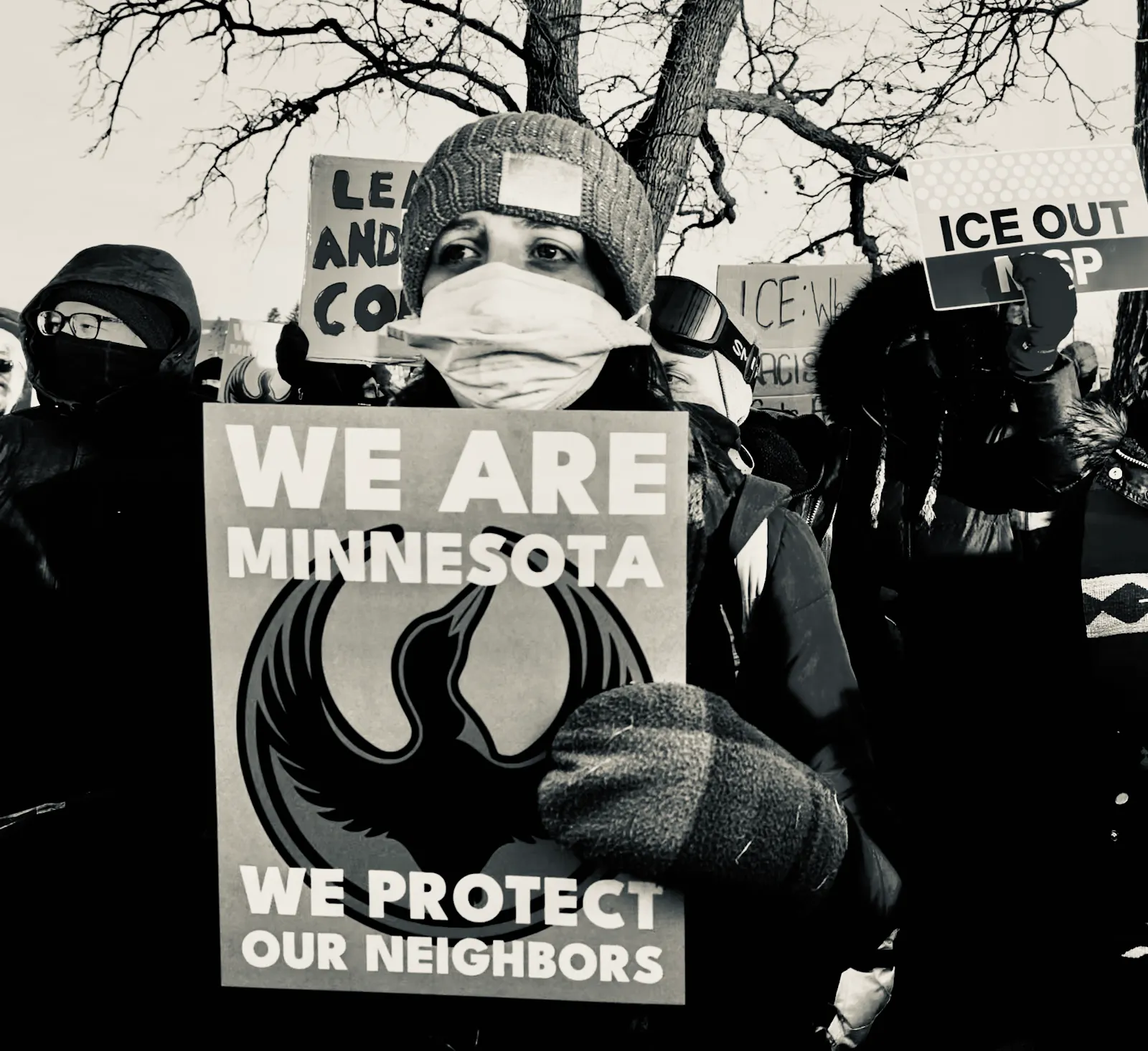
Minneapolis was supposed to serve as a warning to the rest of the nation. But as the resistance is holding, the paramilitary occupation of the city is turning into something different: A window into the weaknesses of the MAGA regime, a case study of the potential limits of violent authoritarianism, and a reminder of what democratic solidarity can achieve.
The raids on Minneapolis started in early December. Then, on January 6, the Department of Homeland Security announced “Operation Metro Surge,” the largest federal “immigration enforcement” operation ever. Acting as the regime’s paramilitary arm, ICE and Border Patrol would impose MAGA dominance on the ground. Yet all the brute force and all the cruel violence have not been able to vanquish the locally organized resistance or break the will of the people of Minnesota. Meanwhile, most of the public has reacted with horror to the images of heavily armed, masked agents of the state terrorizing an American city. Support for Trump (Si apre in una nuova finestra) on immigration has tanked; ICE is vastly unpopular (Si apre in una nuova finestra), even among self-identified independents. The occupation of Minneapolis is galvanizing the resistance against the regime across the country.
The Trumpists have miscalculated. The outcome of the broader struggle against the authoritarian assault remains very much undetermined. But there is no question that the MAGA government has so far failed to achieve its goals in Minneapolis. We can learn a lot from that: About the condition of the regime and the state of societal opposition, about different forms of resistance and how they can succeed. The resistance the Trumpists are encountering in Minnesota – and in more and more places around the country – is a serious threat to the authoritarian project.
Plenty of protests
The day after Donald Trump’s inauguration in 2017, half a million people marched through Washington, DC to protest the new president. The first Women’s March brought out millions across the United States. In the days after Trump’s return to the White House in January 2025, by contrast, the streets of the capital remained mostly empty.
On the surface, this discrepancy seemed to confirm what had been firmly established as gospel in the mainstream political discourse well before Trump’s inauguration on January 20: There would be no large-scale resistance but instead a “distinct lack of dissidence.” (Si apre in una nuova finestra) Even at the time, there was plenty of reason to be skeptical of such a lament, as the “Resistance, Where are thou?” (Si apre in una nuova finestra) narrative was set basically the minute Trump won the 2024 election. People were tired of protesting Trump, we were told – liberal America was “struggling for the energy to resist.” (Si apre in una nuova finestra)
The gleeful aggression with which pundits from across the political spectrum jumped on the chance to declare that “the resistance is dead” (Si apre in una nuova finestra) should have been a clear indicator that there was quite a bit of score-settling going on here – and pundits vying for relevance by presenting grand reckonings rather than careful empirical assessments. There was also a gendered dimension to the critique – a distinctly sexist dismissiveness towards “wine moms” as the backbone of the opposition to Trump: Their political activism from the Women’s Marches to the outrage over the Supreme Court’s Dobbs decision was derided as “cringe,” (Si apre in una nuova finestra) the “Liberal resistance was a joke.” (Si apre in una nuova finestra) Liberal hysteria, so the argument went, had finally exhausted itself.
Most importantly, perhaps, the notion that there were no protests, no potent resistance to Trump, aligned perfectly with the idea that the 2024 election had signaled a lasting rightward realignment, that Trump had a broad “mandate” (Si apre in una nuova finestra) to impose his vision on the country. If you’ll recall, the election was actually very close. Trump won with a narrow 1.5-point margin in the popular vote. And yet, the idea that America had experienced a political “earthquake” (Si apre in una nuova finestra) that demanded far-reaching interpretations became gospel almost immediately. Within days, the country’s leading newspapers and most influential commentators attempted to outdo each other with ever more sweeping narratives, mostly built on vastly inadequate, unreliable data – and a whole lot of personal preference. Trump’s victory, we were confidently told, was the result of lasting societal shifts (Si apre in una nuova finestra) and signaled a profound reordering of American politics, an “American realignment” (Si apre in una nuova finestra) – perhaps even the end of political liberalism (Si apre in una nuova finestra) and the beginning of a permanent Trumpist era in U.S. history.
The thing is: The argument that America had undergone a massive rightward shift was less a factual contention and more an ideological assertion, an article of faith. It has proven to be a stubbornly resistant myth (Si apre in una nuova finestra) that is exceedingly hard to kill. And the same is true for the idea that “there are no protests.” Yes, Democratic Party leadership was still busy deciding whether or not they wanted to fight at all; yes, the pervasive tendency among America’s elites and elite civic institutions to acquiesce was pathetic. But anyone who cared to look at the empirical evidence that was literally gathering in the streets around the country could have seen quite quickly that a lot of ordinary people cared little about the punditry’s handwringing and got organizing.
While it didn’t initially take the form of mass protest in Washington, DC, there is no question that protest picked up significantly during the first year of Trumpism in power. For instance, Harvard University’s Crowd Counting Consortium, established right after Trump first rose to power under the leadership of political scientist Erica Chenoweth to observe the societal opposition to Trump, counted more than 10,000 organized protests (Si apre in una nuova finestra) by the end of 2025 – more than twice as many as in 2017. These included nation-wide mass events (Si apre in una nuova finestra) like the “Hands Off” protests against the DOGE-led destruction of the administrative state in April and the two “No Kings” marches in June and October – the latter turning out around seven million people, making it the largest single-day protest in recent U.S. history.
There have also been, very much right from the start last January, smaller protests in thousands of towns across America. These protests have been far more numerous and far more sustained (Si apre in una nuova finestra) than anything we saw during Trump I – far more geographically widespread also, penetrating even the most rural, Republican-dominated areas. Yet for the longest time, they took place almost entirely below the radar of a political discourse that remained invested in lamenting the supposed lack of resistance.
New forms of resistance
The first year of Trumpism in power also saw the emergence of different forms of societal resistance that aren’t adequately captured by the term “protest.”
Data
08/02/2026
2 commenti
Vorresti vedere i commenti?
Abbonati a Democracy Americana e partecipa alla conversazione.