October 2023
In the heart of Europe, Luxembourg has presented a bold vision for its economic future with the aim to strengthen resilience, inclusivity, and competitiveness by the year 2050. This ambitious objective, entrusted to Luxembourg Stratégie by the minister of economy, requires proactive measures to navigate the complex economic, societal, environmental and spatial transitions ahead. Recognising the risks and challenges posed by rising inequalities, slowing growth, and ecological boundaries, Luxembourg seeks to identify new entrepreneurial opportunities that will safeguard the quality of life for future generations and enhance the country's overall attractiveness.
The ministry of economy established Luxembourg Stratégie with a mission to equip its policies with tools for strategic foresight. This was a long and intensive process, which culminated in the presentation of a vision of Luxembourg’s economy in 2050. The visioning process involved a wide range of stakeholder participation events, a series of scientific background studies, and a set of three possible scenarios.
ECO2050 Vision: Guiding the Transition
The strategic vision ECO2050 - Towards a Resilient, Inclusive, and Competitive Economy (Si apre in una nuova finestra) sets out to reinvent Luxembourg’s economic model to become less carbon-intensive, energy-efficient and environmentally friendly. It offers a compass that aligns various national strategies – including industrial development, research & innovation, energy, climate, mobility and spatial development – towards greater coherence. This vision is constructed on ten pillars that form the foundation of a new economy:
Strategic Autonomy: Promoting domestic production reduces dependence on imports, insulating the economy from international market shocks.
Circularity and Resource Efficiency: Achieving energy and resource savings facilitates compliance with environmental and financial constraints.
Human Focus: Innovations in societal and organizational aspects foster economic activity, attract talent, and preserve a high quality of life.
Integration of Digital, Ecological, and Social Transitions: Building a competitive economy that mitigates the environmental and societal impact of new technologies promotes social and ecological progress.
Critical Redundancy and Strategic Stockpiling: Duplication of solutions and the establishment of reserves for essential goods and services enhance economic resilience.
Administrative Simplification: Streamlining procedures improves the business environment, making the economy more agile.
Economic Diversification: Adapting key sectors to new challenges strengthens the preservation of common goods and the capacity of existing economic players to turn transitions into business opportunities.
Sustainable Economic Diplomacy: Forging close diplomatic and trade ties with partners sharing ecological and social values leverages strengths for global resource governance.
Sound and Sustainable Public Finance: Guarding against budget imbalances enables funding for sustainability efforts and transitions.
Anticipation and Agility: Long-term planning, constant adaptation to rapid changes, and monitoring developments provide a comparative economic advantage by mitigating threats and enhancing opportunities.
Luxembourg's role in sustainable innovation
With its high levels of dynamism, audacity, and economic agility, Luxembourg wants to assume a pioneering role in sustainable and social innovation. However, for this vision to become true, it requires the redirection of investments towards environmentally and biodiversity-friendly technological solutions and socio-economic models.
While technological innovation is seen as key driver of Luxembourg's economic vitality and attractiveness, the vision highlights also the essential role of behavioural change in shaping and strengthening the economy of the future. Low-tech solutions will complement high-tech innovations. Through technological progress, Luxembourg's industry and craftsmanship are called upon to drive technological and energy transitions while exporting climate-friendly solutions and models.
Through circular economy practices, the country aims to meet a significant portion of its essential needs with sustainable, repairable, and robust products. Urban areas will transform, with personal vehicles and traffic congestion giving way to an exceptional network of low-carbon public transportation extended to the Greater Region. Streamlined bureaucracy, shorter pathways, and local services will support entrepreneurship, competitiveness, and resilience. Luxembourg's financial centre will gain global recognition for sustainable investments, while the space sector will contribute to sustainable development on earth and beyond. Agriculture and forests will be preserved, biodiversity will recover, contributing to carbon neutrality and the supply of food and raw materials. Digitalisation and ecology will not be in opposition but mutually beneficial. Infrastructure will be built to last longer, protecting the population from climate-related damages. Health will improve to the point of making Luxembourg a place, where longevity and quality of life are exceptionally high.
The economy will no longer be based on endless accumulation of objects but on individual development and fulfilling employment crucial to the success of transitions. By embracing simplicity and adopting new consumption patterns, new opportunities will emerge.
The spatial diversity of the vision
Even in a small country like Luxembourg, such an ambitious economic vision will play out differently in different parts of the country. It has spatial implications and it needs to consider spatial preconditions which vary across the country.
What are its territorial and economic strengths for building an autonomous, resilient, inclusive, and competitive economy by 2050?
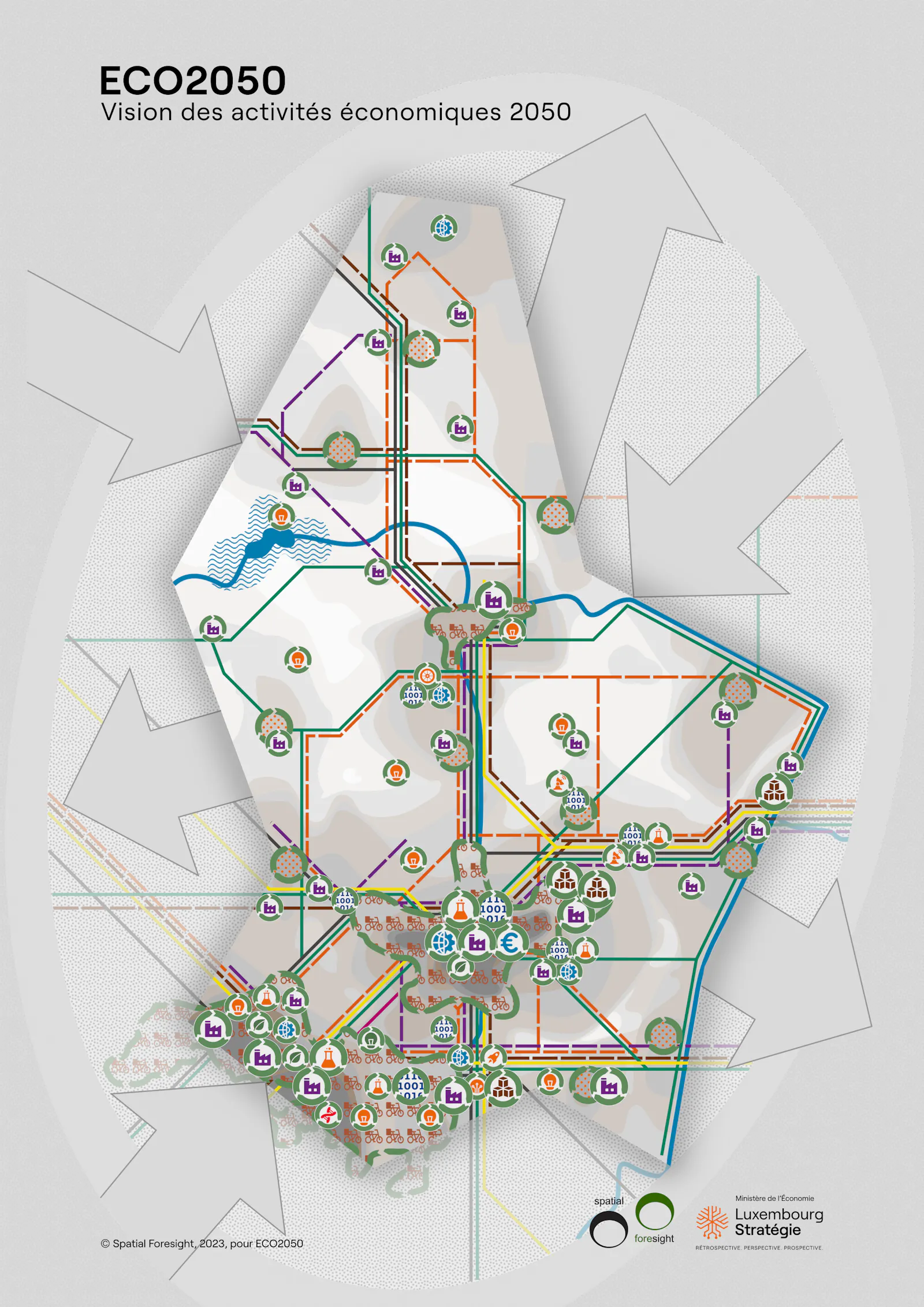
To answer this question, it is necessary to identify the spatial structures that currently support autonomy, resilience and inclusion, while understanding which parts of Luxembourg are already well-prepared for 2050.
Communication axes: Luxembourg is structured around two main axes: north/south and east/west. These axes concentrate transportation infrastructure, energy flows and the fiber optic network. They also connect the three major agglomeration areas, places of action and interaction. In the vision the importance of the axes is likely to increase, especially concerning the need to make the infrastructure networks more efficient, sustainable and resilient.
Agglomerations: Luxembourg has three main urban agglomerations: Luxembourg city, the agglomeration around Esch-sur-Alzette in the South, and the agglomeration around Ettelbruck and Diekirch on the way North. It is within these hubs that economic and social life predominantly thrives. Looking at the economic activities boosted in the vision, these three agglomerations will continue to concentrate and polarise most of the leading developments.
Secondary urban centres: Secondary urban centres (so called CDAs) play a vital role in providing access to public services and social interaction. CDAs can contribute to a more balanced spatial distribution of economic activities, public services, housing, as well as public facilities and infrastructure. However, the specific role of each CDA is yet to be defined. While the three urban agglomerations are seen as the centred points of the economic transition presented in the vision, also the CDA´s play an important role not at least as concerns crafts and circular economy industrial zones. CDAs located near major transport routes, for example, are likely to develop commercial and logistical functions. In border areas – and Luxembourg has many border areas – CDAs serve as vital nodes for cross-border flows (e.g. transportation and energy, ecological continuity). This is important as cross-border living and working is expected to intensify in the years to come.
Rural areas: Most of the population in Luxembourg already has access to fiber optic internet, and the entire territory is expected to be covered in the coming years. Digital transformation is enabling service-based businesses to leave urban areas. Some may choose to establish themselves in CDAs or their vicinity, working from home, shared public spaces, or as digital nomads. Thus, a lot of the changes proposed in the vision will also imply new economic possibilities in rural areas. However, they are not expected to be at the forefront of the transition.
Communication hubs: Luxembourg’s economy is highly integrated in international value chains. Therefore, transport hubs play a crucial role. There are four international logistics hubs, including an international rail-freight transport hub, the airport with a huge cargo hub, a road-cargo hub, and the port of Mertert. They are situated along the main communication axes, facilitating internal and external flows of goods. Their role as international green transport hubs is expected to grow in future.
Greater Region: The performance of Luxembourg’s economy is closely tied to networks of exchange and cooperation connecting it to the Greater Region, the EU, and the global economy, both for exports and imports. The current organisation of Luxembourg's territory reflects this international openness. The vision pictures also in future Luxembourg to be tightly integrated in international flows and value chains. In particular in boarder areas, the integration of the places across national borders is expected to intensive and national borders to lose relevance.
Conclusion
The transformation outlined in this vision is a forward-looking project which only can become a reality if a wide range of public and private players engage with it. Luxembourg's journey towards a resilient, inclusive, and competitive economy by 2050 is a commitment to a sustainable future that promises a better quality of life for all its citizens. At present it still does pay rather little attention to its spatial dimension, i.e. which places can contribute how, benefit or lose in the envisage future. For the vision to be successful, it needs to look beyond the economic aspects and also understand the spatial dimension and dynamics.
by Kai Böhme
https://steadyhq.com/en/spatialforesight/posts/9beeadeb-be44-439e-be5d-96d35f78ac07 (Si apre in una nuova finestra)https://steadyhq.com/en/spatialforesight/posts/68f4d8d3-e066-4df3-a554-3fba727fb916 (Si apre in una nuova finestra)
Data
17/10/2023
Argomento
Scenarios & visions
0 commenti
Vuoi essere la prima persona a commentare?
Abbonati a spatialforesight e avvia una conversazione.