July 2026
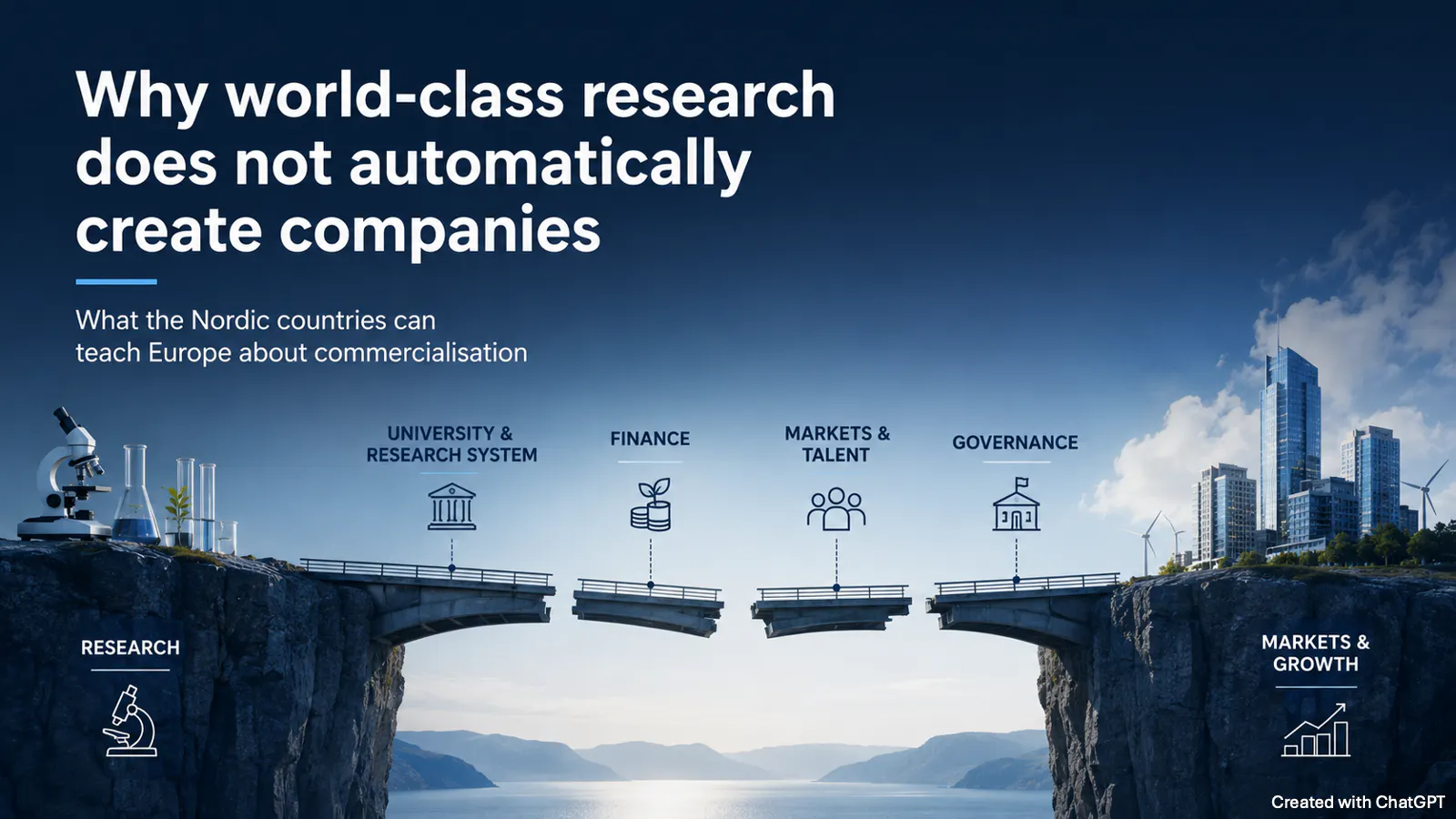
The Nordic countries are among the world's strongest research economies, yet they struggle to turn that research into globally competitive companies. That gap is the clearest illustration of what may be Europe's real competitiveness problem.
Competitiveness has become a central concern of economic policy in Europe. In his report, The Future of European Competitiveness, Mario Draghi argues that Europe’s long-term prosperity increasingly depends on its ability to transform scientific excellence into innovation, industrial renewal, and globally competitive firms.
Consequently, much of the current policy debate focuses on increasing investment in research and development. This is undoubtedly part of the solution. However, it may not address the main bottleneck. The experience of the Nordic countries suggests that the more fundamental challenge lies in the transition from research to market.
While Europe continues to perform well in scientific research, it has been considerably less successful in translating knowledge into commercial success. European venture capital markets remain substantially smaller than those in the United States, and between 2008 and 2021, almost 30% of European unicorns relocated their headquarters abroad, primarily to the US.
A recent study commissioned by Nordic Innovation (Si apre in una nuova finestra) provides valuable insights into commercialisation for Denmark, Finland, Iceland, Norway and Sweden. These lessons are largely applicable to other parts of Europe too.
Strong research does not automatically lead to commercial success
The Nordic countries are consistently among the strongest innovators in Europe. They combine substantial investment in research with well-developed universities, robust public institutions, and a highly educated workforce. As measured by traditional innovation indicators, they represent one of Europe’s strongest knowledge economies.
If research intensity alone determined commercial success, one might expect the Nordic countries to generate a correspondingly high number of globally successful companies.
However, the evidence suggests a more nuanced picture. Despite their scientific strengths, the Nordic countries face many of the same commercialisation challenges as the rest of Europe. Promising research often struggles to become marketable products and services, young companies find it hard to attract specialised investors and grow internationally, and innovation ecosystems often fail to convert scientific excellence into sustained economic value creation. As a recent Nordic Innovation report concludes, the challenge lies not primarily in research capacity, but in the conditions that determine whether knowledge can successfully move from laboratories to markets.
The Nordic experience offers an important lesson in this regard. High-quality research is clearly a necessary condition for innovation. However, it is far from a sufficient one.
Commercialisation is an ecosystem challenge
One of the study's key findings is that commercialisation should not be viewed as a single step between research and business. Instead, it is the result of interactions within a broader innovation ecosystem comprising universities, firms, investors, public authorities, intermediaries, and customers.
The study identifies four broad categories of barrier that consistently affect commercialisation across the Nordic countries.
University and research incentive system. Academic career structures continue to reward publications and scientific excellence more than entrepreneurial activity or commercial impact. Researchers often lack the incentives, experience or institutional support to pursue commercial opportunities. At the same time, commercialisation is often seen as conflicting with academic careers rather than being complementary to them. Consequently, promising research with commercial potential may never enter the innovation pipeline, not because the underlying science is weak, but because the institutional environment provides little incentive or support for pursuing market applications.
Finance and investment ecosystems. Financing instruments are often fragmented, early-stage risk capital remains limited and investors with deep expertise in the relevant fields are relatively scarce. Although research funding is generally available, many ventures struggle during the transition from proof of concept to commercial validation. This period is often referred to as the 'valley of death'. Furthermore, the issue is not only one of insufficient capital, but also of ensuring that the appropriate forms of finance, with the right level of risk appetite and sector expertise, are available at the right stage of a company's development.
Market size and human capital. Small domestic markets make it difficult to validate and scale innovative products, and a shortage of experienced entrepreneurs and commercialisation specialists reduces firms’ ability to grow internationally. Consequently, many Nordic companies need to internationalise at a very early stage, often before their products, business models and organisational capacities have fully matured. At the same time, commercial expertise for emerging sectors and young technology firms is often limited due to experienced talent being concentrated in established industries.
Regulatory and governance frameworks. Public support systems are often fragmented and difficult to navigate, which increases transaction costs and reduces transparency for innovative firms and investors. Different funding programmes, intermediary organisations and support schemes often operate alongside one another without sufficient coordination, which makes it hard for companies to identify the right support at every stage of the commercialisation process. The challenge is not a lack of public initiatives, but the absence of coherent pathways to help firms move efficiently from research to market.
Insufficient incentives for commercialisation reduce the number of projects entering the pipeline. Limited access to finance slows their progression. Small markets increase commercial risks and reduce investor interest. Furthermore, fragmented support systems increase complexity and uncertainty. The result is not a single bottleneck, but rather a series of interconnected constraints that diminish the effectiveness of interventions throughout the commercialisation process.
Commercialisation is a systemic challenge rather than the consequence of a missing policy instrument.
Beyond research funding
If commercialisation is understood as an ecosystem challenge rather than a sequence of isolated market failures, policy responses also need to become more systemic. The objective is not simply to strengthen individual policy instruments but to improve how the different components of the ecosystem interact.
Calls for increased investment in research are justified. Similarly, improving access to venture capital remains important. However, neither of these measures is likely to resolve Europe’s commercialisation challenge on its own.
Instead, greater attention needs to be paid to the quality of commercialisation ecosystems. These include incentive structures within universities, technology transfer capacities, specialised investment communities, entrepreneurial competencies, regulatory simplicity, and access to markets. Progress depends not only on strengthening individual components, but also on improving the connections between them.
For the Nordic countries, the study identifies an additional opportunity. Individually, each country represents a relatively small market. However, collectively, the Nordic region constitutes a much larger innovation ecosystem. Therefore, stronger cross-border cooperation between investors, universities, technology transfer organisations, commercialisation experts and innovative firms could increase access to specialised competencies and enlarge the effective market available to innovative companies. Rather than replacing national policies, Nordic – or even European – cooperation could reduce fragmentation and strengthen ecosystem connectivity.
Implications for European competitiveness
The Nordic experience has implications that extend far beyond Northern Europe.
The current debate on European competitiveness often focuses on increasing research intensity and supporting cutting-edge technologies. Both are important objectives. However, if the commercialisation environment remains fragmented, Europe risks producing excellent research while much of its economic value is realised elsewhere.
Strengthening European competitiveness therefore requires a broader understanding of innovation policy. While scientific excellence remains indispensable, equal attention must be given to the institutional, financial, and governance conditions that enable ideas to become businesses.
This perspective also has implications for the future European Competitiveness Fund and European Cohesion Policy. Innovation has long been a central EU policy priority, often through investment in research infrastructure and regional innovation capacity. Looking ahead, greater emphasis could be placed on strengthening regional commercialisation ecosystems, which, in many cases, could build on smart specialisation strategies. This would involve supporting collaboration between universities and firms, developing intermediary organisations, improving access to specialised competencies and finance, facilitating public procurement for innovation and strengthening cross-border innovation networks. The aim would be to focus more on addressing the conditions that determine whether knowledge ultimately creates economic value.
The Nordic countries demonstrate that robust research systems alone do not ensure commercial success. Their experience suggests that Europe’s competitiveness challenge is not solely about generating more knowledge. It is equally important to create the ecosystems that allow knowledge to move efficiently from research to markets, from innovation to business, and ultimately to sustainable economic growth.
by Kai Böhme
 (Si apre in una nuova finestra)
Data
09/07/2026
Argomento
Resilience & transition
0 commenti
Vuoi essere la prima persona a commentare?
Abbonati a spatialforesight e avvia una conversazione.