Aprill 2026
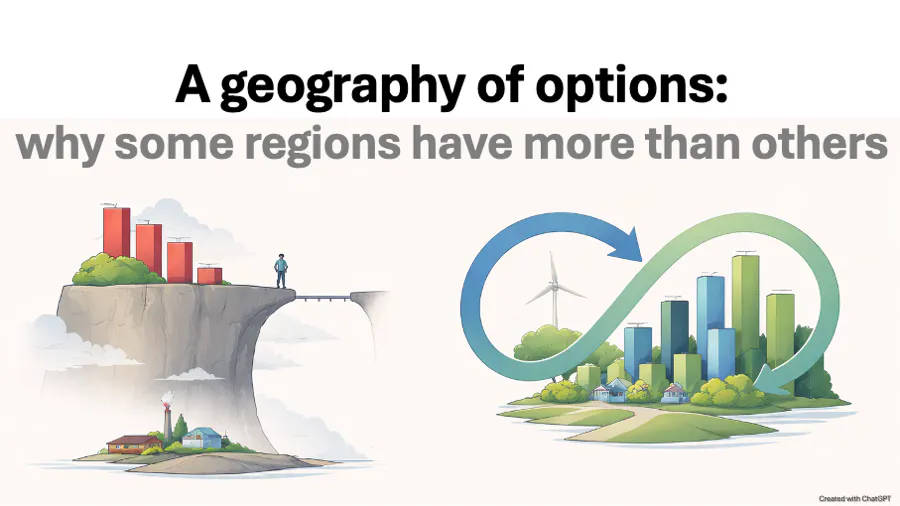
Persistent regional disparities are a defining feature of Europe's economic landscape. While some regions continue to grow and diversify, others struggle to keep pace. The dominant explanation has long been framed in terms of gaps in productivity, innovation, or investment. In recent years, the focus has increasingly shifted towards the concept of 'development traps', which considers development over time rather than at a single point in time. Regions facing development traps tend to have lower GDP growth, productivity and employment per capita than the EU, their own country and themselves in previous periods (see the earlier blog post on a more dynamic typology of regions for Cohesion Policy (Si apre in una nuova finestra)).
From lagging behind to being structurally constrained
Based on these ideas, Balland and Boschma published a paper in late 2025 on an evolutionary approach to regional development traps in Europe (Si apre in una nuova finestra), taking the debate one step further. They invite us to fundamentally rethink the issue (Rather than focusing on outcomes such as GDP or employment, they argue that the real challenge lies in regions' capacity to evolve. In their words, regional traps are not merely about low growth, but about regions' structural inability to develop new, complex activities.
Following this shift in thinking, we should reconsider how we understand territorial development and how we design policy.
Traditional approaches to regional disparities tend to assume that, in principle, all regions can converge given sufficient time, investment, good governance, and policy support. Put more bluntly, except for regions with permanent geographical disadvantages, regions may be behind, but they are not fundamentally different.
The evolutionary perspective challenges this assumption. Regions accumulate capabilities over time, such as skills, institutions and industries, that shape what they can realistically do next. As a result, some regions face structural limits in moving into more advanced activities.
This is a crucial distinction. It suggests that disparities are not only about levels of development, but also about future options.
Multiple traps and a geography of future perspectives
One of the paper's most important contributions is moving beyond the one-size-fits-all notion of regional development traps. Instead, it identifies different types of trap depending on two key dimensions:
Economic complexity. How advanced and knowledge-intensive is the regional economy?
Relatedness. How easily can a region diversify into new activities based on existing capabilities.
Combining these dimensions leads to a typology of regional trajectories. This typology reveals that regions face fundamentally different structural conditions. Treating them as if they were the same carries the risk of ineffective or even counterproductive policy.
Structural traps. Regions with low complexity and few diversification opportunities. These are the most constrained territories, with limited prospects for transformation. Many less developed regions in Eastern Europe, such as those in Romania, Bulgaria, Hungary, Slovakia, Poland and Greece, are considered to be 'stuck in a structural trap'. However, this also applies to some regions in Portugal, southern Italy, and Austria.
Low-complexity traps. Regions that can diversify, but mainly into low-value activities. Growth may occur, but upgrading remains elusive. These traps are most commonly found in Eastern Europe, for example in regions of Croatia, the Czech Republic, Poland, Estonia, Latvia, Hungary and Bulgaria, but also in regions of Spain, Italy, Sweden and Austria.
Low-relatedness traps. These are regions with relatively advanced economies, but weak connections between activities. Past success does not translate into new opportunities, making them vulnerable. Most of these regions are located in the more peripheral parts of Western European countries such as France, the Netherlands, Germany, and Belgium. These regions offer limited opportunities to work in industries of varying complexity.
Complexity loops. Regions that combine high complexity with strong diversification potential find themselves in a complexity loop rather than a trap. More developed regions often find themselves in a 'complexity loop'. This includes almost all capital and major urban regions. Many regions in Germany (including eastern Germany), as well as some regions in the Netherlands (the major urban areas), Belgium (part of Flanders), Italy (Piedmont, Lombardy and Emilia-Romagna), Sweden (the north and south-west) and Spain (the Basque Country and Catalonia), are in a 'complexity loop'.
Summing up, the territorial patterns emerging from this analysis indicate a fragmented geography of future prospects. Regions in complexity loops tend to be concentrated in major urban areas and capital regions across Europe. These places benefit from dense capability bases and multiple pathways for diversification. They are not only richer; they are also structurally better positioned to adapt.
By contrast, many regions in Eastern and Southern Europe are caught in structural or low-complexity traps. Their economies are less complex and have limited options for improvement. Meanwhile, parts of Western Europe — often outside the main metropolitan areas — display characteristics of low-relatedness traps, where advanced but fragmented economic structures prevail.
The result is an increasingly divided Europe, not only in terms of income, but also in terms of adaptive capacity. Some regions have expanding opportunity spaces, while others face narrowing ones.
The persistence of regional trajectories
Examining the evolution over time reveals a high degree of stability in these patterns.
Most regions remain in the same category over time. Transitions between different types of trap are rare. Escaping a trap, particularly a structural one, is the exception rather than the rule.
This reflects the deeply embedded nature of regional capabilities and institutions. It also raises uncomfortable questions about the effectiveness of existing policy frameworks. If structural conditions are so stable, then incremental interventions may not be sufficient to trigger meaningful change.
Furthermore, the paper shows that the relationship between traps and economic performance is more nuanced than expected. Regions in complexity loops generally perform better in terms of employment and wage growth. However, some 'trapped' regions still experience growth, particularly in wages, which often reflects convergence dynamics from a low base.
This suggests that growth alone is not a sufficient indicator of structural transformation. Regions can grow without fundamentally altering their economic structure, which leaves them vulnerable to future shocks and long-term stagnation. In other words, not all growth is equal.
What does this mean for policy?
The first implication is that place-based policies need to be more sensitive to the specific circumstances of each location. Tailoring interventions to local conditions is not enough; policies must also reflect the structural position of regions within their development trajectories.
Different traps require different strategies.
Regions in structural traps may require bold, high-risk interventions, including investments in new capabilities and stronger connections to external knowledge networks.
Regions in low-complexity traps may benefit from targeted upgrades to more complex niches, building on existing strengths.
Regions in low-relatedness traps require efforts to reconnect fragmented capabilities and foster new combinations.
Regions in complexity loops need support to remain at the frontier and avoid new forms of lock-in.
This shifts policy away from generic recommendations such as 'more innovation' or 'better governance' towards more specific, strategic interventions.
The broader implication is more challenging: Cohesion policy has long been based on the idea of convergence, namely that all regions can catch up with the right support. However, the evolutionary perspective suggests that this assumption may no longer hold universally.
If some regions face structural limits to diversification, policy must confront difficult choices. Should the focus remain on transforming places? Or should greater attention be given to connecting people and firms to opportunities elsewhere? In such a context, how should policy balance efficiency, equity, and territorial cohesion?
These are not purely technical questions. They lie at the heart of the European project.
Towards a policy of regional evolution
The key message is not that some regions are destined for stagnation. Rather, it is that development is a dynamic, path-dependent process shaped by capabilities accumulated over time. Therefore, policy should not only aim to support growth, but also to enable evolution.
This requires a shift in mindset, moving from closing gaps to expanding opportunities and from supporting places as they are to enabling them to evolve. The challenge is not simply to make regions grow. It is to make them capable of change.
by Kai Böhme
 (Si apre in una nuova finestra)
Data
16/04/2026
Argomento
Cohesion (policy)
0 commenti
Vuoi essere la prima persona a commentare?
Abbonati a spatialforesight e avvia una conversazione.