October 2025
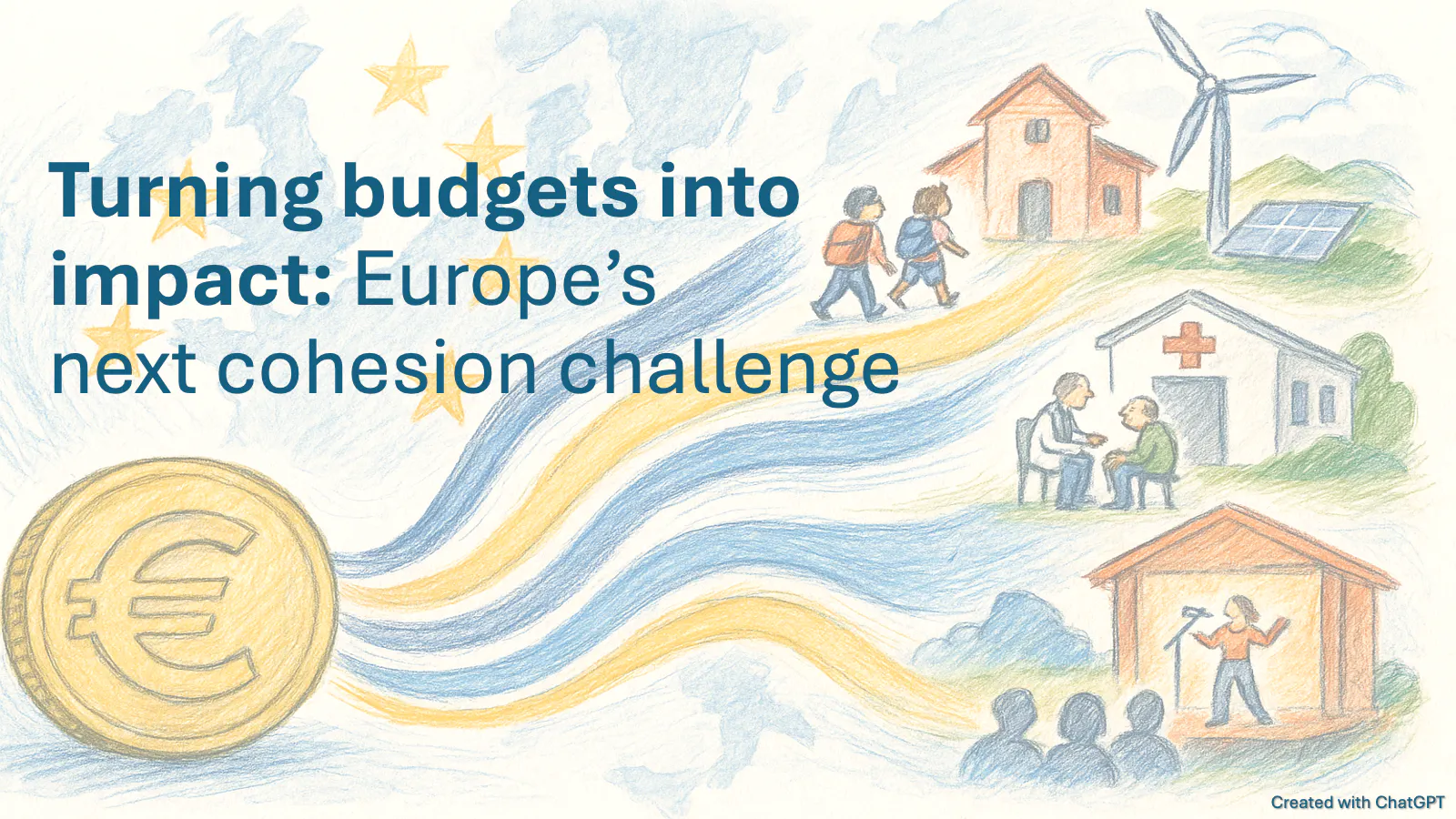
Within the EU and the wider continent, cleavages between different types of places are on the rise. Beyond territorial fragmentation, rising populism, democratic backsliding, inequality, and questions of identity strain the social and political fabric holding the European project together.
Taken together, these pressures form a kind of multi-layered stress test for Europe, with their interconnected nature requiring equally integrated solutions. If poorly managed, they risk creating further social and cultural rifts, feeding populism and weakening cohesion. Europe cannot afford to lose sight of these interlinked trials and the scenarios required to respond to them.
The European Commission has responded by proposing a budgetary architecture, which could provide a basis for a more ambitious mission-driven policy agenda (see also an earlier blog post on the MFF (Si apre in una nuova finestra)). Whilst ambition has been commanded, there are also suspicions as to the ability of the current (politically weak) Commission to deliver. The Commission proposes a Multiannual Financial Framework (MFF) amounting to almost EUR 2 trillion (or 1.26% of the EU’s gross national income on average between 2028 and 2034), though much remains open and strong Member State opposition – notably from Germany – makes agreement uncertain.
The Commission’s MFF proposal introduces structural changes — National and Regional Partnership (NRP) Plans, large strategic funds and a significantly enlarged crisis/resilience instrument — that materially increase the potential for mission-oriented, cross-sectoral and resilience/wellbeing focused policy. But realising that potential depends on how the Commission and Member States translate the new instruments into Plan requirements, governance arrangements, outcome metrics and adaptive financing tools (see also an earlier blog post on the NRP Plans (Si apre in una nuova finestra)). The proposal provides the architecture; implementation choices will decide whether the EU actually spends for impact and wellbeing, rather than just re-labelling inputs.
All these changes are intended to make the MFF more effective in addressing the above challenges. This calls for discussing the MFF proposal in the context of impact-based policy design and delivery (see the earlier blog post on wellbeing (Si apre in una nuova finestra)). Along these lines of thinking, there are a number of potential scenarios for utilising the structural enablers underlying the EU budget proposal. In the following, we explore one such possible scenario. More scenarios will follow over the next few weeks.
MFF Scenario 1:
Partnership Plans as a vehicle for impact-driven EU policy
Europe is currently facing a multi-layered stress test. External security threats, persistent fractures in cohesion, fiscal pressures from ageing societies and the transition to sustainability together create this test. The question is not whether the EU should do 'more' or 'less', but whether it can do things differently. Responding to these issues requires more than isolated policies. What the EU needs is an impact-driven framework that links reforms and investments into coherent missions, delivering measurable improvements to people's lives and to the territorial fabric of the Union.
Against this backdrop, the MFF architecture has been reorganised into major pillars, with the NRP Plans forming the core 'domestic investment and reform' channel, alongside a Competitiveness Fund (e.g. Horizon Europe), a Global Europe pillar and the EU administration.
The Commission proposes integrating key shared-management funds into 27 NRP Plans (one per member state), plus a dedicated Interreg Plan. The intention is to transition from hundreds of operational programmes under various funds (including ERDF, ESF+, EAFRD, EMFAF, etc.) to 27 NRP Plans that sequence interventions around clearly defined results, offering greater flexibility in response to shocks and a stronger performance orientation.
The proposal for NRP Plans is more than a technocratic rewrite. They are not an additional appendix — they are the primary means of territorial investment under shared management.
The concept of the NRP Plans is highly contentious within the cohesion policy community. However, viewed from a distance, they could potentially overcome the current deadlock of policy silos and become a structural enabler. If properly designed, the NRP Plans could provide the framework for impact-driven, place-based missions across Europe. The risk, of course, is that they devolve into another cycle of ticking boxes. The path they take will be a political and governance choice, not an inevitable consequence of the drafting process.
Conceptually, this represents a significant departure from siloed programming. But will it deliver impact rather than administrative simplification alone?
From spending lines to a stronger impact focus
In a positive scenario, the NRP Plans could provide an apt opportunity and turning point towards more impact-based policymaking. In order to pass Europe’s stress test, the NRP Plans must function as ‘impact compacts’, which are time-bounded, multi-actor agreements that bind ministries, regions, cities, agencies and social partners to a small set of shared outcomes (e.g. reducing excess mortality in underperforming regions, decarbonising heating for low-income households and halving skills mismatches in areas undergoing industrial transition). They would:
Align EU, national and regional trajectories on wellbeing, sustainability, and resilience. This is the main rationale and “why” behind investments.
Sequence reforms and investments across policy fields (transport, energy, health, social policy and research and innovation), replacing one-off projects with coherent, mission-style portfolios. Lessons from integrated policy approaches in various parts of the EU and beyond demonstrate the advantages and limitations of this coordinated approach.
Provide a single mechanism for monitoring of outcomes trajectories – not just financial absorption – at meaningful territorial scales.
Build the basis for anticipatory governance by embedding foresight, risk scanning and adaptive reallocations.
Ensure a rigorously place-based approach, with co-design and implementation by regional and local stakeholders who are best placed to understand the territorial conditions.
This does not need to be fantasy. Small states and devolved systems are already experimenting. For example, Scotland’s National Performance Framework (NPF) sets wellbeing outcomes to inform budget choices, although scrutiny bodies still demand a tighter link. Nevertheless, the architecture for outcome-based budgeting already exists. Finland has adopted an 'economy of wellbeing' approach, integrating social, ecological and economic indicators into decision-making processes. The EU can learn from these experimental models while increasing its level of ambition in policy and impact terms.
A sceptical read: territorial risks we should not gloss over
A policy architecture is only as good as its political economy. Three territorial risks deserve honest acknowledgement:
Recentralisation by design or drift. Merging multiple programmes into one national plan can facilitate coordination and by so doing improve the overall impact, but it can also transfer influence from regions and cities to national capitals. Regional stakeholders and the Committee of the Regions have already expressed concerns about losing control over cohesion spending under the new budget structure (see also (Si apre in una nuova finestra)). Careful co-governance clauses will be decisive.
Mission creep towards security without sufficient territorial balance. Europe is rightly shoring up defence-related capabilities. However, the flexibility to allow cohesion-adjacent resources to pivot towards dual-use or security priorities must not undermine long-term place-based investments, particularly in vulnerable regions. The political pressure to do so is real.
Allocation shock and east–west tensions. A reweighted formula that moves resources eastwards and towards border/pressure states may be justified by geopolitical exposure, but it could create losers among other member states with significant internal disparities (consider lagging regions within wealthy countries). Capped adjustments limit volatility, but they do not eliminate political considerations. Transparent management of these distributional effects is essential.
The Interreg element of the European cohesion agenda provides a partial counterweight in the form of cross-border cooperation, which remains visible with a dedicated plan. However, the budget is limited, and integration with national missions will require active management to prevent fragmentation along borders and within macro-regional strategies.
What would make NRP Plans actually work?
To convert the architecture into impact, the following design tests should be hardwired into the NRP Plans and their implementing rules:
Outcome hierarchies anchored in place. Define a sufficiently limited number (e.g. three to five) national missions with territorially disaggregated targets (regions or functional territories, not just national targets). Ideally missions would be such that they are capable of mobilising, bringing together and inspiring into action a diverse set of partners, organisations and individuals to work towards a shared goal and with a capacity to self-organise to build a some kind of functioning governance structure towards working together. In order to work in a coordinated fashion, it would also be beneficial if the impacts of such shared missions could be transparently shared and unpacked into impact chains and frameworks, which are built around a theory of change and credible and evidence-informed logics, including the publication of baselines and trajectories in open data. This is where the NRP Plan with their focus on outcomes first, then spending, might help.
Statutory multi-level co-design. Each mission must include a regional compact that clearly states who is responsible for what, when and how, with transparent selection of territories (including rural and peripheral areas, as well as cross-border functional regions). Participation must extend beyond consultation; the governance text should specify veto points and dispute resolution procedures. The AER’s warning on uneven participation is a signal to design for inclusion, not hope for it.
Portfolio logic and sequencing. Move beyond project lists to portfolios that combine reforms, enabling investments and diffusion instruments (such as standards, procurement and skills) with milestone logic similar to that of the RRF, but with stronger territorial metrics and learning loops.
Resilience and criticality screening. Given Europe’s risk landscape, apply a resilience lens to mission portfolios, considering redundancy in energy and digital networks, climate-proofed transport hubs and health systems with surge capacity, all mapped explicitly onto vulnerable territories. The Commission’s cohesion diagnostics already recognise territorial diversity, and this should now govern prioritisation.
Adaptive performance management. Establish annual 'impact reviews' with a clear focus on anticipatory governance (Si apre in una nuova finestra) to allow reallocation within the NRP Plan when developments lag or shocks occur. Performance bonuses should consider not only the 'here and now', but also have a clear focus on transformative change (see also earlier blog post (Si apre in una nuova finestra)).
Reward transformative missions. Foster mission-oriented roadmap processes, which may involve decision-making where costs and benefits are separated by long time lags, and even spatial lags in some cases. The actual benefits of transformative actions often have a considerable time lag and do not necessarily occur in the same place as the action or investment. Today's actions and costs are linked to long-term benefits that may occur elsewhere, which should also be reflected in the impact frameworks designed and used, requiring more sensitivity to contextual factors and long-term commitment to mechanisms of change.
A forward-looking territorial agenda
This is certainly just one scenario of how the MFF could become more impact-based and mission-oriented, utilising the potential of NRP plans. Consider how this could look in practice:
Mission: Heat decarbonisation in energy-poor regions. Combine ERDF-backed building renovations, ESF-funded installer upskilling and targeted CAP rural measures to avoid rural lockout, sequenced region by region with municipal delivery agencies.
Mission: Strategic mobility corridors for security and prosperity. Invest in dual-use rail and bridge upgrades where military mobility and trade bottlenecks coincide, and develop drone corridors for dual use purpose. This idea is subject to strict additionality criteria to ensure that cohesion goals are not crowded out. Cross-border governance via Interreg should be the default where corridors traverse borders.
Mission: Renewed agenda for education and skills for industrial transformation. These examples are not about 'shiny projects', but about territorial problem solving: diagnosing bottlenecks and aligning instruments over several years to improve outcomes that matter to communities themselves and are bottom-up and social in their nature.
Mission: Cultural industries for territorial capital. These could mobilise Europe’s cultural and creative sectors (from film and media to performing arts or cultural heritage, even food and tourism) as catalysts of place-based development. Such missions would encourage regions and cities to use cultural industries not just as symbolic assets but as engines of innovation, cohesion, and sustainable growth, linking local film projects, festivals, and production hubs with broader initiatives like the European Capitals of Culture.
These examples are not about 'shiny projects', but about territorial problem solving: diagnosing bottlenecks and aligning instruments over several years to improve outcomes that matter for communities. By connecting EU-level support with regional strategies, the idea would be to maximise the potential for cross-sectoral impact by turning investments into lasting territorial capital: strengthening local identities, boosting employment, attracting tourism, and enhancing Europe’s soft power while ensuring that cultural benefits are reinvested in communities.
The bottom line
If NRP Plans are treated merely as an administrative simplification, they will disappoint and could even centralise power in ways that undermine Europe’s place-based tradition. However, if they evolve into impact compacts, co-designed with regions and cities, anchored in well-being and resilience outcomes, and managed adaptively, they could bridge the gap between programmes and missions. This would represent a turning point, with spatial development policies serving a broader vision of cohesion and resilience. In this model, Europe's territorial diversity would be treated not as a constraint to be managed, but as the canvas on which impact is delivered.
What do you think about this? More scenarios will follow in the coming weeks. Stay tuned.
by Kaisa Lähteenmäki-Smith & Kai Böhme
 (Si apre in una nuova finestra)
Data
20/10/2025
Argomento
Cohesion (policy)
0 commenti
Vuoi essere la prima persona a commentare?
Abbonati a spatialforesight e avvia una conversazione.