January 2023
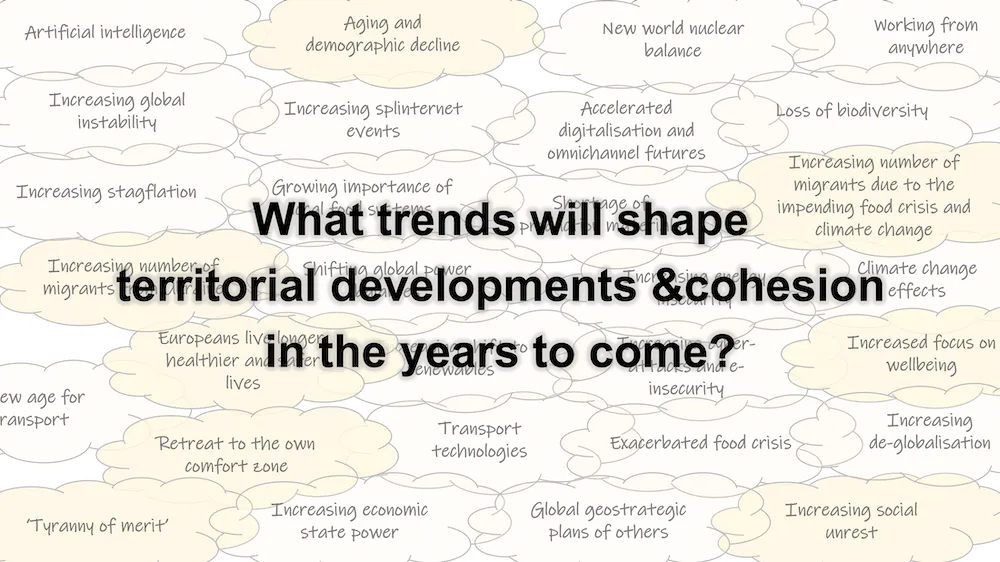
Following up on the blog posts on technological (Si apre in una nuova finestra) and environment related (Si apre in una nuova finestra) trends shaping territorial cohesion, this blog post addresses a collection of societal and demographic trends. The collection is based on various studies addressing mega-trends which we have conducted during 2022, e.g. for the European Parliament (Si apre in una nuova finestra), the European Committee of the Regions (Si apre in una nuova finestra) or ESPON (Si apre in una nuova finestra). Bringing together the various pieces of trend analysis provides a rich picture about possible developments which may shape territorial development and cohesion in Europe.
Trends considered to have the strongest impacts on territorial development and cohesion include exogenous technological trends (e.g. digital society, post-carbon and circular economy), social change (e.g. migration, aging, fluid social institutions and shifts in values), environment (e.g. adapting/mitigating climate change and managing scarce resources), and economic (e.g. slowbalisation, peak of everything, working from anywhere). Also political trends play an important role, both political developments in Europe, as well as those in other parts of the world which affect development prospects in Europe.
The combined picture which emerges from this suggests that future trends are likely to exacerbate spatial and societal fragmentation, interdependencies and policy mismatches. In many regards, the trends point to a risk of increasing concentration on urban areas with growing territorial imbalances and inequalities, which may translate into social fragmentation and increasing discontent. This also risks to increase perceptions of uncertainty and vulnerability in a world of disruptive changes leading to ‘pervasive uncertainties’.
From a global perspective, while some countries and societies will increasingly age, others will have low median ages. The most attractive and fastest growing centres are expected to not be in the EU and may increasingly attract talents from Europe. At European level, ageing will remain the key influence on demographics with significant impact on pension systems, social values and lifestyles. Other European trends refer to increasing migratory pressures, for both external and internal migration. As a result of these trends, retrospective political values may continue to rise across Europe in the coming years. Taken together, demographic trends have a negative impact on territorial development objectives. Asymmetric global demographic growth can result in further fragmentation across spaces. Similarly, these trends exacerbate interdependencies across territories or even ignore them (when it comes to closing borders), stressing at the same time a misalignment of geographical jurisdictions for decision making.
Demographic trends
Some of the societal and demographic trends to be considered:
Aging and demographic decline. As already discussed in an earlier blog posts (‘Prepared for population decline? (Si apre in una nuova finestra)’ and ‘Demographic decline will influence territorial futures’ (Si apre in una nuova finestra)) this will be a growing concerning for European municipalities, regions and even countries. Eurostat’s long-term population projections point to a small population increase in the EU-27, from 447 million inhabitants in 2019 to peak around 449 million in 2026. Thereafter, numbers are expected to decline, gradually decreasing to 441 million in 2050 and 416 million in 2100. Basically, by 2050 77% of NUTS3 areas in the EU will be dealing with population decline or shrinkage. This has direct impacts on the labour market, health and social care, the quality of life of citizens, the housing market, education, childcare and eldercare, as well as the EU’s position in the world.
Europeans live longer, healthier and safer lives. Aging is accompanied by increasing life expectancy at birth. The projections for 2070 are 86.1 years for men and 90.3 for women. This trend may pause due to the current energy crisis and recession. Nonetheless, the EU is on the verge of a silver tsunami, where elderly dominate the demographic picture. By 2070, an estimated 30% of people will be over 65, while the working age population is projected to decrease to 51% by 2070. As birth rates are expected to further decrease, keeping a constant (working age) population size will be challenging without signification global immigration.
Increasing number of immigrants from Ukraine. Millions of Ukrainians have fled their country since the outbreak of war. In the short term, such an influx puts additional pressure on EU countries hosting refugees, and requires extra efforts from administrations and people in the regions where they arrive first and then where they end up living. However, in the medium- to long-term the refugees might also be a welcome addition to the labour market and temporarily cushion some effects of demographic aging and decline.
Increasing number of immigrants due to the impending food crisis and climate change. Large immigration waves from neighbouring countries are also expected. Climate change effects and food crises (e.g. caused by Russia´s war on Ukraine) are expected to trigger major migration waves from Africa and the Middle East to Europe. Half of Africa’s wheat imports come from Ukraine and Russia, which also supplies fertilisers. This worsens the situation, creating a shockwave in food markets and exacerbating existing global hunger. This has direct implications for poorer and famine-hit places. In addition, Europe may face increasing immigration from areas heavily affected by climate change impacts.
Societal trends
Certainly, all this puts pressure on public budgets, social inclusion, education and the labour market. It also sets further challenges to the position of the EU in the world, with Europe’s share of world population reducing while, at the same time, there are implications on its GDP.
Other larger societal trends will also impact on territorial developments and cohesion. Among these are, e.g.
Retreat to the own comfort zones: Tribalism, cocooning or ‘home-nesting’, digitalisation of society or e-society and ‘inertia to change’ are just some of the overarching social trends shaping future developments. Taken together, they point to an increasing manifestation of differences between societal groups and may challenge social cohesion and the perception of ‘being in it together’.
‘Tyranny of merit’. There are also growing voices arguing that the pursuit of meritocracy has betrayed the working class, or put them aside. A populist backfire to this is a disgust against this ‘tyranny’, which implies that if one has not succeeded it is because of one’s lack of abilities. This has implications on the way people see inequality in a wider perspective, also in relation to their work.
Increasing social unrest. The surge in commodity prices including energy and food leads to higher living costs and risks of ‘social instability’ driven by the high prices. This may further fuel growing disparities and disgust between societal groups. An example is the widespread social unrest of the ‘yellow vest’ movement in France, where people protested against high prices.
Increased focus on wellbeing. Another trend points to shifts in our ways of life. People’s wellbeing and quality of life receive more attention. Especially during the pandemic and continuing today, people have realised the importance of a good quality of life. There is talk even about the ‘end of ambition’ where employees quit their jobs in pursuit of better or less stressful ones, changing the presumption that work is the most important thing in life.
Mega-trends related to demographic and societal change point to challenges of aging and demographic decline, which are likely to accelerate territorial concentration processes and issues of demographic shrinkage becoming more widespread. Furthermore, there are also increasing risks of societal fragmentation and conflicts, which also may take spatial expressions and lead to growing disparities between regions but also between neighbourhoods within a municipality.
At the same time, there are also trends pointing at changing societal value systems, e.g. putting a stronger focus on wellbeing and quality of life. If our value systems change not just on the surface, this might actually hold the potential mitigate some of the societal fragmentation trends pointed out above and also help to see potential in the demographic changes ahead.
by Kai Böhme
https://steadyhq.com/en/spatialforesight/posts/81662208-b7b9-4956-b88d-9fe96b13042d (Si apre in una nuova finestra)https://steadyhq.com/en/spatialforesight/posts/74877376-8fa7-4392-acf2-d91c17ee3eb0 (Si apre in una nuova finestra)
Data
23/01/2023
Argomento
Trends
0 commenti
Vuoi essere la prima persona a commentare?
Abbonati a spatialforesight e avvia una conversazione.