(21 Jan 2026; 1851 words)
My thinking about the Cognitive Republic (Abre numa nova janela) - that to survive and prosper, liberal democracies must reinvent themselves as learning systems, ones continuously experimenting, measuring, and adapting, has at least two origins.
First: I teach a course on policy and the behavioural and brain sciences, where we discuss the use, misuse, and ignoring of data, evidence, and thinking from the behavioural and brain sciences to try solve major social and other problems. There are problems, though: among them, very often the data we have are soft, do not generalise, lack strong causality, do not exist, and probably worse still, our theories, while getting better, are still not very good (sorry, colleagues, but you know it’s true!).
It is often said that there is ‘nothing so practical as a good theory’ - usually because in physics and chemistry, a good theory allows you, for example, to calculate the movements of stars, planets, asteroids decades ahead of time - and you’ll be right (within a margin of error). And if you’ve seen Oppenheimer, or have a vague grasp of 20th C physics, you’ll know that the theory that E=MC2 is the most far-reaching theoretical statement of that century, for it gave us an understanding both of what happens within stars and the means to blow ourselves to bits on a planetary scale.
No theories in the behavioural and brain sciences have this scale, scope, and precision. We’ve got some excellent frameworks for thinking - that’s certainly true - and some very good, but very domain-specific, theories (I’m looking at you, cognitive map theory! (Abre numa nova janela)).
Second, I’ve been interested in politics and governance (of course! Politics is hard to get away from) for as long as I can remember. In recent years I’ve begun to wonder if the behavioural and brain sciences have anything useful to contribute to how we should think about democracy and governance.
I think the answer is yes, but not perhaps in the way that you might think. Heading down a technocratic, ‘we know what’s best for society’ route is dangerous, and is going to fail. Nobody knows best, we don’t know what we don’t know, and people have opinions, and ideas, and identities, and can’t be reduced to idealised abstractions on a spreadsheet (even though this happens all the time).
There is another way that the behavioural and brain sciences can contribute, but not perhaps in the way that you might expect...
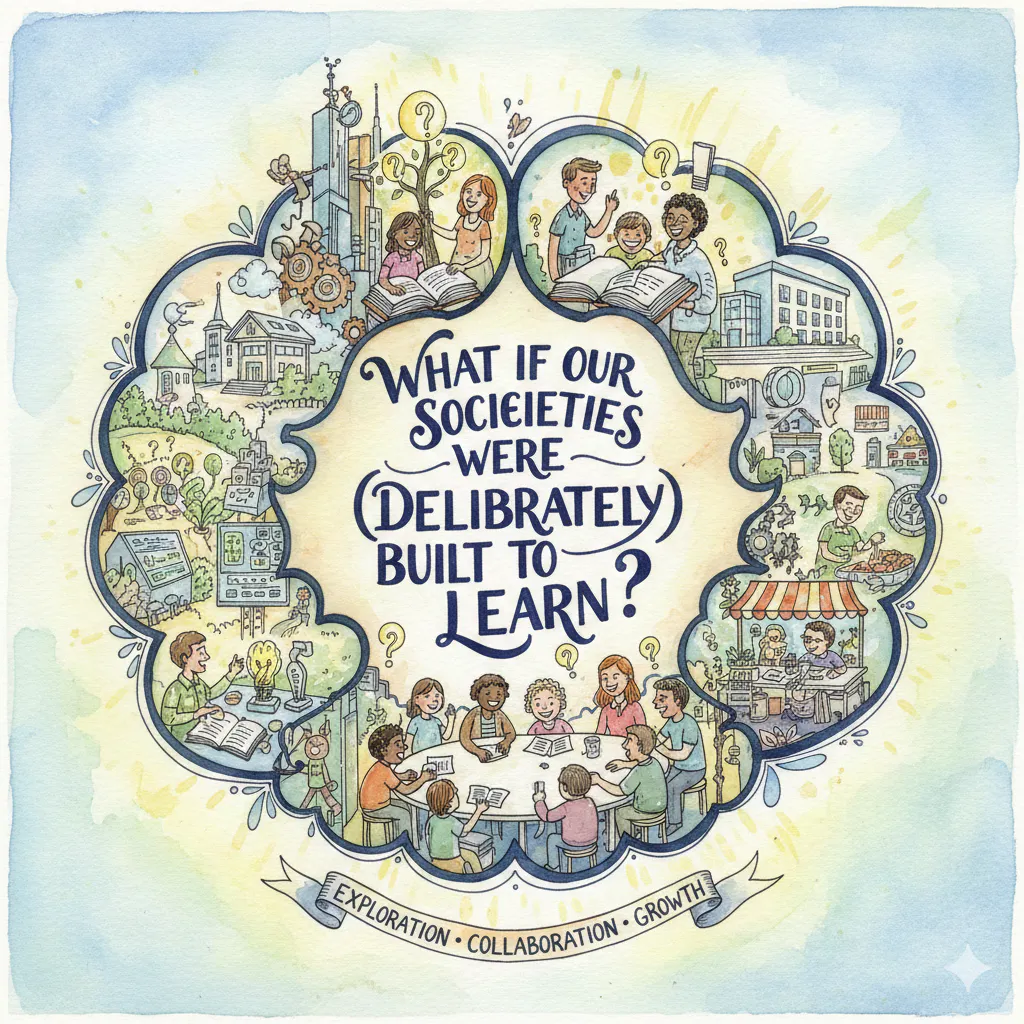
What if our societies were (deliberately) built to learn?
We can start with what is not an obvious question - what is built our societies in a new way - what if we built them deliberately to learn? This is a major part of the ambition of the “Cognitive Republic” — government by experimentation, adaptation by design, prospering through selection (it’s not the whole story, by any means, but certainly a major part of it).
This view is not original to me, by any means. The concept has interesting intellectual roots, especially in the psychologist Donald T. Campbell’s manifesto on the “Experimenting Society”, which declared public programmes should be treated like laboratory trials, evaluated without mercy, and rolled back when the data disappoint.
Consider how this contrasts with governance by doctrine. In doctrinaire systems (be it a Marxist-Leninist state, a theocracy, or even a democracy captured by a single-party ideology, such as MAGA), the role of public institutions is largely to implement the doctrine and defend it (or be dismembered for failing to implement it).
Failures are often reframed or hidden to protect the doctrine’s prestige; learning is stifled because admitting mistakes can delegitimise the ruling ideology.
By contrast, in a method-focused system, admitting a mistake reinforces legitimacy because it shows commitment to truth and improvement over politics or pride.
The Experimenting Society
Donald T. Campbell (1916–1996) was an American social scientist, methodologist, and psychologist, renowned for pioneering ideas bridging the social and life sciences. Over a prolific career spanning the mid- to late-20th century, Campbell authored and co-authored among the most frequently cited methodology works in social science, leaving a last impression on psychology, sociology as well as anthropology, biology, and philosophy).
His intellectual reach was broad – he ventured into anthropology (joining fieldwork in East Africa to study cultural transmission), into sociology of science (analysing how scientific communities self-correct), and even into biologically-inspired theories of social behaviour.
Campbell’s overarching intellectual mission was improving how society generates and uses knowledge to ameliorate important social problems. He did not advance a particular political ideology, but instead articulated a way of doing things in politics, offering a vision of a ‘learning democracy’ grounded in scientific experimentation and evidence-based policy. Campbell’s name is not widely known to the general public, seems to be waning within social science, and his lasting influence on mainstream political philosophy seems modest.
However, his legacy in how we design, test, and learn from social programs is profound, especially in the realms of policy evaluation and behavioral public policy.
I will examine here certain of Campbell’s key ideas regarding ‘learning democracy’ and the ‘experimenting society’, as they are very far-reaching, indeed, radical, and far ahead of his time.
Central to Campbell’s thought is the concept of the ‘experimenting society.’ In a 1969 paper (Reforms as Experiments), Campbell argued democratic governments should treat social reforms as scientific experiments: first, trying new policies on a small scale, then rigorously evaluate their effects, and finally adjust course based on the evidence accrued: public policy could advance only if society learned from systematic trial-and-error, rather than from untested ideology or top-down mandates. He described this vision as a ‘utopian ideal’ worth striving for.
An ‘experimenting society’, according to Campbell, has several defining features: decentralization and diversity in policy approaches (encouraging multiple local experiments); an inclination toward action (trying innovative solutions rather than remaining paralyzed); a strong emphasis on honest, transparent evaluation of results; and a willingness to change course by abandoning policies the evidence shows are ineffective.
An experimenting society has other features: in particular, placing a premium on ‘honest assessment based on transparent data’ and ‘a willingness to change theories and values in the face of disconfirming evidence’1. Campbell was here advocating for a learning democracy: a political system capable of continually learning and self-correcting through feedback by accumulating evidence systematically and rigorously. Importantly, Campbell did not see this learning-by-experimentation approach as technocratic rule by experts; rather, he stressed compatibility with democratic values.
Currently, there are about c. 6k subscribers to the Cognitive Republic (Abre numa nova janela). The open rates for each piece, delivered approximately every two weeks, are close to 50% (way above average) - click here to start (Abre numa nova janela).
In his lecture entitled The Experimenting Society, he posed the provocative question: ‘Is the open society an experimenting society?’, acknowledging the possible tensions between expert-driven experiments and egalitarian, participatory democracy, because it may prove dangerous to generate experimental knowledge ‘apart from democracy’ (that is, without the willing consent of the citizens involved): citizens should be active partners in the process of social experimentation.
Campbell outlined mechanisms for democratic field experiments where citizens would act as ‘co-agents directing their own society,’ helping to define policy goals, shape interventions, and interpret results.
He even anticipated practices now common in open science (such as data transparency and replication), suggesting community-led experiments and publicly shared data could improve policy and social science.
Campbell’s idea of a ‘learning democracy’ went beyond advising policymakers to use evidence; it envisioned ordinary citizens learning democracy by doing, by participating in the collective inquiry into ‘what works’ for society.
Campbell advocates for an “experimenting society” – a society that systematically uses experimentation and empirical evidence, particularly randomised controlled trials, to evaluate social programs and policies. Campbell was well ahead of his time - perhaps eternally so - by forcefully suggesting that we adopt empirical methods as the best way forward to understand and hopefully solve big social problems.
Learning Democracy
Campbell argued that the answers to complex societal problems—such as alleviating poverty, reforming criminal justice, improving public health, and the one hundred and one other issues which continue to nag away at us—are rarely intuitive and obvious. Instead of relying on assumptions or untested theories, he championed the use of empirical and experimental methodologies to design, test, and refine social programs before going for anything like their widespread implementation.
This is a very challenging view of how we should organise our affairs - our societies are very complex, and deep, disinterested, motivated expertise, capacity and capability are, if we are honest, rare - and many of our problems have so many moving parts that any simplistic, reductionistic, view of how to solve them will be one that causes as many problems as it solves.
Campbell’s name is not widely known to the general public, seems to be waning within social science, and his lasting influence on mainstream political philosophy seems modest at the very best. However, his legacy in how we design, test, and learn from social programs is profound, especially in the realms of policy evaluation and behavioral public policy.
Over the next few pieces here, I’ll discuss these ideas of how we can have a learning democracy in detail, provide some readings, and discuss why Campbell’s programme failed to gain meaningful traction.
And over the coming period, I will be developing more deeply the ideas behind what a Cognitive Republic (Abre numa nova janela) can be - bringing a new language and a new philosophy to bear on how we organise our affairs. I will argue we need to reboot our democracies, top-to-bottom from cognitive first principles:- sensing/attention, learning, prediction, adaptation, measurement, falsifiability/correctability, and collective (institutional) memory coupled to government-by-experimentation (policy trials, feedback loops, error-correction; institutions designed to learn across time (past/present/future); legitimacy maintained through transparency, participation, and safeguards against capture)– all to allow us to rethink liberal democracy as an adaptive learning and governance system.
And this, I argue, is how we are going to save ourselves and safeguard our futures.
Start Here for the Cognitive Republic - Table of Contents (Abre numa nova janela)
‘The Unfinished Contract — Our Democracies Must Learn or Die (Abre numa nova janela)’ (1771 words)
Democratic operating systems are glitching everywhere: Let's (not) patch and repair them (Abre numa nova janela) (2109 words)
Podcast 1: Announcing the Cognitive Republic (Abre numa nova janela)
You can subscribe for free email updates here - just click: Subscribe to newsletter (Abre numa nova janela)
or better yet, become a member - just click: Become a member (Abre numa nova janela)
One request: If this project feels useful, forward one piece to one person. That is how it grows; that is how ideas travel.
Huitema, D., Jordan, A., Munaretto, S., & Hildén, M. (2018). Policy experimentation: Core concepts, political dynamics, governance and impacts. Policy Sciences, 51, 143–159. https://link.springer.com/article/10.1007/s11077-018-9321-9 (Abre numa nova janela) ↩
Data
21/01/2026
0 comentários
Gostaria de ser o primeiro a escrever um comentário?
Torne-se membro de Cognitive Republic e comece a conversa.