About cowardice and conviction, the complicity of conservative elites, and the permission structure that governs the Right
By Thomas Zimmer, July 26, 2026
A note before we get started: My apologies for the lighter publication schedule in July as I am (supposed to be) on vacation with my family. I promise I will be back to a more regular and more frequent schedule soon (and let me also tease a bunch of new ideas and formats I’d like to add in the fall, as Democracy Americana nears its first birthday!).
Only the extended intro to this piece is free for everyone. If you want to read more than the preview, please consider becoming a paid member of Democracy Americana, which is solely funded by readers and constitutes my main source of income.
Being an independent writer offers a lot of autonomy, which is a privilege. But it is also precarious and comes with lots of financial uncertainty. If you can become a paid member, please do.
As a paid member, you also gain access to the audio version of the essay – which you can find at the end of the piece or available for download in the podcast player of your choice.
Without your support, I will not be able to continue this work. Please know that I am immensely grateful for your generosity!
Not ready yet for a paid membership? You can subscribe to the free version of the newsletter:
Donald Trump is outlasting the Republican establishment: The people who thought they could control him, harness the “populist” energies he was mobilizing for their own purposes; those who initially vowed to resist his temptation, but then quickly acquiesced; the people who constantly debased himself in his service and their quest for domination.
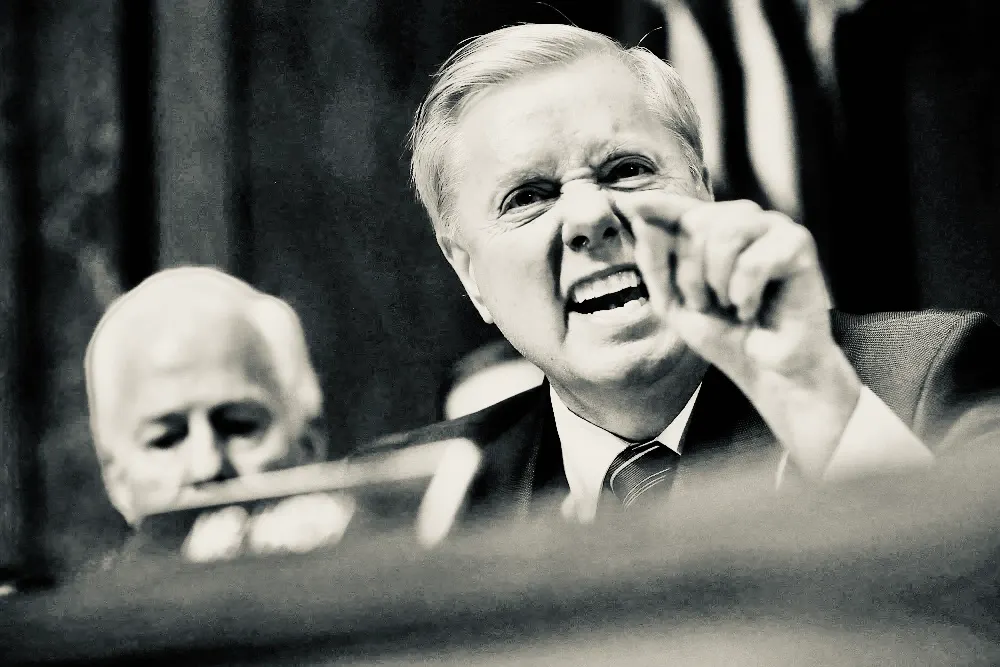
It has occurred to me that my life choices may not have been ideal if I am thinking about Lindsay Graham and Mitch McConnell while sitting on a beach during a family vacation at the Atlantic Ocean. Alas, here we are, and I will admit that Graham’s story, in particular, continues to have an effect on me. Not that I am mourning the man who should be remembered as one of Trump’s most willing enablers. Not that his case was so exceptional, in the grand scheme of things - even though few people disgraced and humiliated themselves quite as much as quite as often as Graham did in his struggle to be Donald Trump’s friend. The reason why it is worth dwelling on the last decade of Graham’s life is that it captured the core dynamics that have defined the behavior of the Republican establishment more broadly. His trajectory was precisely that of conservative elites in general: Faced with an insurgency from far-right extremists, they may have initially signaled distance and skepticism. But once it became clear that the base was enthralled with Trump, they quickly fell in line – and in the process made a mockery of every stated principle they ever claimed to follow.
Senator Lindsay Graham from South Carolina passed away on July 11, aged 71. In December 2015, when Donald Trump first rose within the GOP, Graham vowed to stand against the man he called “a race-baiting, xenophobic, religious bigot” in a CNN interview (Abre numa nova janela). In May 2016, when Trump was already certain to emerge from the GOP primaries as the Republican presidential nominee, he infamously posted on Ex-Twitter (Abre numa nova janela): “If we nominate Trump, we will get destroyed … and we will deserve it.” That tweet, remarkably, is still up. But even though his public comments suggested Graham understood who Trump was and what he represented, he quickly became a staunch defender of the MAGA president during his first term – constantly praising him and fighting for his agenda. Then January 6 happened and Graham once again seemed to change course. The night of the Insurrection, he declared on the Senate floor (Abre numa nova janela): “Trump and I, we had a hell of a journey. I hate it being this way. Oh my God I hate it … All I can say is count me out. Enough is enough.”
Alas, it wasn’t enough for Lindsay Graham. Just as the rest of his party quickly closed ranks behind Trump once the initial shock of the assault on the Capitol faded, Graham returned to doing whatever he could to be in Trump’s good graces.
What is there left to say about the rather pathetic case of Lindsay Graham? About his trajectory and that of his fellow Republican elites?
It has been a little over two weeks since he passed away, and I know a lot of people have weighed in. You know how we roll here at Democracy Americana (especially while I am nominally on vacation…): This is not the place for immediate commentary. It is unlikely I will ever be among the quickest to offer my take. But I believe there is value in letting the dust settle a little bit and then go deeper.
This piece is about Lindsay Graham and, more importantly, about the broader questions his case rases: About the trajectory of the Republican Party and the conditions that made Trump’s rise possible; about what made Trump attractive to conservative elites and why they are sticking with him; about the relationship between opportunism and ideology, cowardice and reactionary conviction; about the logic of escalation that is fueled by a sense of having burned all bridges; and, ultimately, about the permission structure that has governed rightwing politics for decades.
Unless we understand that, we understand nothing. Not how the Republican Party got to this point. And not where it is most likely going next.
Data
26/07/2026
2 comentários
Gostaria de ver os comentários?
Torne-se membro de Democracy Americana para participar no debate.