The champagne toasts are over. The hard work begins.
If Davos 2024 celebrated the shock of the new, and 2025 marked the peak of inflated expectations, the World Economic Forum in January 2026 signaled something unexpected: a definitive shift from revolution to execution. The prevailing conversation moved away from model capabilities and toward energy grids, sovereign compute, and architectural patterns.
For the software practitioner, this represents progress. The conversation has shifted from magic to mechanics.
You have probably lived through this arc yourself. In 2023, your team trialed ChatGPT and marveled at its ability to generate boilerplate. By 2024, someone pitched a "ChatGPT for our domain" that never left the pilot stage. In 2025, leadership asked why adoption metrics looked strong, but velocity remained flat. Now, in 2026, the question is no longer "Should we use AI?" but rather "How do we make AI work in our actual workflow without breaking what already functions?"
The central signal from Davos 2026 is clear: intelligence is being industrialized. It is transitioning from an abstract cloud service to a physical, sovereign asset that requires a new engineering discipline—one that prioritizes reliability over novelty and workflow integration over model size.
We are witnessing the end of the "Chat" paradigm and the beginning of the "Work" paradigm.
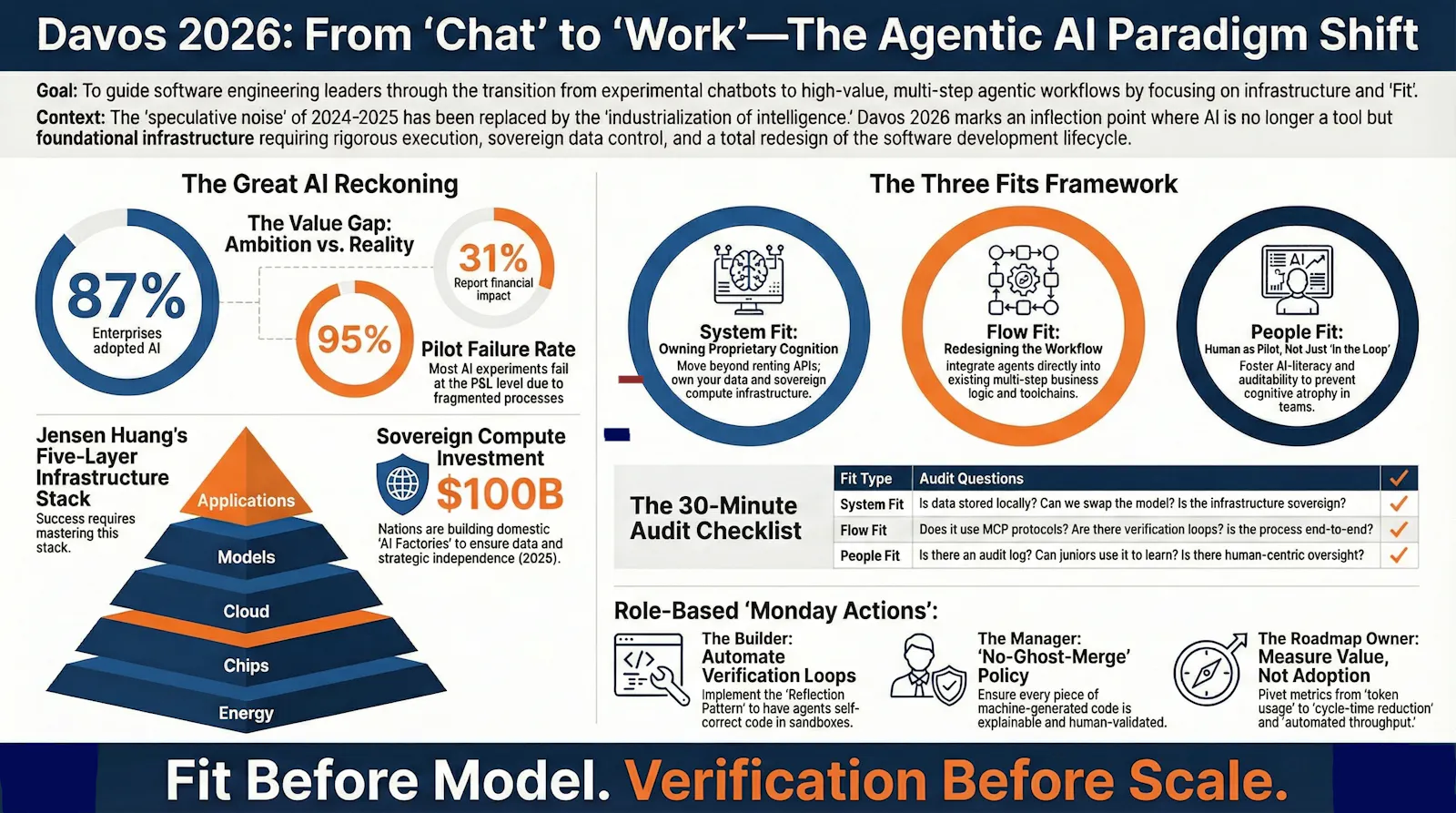
The Architectural Shift: From Model-First to Stack-First
The most significant development from Davos 2026 is the redefinition of the AI stack itself. NVIDIA CEO Jensen Huang, speaking with BlackRock CEO Larry Fink, described AI not as a single technology but as a "five-layer cake" spanning energy, chips and computing infrastructure, cloud data centers, AI models, and applications.
This framing represents a fundamental departure from the simplistic "Model + App" view that has dominated enterprise AI strategy. Huang was explicit: "AI is the largest infrastructure buildout in human history," urging every country to treat AI like electricity or roads. With nearly $100 billion expected to be invested in sovereign AI compute by 2026 alone, the message is unambiguous: AI is becoming critical national infrastructure, not a vendor-supplied service.
We cannot obsess over the model while ignoring the daily reality of the infrastructure.
If you are an engineering leader, this reframing should clarify a persistent confusion: why do demos impress but production deployments stall? The answer is that demos test the top layer—model cleverness—while production requires all five layers to align. Your energy budget, your chip allocation, your data center topology, your model choice, and your application interface must work as a system. Miss one layer, and the entire stack becomes a liability.
Consider a scenario many teams have encountered: you deploy a code-completion tool that works beautifully on a developer's laptop but times out in CI/CD because the inference endpoint cannot scale with concurrent requests. That is not a model problem. That is an infrastructure problem masquerading as an AI problem. Huang's five-layer framing makes this failure mode explicit.
System Fit: The Sovereign Imperative
The term "Sovereign AI" dominated summit discourse. While politicians invoked it to discuss national security, for engineering leaders, it means something far more operational: proprietary cognition.
In 2023, companies were content to wrap a thin UI around a public API. By 2026, that approach will be recognized as a strategic liability. Sovereign AI in the enterprise context means owning the intelligence layer—capturing your organizational knowledge (the tacit understanding of how your business writes code, processes claims, or designs circuits) in models and workflows that you control, not rent from a provider who might deprecate a feature on Tuesday.
Let me make this concrete. Imagine your organization has spent five years building a domain-specific testing framework. Your engineers understand its idioms. Your CI/CD pipeline is tuned to its output. Your incident response playbook references its error codes. Now imagine you deploy a general-purpose code assistant that generates tests in a completely different style—different assertion libraries, different naming conventions, different structure. The assistant's tests may be correct in isolation, but they are incompatible with your system. Adoption stalls. Velocity declines. The pilot is quietly shelved.
That is the System Fit problem.
The empirical evidence supports this diagnosis. While 87% of large enterprises have implemented AI solutions, only 31% report measurable financial impact, and a mere 24% observe profit improvements. The gap is not caused by insufficient model intelligence. It is caused by insufficient System Fit. Organizations are failing to integrate these tools into their proprietary data estates, resulting in generic intelligence that offers no competitive differentiation.
The statistic that should concern every CTO: enterprises have spent tens of billions on generative AI, yet 95% of implementations show no measurable profit-and-loss impact. The failure mode is not the model—it is brittle workflows and tools that do not integrate with existing systems.
Flow Fit: From Chatbots to Agentic Workflows
The second major theme at Davos 2026 was the maturation of agentic AI. Unlike single-turn request-response loops, agentic workflows execute complex, multi-step processes with minimal human intervention.
Research from Gartner indicates that by 2026, 40% of enterprise applications are expected to embed task-specific AI agents, up from low single-digit adoption just a few years earlier. Empirical data from the enterprise adoption survey conducted by Mayfield Fund confirms this acceleration: 42% of organizations now have AI agents in production, with 72% either in production or actively piloting agentic systems.
A new taxonomy of work is emerging:
Sequential Pipelines: Deterministic chains where an agent handles a specific sub-task (e.g., "Run Unit Tests" → "Analyze Failures" → "Suggest Fix")
Hierarchical Systems: A "Supervisor" agent decomposes high-level goals for "Worker" agents
Swarm Architectures: Decentralized agents collaborating on dynamic problems
This evolution creates a substantial challenge for Flow Fit. A chatbot waits for your input. An agentic workflow runs in the background, potentially altering the state of your codebase or database without direct oversight.
Here is where theory meets practice. You have probably experienced this tension: an engineer opens a pull request containing AI-generated code. The code compiles. The tests pass. But during review, you discover the AI misunderstood a critical constraint—perhaps it ignored a deprecation warning, or violated an internal security policy, or introduced a dependency on a library your organization has explicitly banned. The engineer, trusting the AI's output, did not catch the violation. The review cycle doubles. Confidence erodes.
This is the Flow Fit problem at the human layer.
For the Builder, this shifts the job description from "writing code" to "auditing the output of autonomous loops." The cognitive load does not disappear—it transforms. Instead of the steady, predictable rhythm of writing and testing code, you now face the high-intensity, context-switching burden of verifying AI-generated artifacts. Some engineers thrive in this mode. Others experience it as exhausting and disorienting.
The question is no longer "Can the agent write code?" It is "Can I verify what the agent wrote before it ships to production, and can I do so without burning out?"
People Fit: The Cognitive Load Crisis
The industrialization of intelligence brings us back to the socio-technical reality: you cannot industrialize a process you do not understand.
The People Fit crisis of 2026 is not about mass unemployment—Davos reports suggest a labor shortage in skilled technical roles. It is about the cognitive load of hybrid systems.
When we deploy an agentic workflow that automates 40% of a developer's routine tasks, we do not simply "save time." We compress the remaining work into a high-intensity stream of complex decision-making. The routine work that used to provide cognitive breaks—reading logs, writing simple tests, updating documentation—is gone. What remains is concentrated judgment under uncertainty.
Let me illustrate with a scenario that many teams are encountering. A junior engineer joins your team. In the past, they would spend their first few months writing straightforward features, debugging simple issues, and gradually building mental models of the codebase. Those tasks provided safe practice—low stakes, high repetition, steady skill accumulation.
Now, the AI handles many of those tasks. The junior engineer is immediately thrust into higher-level work: reviewing AI-generated code, resolving edge cases the AI cannot handle, and making architectural decisions about which tasks to delegate to the agent. They lack the foundation of routine practice. They struggle. Onboarding takes longer. Confidence develops more slowly.
This is the "Junior Problem," and it is not hypothetical. It is happening now.
This requires new skills:
Control: The ability to define rigorous guardrails (e.g., "The agent can draft the PR, but it cannot merge to Main without human audit")
Authenticity: The discipline to sign your name only to work you have verified. In a world of infinite generated content, your signature—your reputation for correctness—is your only scarcity
Community: Relying on peer review more than ever. If an AI generates the code, a human must understand the intent
These are operational necessities. Without Control, your agentic systems will violate constraints you have not explicitly encoded. Without Authenticity, you will ship defects faster than you can detect them. Without Community, individual engineers will drift into incompatible practices, and your codebase will fracture.
The Sovereign Stack Audit: A 30-Minute Drill
Before authorizing the next budget cycle for an AI pilot, run this audit. It tests for Compatibility-First principles over hype.
1. The Infrastructure Check (System Fit)
Energy & Compute: Do we have secured compute capacity to run this workload, or are we reliant on spot pricing that may disappear when demand spikes?
Data Sovereignty: Does the model train or finetune on our data in a private environment, or are we leaking intellectual property to a public model provider?
Dependency Risk: If the model provider changes their API schema tomorrow, does our production workflow break? Do we have fallback options?
Why this matters: At Davos, speakers emphasized that AI is moving from rental models to owned infrastructure. If your AI strategy depends on a vendor's good faith, you are not building for the long term.
2. The Workflow Check (Flow Fit)
Latency Tolerance: Does the agentic loop run fast enough to keep the human in flow, or does it force a context switch that destroys concentration?
Error Handling: When (not if) the agent hallucinates, is failure containment automated, or does it require manual cleanup that takes longer than the original task?
Interface: Is the AI integrated into the IDE/CLI, or is it a separate "destination" tab that requires context switching?
Why this matters: The Mayfield survey found that the most successful AI implementations are those that embed directly into existing workflows, not those that require users to adopt new tools. Flow Fit is the difference between a feature that gets used daily and a feature that gets disabled after two weeks.
3. The Cognitive Check (People Fit)
The "Junior Problem": Are we using AI to replace junior engineers? If so, who will be the senior engineers in five years? What is our plan for skill development?
Auditability: Can a human explain why the agent made a specific decision, or is the reasoning opaque?
Psychological Safety: Do developers feel safe rejecting AI suggestions, or is there implicit or explicit pressure to "just ship it" because the AI generated it?
Why this matters: The PwC survey revealed that while 73% of CEOs expect generative AI to significantly change how their companies create, deliver, and capture value in the next three years, only 31% report measurable financial impact today. The gap is often caused by People Fit failures—teams that adopt the tool but cannot sustain the practice.
Role-Based Action Items
For The Builder (Individual Contributor)
Stop being a "Prompt Engineer." Start being a "Workflow Architect."
The value of typing a clever prompt into a chat box is collapsing to zero. The value of constructing a reliable chain of prompts, scripts, and verification steps is increasing rapidly.
Here is a concrete experiment you can run this week:
Next Move: Build a "Sequential Pipeline" for a routine task. Do not simply ask an LLM to "write a test for this function." Instead:
Write a script that extracts the function signature and docstring
Pipe that context to an LLM with explicit constraints (e.g., "Use pytest, cover edge cases, follow our naming convention")
Extract the generated test code
Run it against the actual function
If it fails, pipe the error back to the LLM with the instruction "Fix this test given this error"
Repeat until the test passes or you hit a retry limit
Save this script. Refine it. Share it with your team. You have just automated a workflow, not a task. That is the skill that compounds.
The result you should observe: The first iteration may take longer than writing the test manually. By the tenth iteration, you will be faster. By the fiftieth, you will wonder how you ever worked without it.
For The Manager (Team Lead)
Prioritize "Cognitive Sovereignty."
Your team is likely overwhelmed by tools that promise to help but actually distract. Every new AI feature is another notification, another interface, another decision point. The cognitive tax is real.
Next Move: Implement a "No-Ghost-Merge" policy. The rule is simple: No AI-generated code enters the codebase without a human explicitly documenting what they verified. This enforces the "Authenticity" pillar and prevents the review fatigue that leads to defects.
Here is what the policy looks like in practice:
When a developer submits a PR containing AI-generated code, the PR description must include:
Generated by: Which tool/model was used
Verified: Which aspects were manually checked (correctness, security, performance, style)
Risk: What could go wrong if the verification missed something
This is not bureaucracy. This is accountability. It also creates a learning corpus—after six months, you can analyze your team's "Verified" notes to identify which verification steps are most commonly skipped and which types of AI-generated code require the most rework.
The result you should observe: Initially, some engineers will resist the overhead. Within a month, the team will develop a shared understanding of what "good" AI-assisted work looks like. Defect rates will stabilize or improve. Confidence in AI-generated code will increase because the verification process is explicit.
For The Roadmap Owner (Executive/CTO)
Measure "Value Realization," not "Adoption."
The statistic that "91% of our developers use Copilot" is a vanity metric. It tells you nothing about profit-and-loss impact.
Here is the uncomfortable truth: adoption without outcomes is worse than no adoption at all, because it creates the illusion of progress while consuming resources (licenses, training, management attention) that could be deployed elsewhere.
Next Move: Shift your KPIs from "Efficiency" (speed) to "Reliability" (uptime/error rates). The industrialization of intelligence means treating AI as critical infrastructure. If your AI strategy does not include a line item for "Energy" and "Sovereign Data Storage," it remains a pilot project, not a production system.
Replace these metrics ❌:
"Percentage of developers using AI tools"
"Number of AI-generated lines of code"
"Time saved by AI assistance"
With these metrics ✅:
"Cycle time from commit to production for AI-assisted vs. manual work"
"Defect escape rate for AI-generated vs. manually written code"
"Mean time to resolution for incidents involving AI-generated components"
"Developer satisfaction with AI tooling (measured via quarterly pulse survey)"
The result you should observe: Within one quarter, you will identify which AI use cases are delivering measurable value and which are consuming resources without return. Double down on the former. Retire the latter. This is portfolio management, not science fair judging.
What This Means for the Next 12 Months
The shift from the "Chat" paradigm to the "Work" paradigm is not a future trend. It is the present reality. The organizations that recognize this shift and adapt their practices accordingly will build sustainable competitive advantages. Those that continue to treat AI as a demo feature will fall further behind.
Three predictions for 2026:
Sovereign compute will become a board-level topic. As AI transitions from a rented service to owned infrastructure, CFOs and CTOs will jointly evaluate whether to build private data centers or negotiate long-term compute contracts. The financial stakes are comparable to cloud migration decisions from the 2010s.
Agentic workflows will expose organizational knowledge gaps. When an agent automates a process, it makes explicit every assumption, constraint, and exception that was previously tacit. Many teams will discover that their processes are less well-defined than they believed. The winners will treat this as an opportunity to codify institutional knowledge.
The "Junior Problem" will force a rethinking of career development. If AI handles routine tasks, how do junior engineers build foundational skills? Organizations that solve this problem—through structured apprenticeships, deliberate practice programs, or AI-augmented learning environments—will have a recruiting advantage.
Daniel Russo, Ph.D., is a Professor of Software Engineering whose research examines the intersection of human cognition and artificial intelligence. Through "Software Insights," he translates empirical research into actionable guidance for software practitioners and organizations.
Partner with Daniel to transform your organization through evidence-based approaches that bridge academic rigor with practical implementation. His consulting work helps technology companies and research institutions adopt scientifically validated practices that improve software development outcomes, team performance, and innovation capacity.
Learn more about his approach to evidence-based organizational change: https://www.danielrusso.org/evidence-based-organizational-change/ (Abre numa nova janela)
References
CloudKeeper. (2026). Top agentic AI trends to watch in 2026: How AI agents are redefining enterprise automation. https://www.cloudkeeper.com/insights/blog/top-agentic-ai-trends-watch-2026-how-ai-agents-are-redefining-enterprise-automation (Abre numa nova janela)
Computer Weekly. (2026, January 21). Davos 2026: Smart thinking needed for sovereign AI investment. https://www.computerweekly.com/news/366637503/Davos-2026-Smart-thinking-needed-for-sovereign-AI-investment (Abre numa nova janela)
Mayfield Fund. (2026, January 27). The agentic enterprise in 2026. https://www.mayfield.com/the-agentic-enterprise-in-2026/ (Abre numa nova janela)
Nvidia. (2026, January 21). Jensen Huang on AI's 'five-layer cake' at Davos. https://blogs.nvidia.com/blog/davos-wef-blackrock-ceo-larry-fink-jensen-huang/ (Abre numa nova janela)
PwC. (2025). AI's productivity promise: Mind the value gap. https://www.pwc.ie/reports/ceo-survey/artificial-intelligence.html (Abre numa nova janela)
Quartz. (2026, January 21). Jensen Huang brings a 5-layer AI pitch to Davos. https://qz.com/jensen-huang-nvidia-speech-davos-2026 (Abre numa nova janela)
Second Talent. (2025). AI adoption in enterprise statistics & trends 2025. https://www.secondtalent.com/resources/ai-adoption-in-enterprise-statistics/ (Abre numa nova janela)
ServicePath. (2025, September 10). The AI integration crisis: Why 95% of enterprise pilots fail. https://servicepath.co/2025/09/ai-integration-crisis-enterprise-hybrid-ai/ (Abre numa nova janela)
World Economic Forum. (2026, January 20). How agentic, physical, and sovereign AI are rewriting the rules of enterprise innovation. https://www.weforum.org/stories/2026/01/how-agentic-physical-and-sovereign-ai-are-rewriting-the-rules-of-enterprise-innovation/ (Abre numa nova janela)
Data
30/01/2026


