May 2026
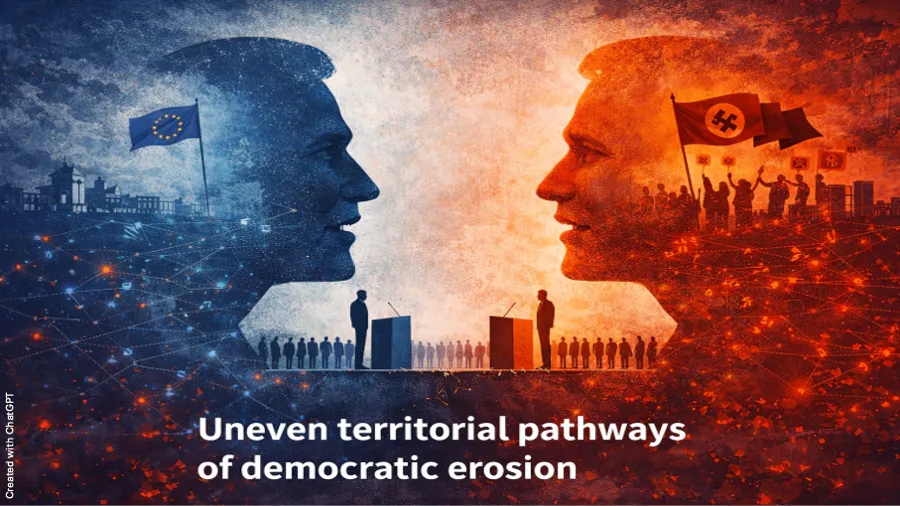
Democratic crises are often imagined as sudden events. A tipping point is reached, institutions fail and the system collapses. While this narrative is compelling, it is also misleading.
A recent German scenario study offers an alternative perspective. Rather than abrupt breakdowns, it maps a spectrum of gradual transformations. The study argues that democracy does not disappear overnight. Instead, it erodes, adapts and sometimes mutates across a continuum of possible futures. The study in question, Alte Grenzen – Neue Gefahren 2035 (Old Borders – New Dangers 2035) (Abre numa nova janela), was published in February 2026 by D2030, a German civic futures initiative. It explores potential futures for liberal democracy in Germany by 2035.
What the study implies, but does not fully articulate, is that this process is not only temporal. It is also spatial. Interpreted spatially, it reveals that democratic resilience is unevenly distributed across territories.
Democratic erosion does not happen everywhere at once. Rather, it unfolds unevenly across territories. Increasingly, your location determines the type of democracy you experience.
A landscape, not a trajectory
At the heart of the study is the concept of a 'landscape of possible futures': eight scenarios ranging from a resilient democratic system to a fully authoritarian state. These are not predictions, but structured possibilities. Crucially, they are not isolated outcomes. They are connected through pathways, transitions and tipping points.
This matters because it changes how we view democratic change. The future is not a linear trajectory from stability to collapse. Rather, it is a landscape with gradients, clusters, and fault lines.
From a spatial perspective, this metaphor becomes literal. Different territories can occupy different positions within this landscape simultaneously. Some regions may remain close to democratic stability, while others may drift towards illiberal practices. The result is not a single national condition, but rather a patchwork of democratic realities.
The hidden mechanism: normalisation
One of the study's most significant findings is that democratic erosion rarely starts with overt conflict. Instead, it begins with subtle shifts in language, norms and expectations.
In scenarios such as 'The sweet poison of the right', democratic institutions remain formally intact. Elections are held, laws are observed, and political competition persists. Yet the substance of democracy changes. Mainstream actors begin to adopt the narratives and frames of illiberal movements. Boundaries blur. What was once unthinkable becomes acceptable.
This process is not driven solely by extremists. It is also driven by the centre, i.e. by actors who adapt to perceived pressures, seek electoral advantage or respond to shifting public sentiment. The implication is uncomfortable but clear: the future of democracy is decided in its mainstream, not at its margins.
From a territorial perspective, this process is highly uneven. Normative shifts tend to emerge first in places where institutional trust is low, media ecosystems are fragile and socio-economic pressures are acute. These places become early adopters of new discourses, long before they become visible at a national level.
Two pathways, one outcome?
The study distinguishes between two broad categories of democratic erosion:
The discursive pathway. In this pathway, the key transformation takes place in the realm of language and public debate. Narratives shift and frames change, resulting in more polarised and exclusionary political communication. Although institutions remain formally intact, their legitimacy weakens over time.
Institutional pathway. Here, changes occur within the formal structures of governance. Political actors who were previously excluded from power become integrated into decision-making processes. Over time, however, checks and balances are weakened and institutional safeguards eroded.
While these pathways are analytically distinct, in practice they are closely linked. Discursive shifts often precede institutional change. Normalisation creates the conditions under which new political arrangements become acceptable.
Less often discussed is how these pathways unfold spatially. Discursive change may first take hold in specific regions. These regions are often those experiencing economic restructuring, demographic decline or political marginalisation. Institutional change may follow when political coalitions at a local or regional level begin to shift. National transformation, if it occurs, is typically the final step. In this sense, democratic erosion follows a territorial logic in that it spreads.
The territorial dimension of resilience
The study identifies four key factors that contribute to democratic resilience: robust institutions, trust in governance, an active civil society, and diverse media systems. From a spatial perspective, however, these factors are unevenly distributed.
Some regions benefit from dense institutional networks, diverse economies and active civic engagement. Others, however, face institutional decline, economic stagnation, and falling participation rates.
This unevenness matters. Where institutional capacity is strong, democratic norms are more likely to be upheld. Where it is weak, these norms are more vulnerable to erosion. The same political pressure can produce different outcomes depending on the territorial context. This suggests that democratic resilience is not just a national attribute. Rather, it is a territorial or place-based attribute that deserves more attention in regional development policies.
Europe as a territorial anchor
One of the study’s more subtle findings concerns the role of Europe. Pro-European orientations are associated with more stable democratic scenarios, while nationalist trajectories correlate with democratic decline.
From a spatial perspective, this highlights the importance of multi-level governance. The EU can act as a stabilising framework, reinforcing legal standards, institutional norms and economic integration. However, its influence is uneven. Regions that are more closely integrated with European networks, whether economically, institutionally or culturally, may experience this stabilising effect more strongly.
From foresight to policy
The study concludes with a set of normative insights. It argues that democracy requires active defence. While it depends on institutions, it also relies on trust, participation and public engagement.
Adopting a spatial perspective adds another layer. If democratic resilience varies across different territories, then policies aimed at strengthening democracy must also be territorially aware. Cohesion policy, regional development strategies and spatial planning interventions are not merely economic or social tools. They are also instruments of democratic stabilisation. However, this is not how they are usually framed. Perhaps this is how they should be viewed.
A different map of the future
Ultimately, what the D2030 study offers is not a prediction, but a map. It is a map of possible futures, of pathways and tipping points, and of trajectories that may or may not materialise. It encourages us to start considering democratic infrastructure in the same way as physical infrastructure, i.e. as something that requires deliberate investment, maintenance and equity analysis across territory.
This means identifying places with the institutional capacity – such as functioning local media, an active civil society, a diverse economic base and trusted public institutions – to resist democratic backsliding. It means recognising that decisions about regional development, such as where to invest, which institutions to support and how to build civic participation capacity, are not politically neutral. In a scenario landscape where the geography of democratic erosion is already visible, they never were.
The D2030 study concludes with eight theses, one of which asserts that democracy requires a vision for the future, not merely defensive measures. The same is true spatially. We need a positive, place-based future perspective that includes democratic life as a core development variable, not a background assumption.
Democracy, it transpires, does not just happen somewhere. It happens or doesn't here. In this region. At this level of governance. In this community.
by Kai Böhme
 (Abre numa nova janela)
Data
05/05/2026
Tópico
Scenarios & visions
0 comentários
Gostaria de ser o primeiro a escrever um comentário?
Torne-se membro de spatialforesight e comece a conversa.