September 2025
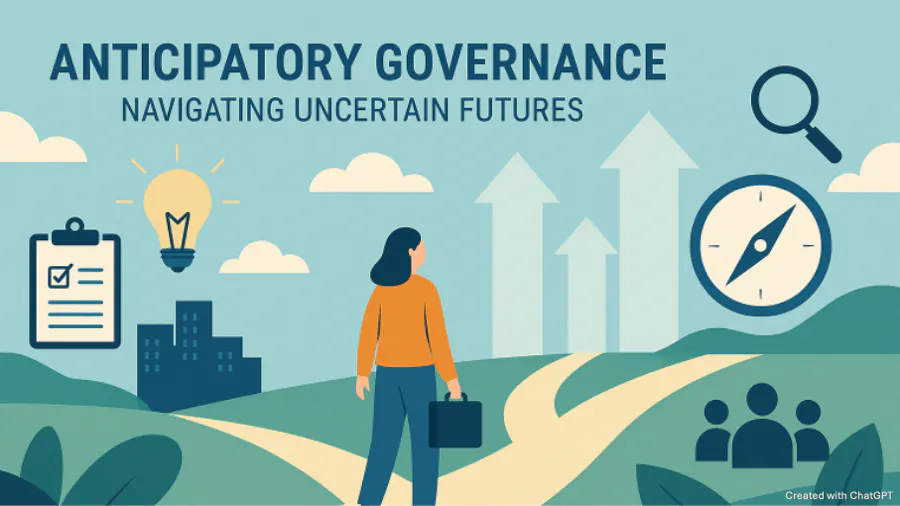
Emerging technologies, alongside geopolitical shocks and other disruptive developments, are reshaping Europe’s territorial future. Yet public debate often remains stubbornly reactive; all too often, we wait for inventions to emerge before rushing to regulate their unintended consequences.
What if we flipped the script? What if governance offered a proactive, inclusive and values-driven framework with which to navigate disruptive transformations?
A recent white paper (Abre numa nova janela) from Finland’s VTT Technical Research Centre highlights that disruptive transformations — technological or otherwise — demand collaborative strategies, cross-sector learning and a combination of problem-solving and problem-finding approaches. In short, we must learn to ask better questions earlier.
There is a clear governance gap. Traditional policy tools are reactive, siloed and often slow, and struggle to keep up with the speed and complexity of emerging technologies. They often react after problems arise and struggle to cope with these fast-moving, far-reaching challenges. A more forward-looking mindset is needed: one that anticipates change instead of merely responding to it.
Anticipatory governance in a nutshell
Anticipatory governance is an approach to governance that looks to the future in order to guide present action. Rather than treating regulation as an afterthought, it incorporates foresight, inclusivity and ethics into the initial stages of technological development.
By exploring 'what if?' scenarios and including diverse perspectives, policymakers can identify potential issues early on and adapt accordingly. Anticipatory governance uses structured foresight methods such as scenario planning and horizon scanning. It also embraces early and meaningful engagement with scientists, citizens, communities and businesses. Crucially, it integrates ethics by design, embedding values such as transparency and responsibility throughout the process.
Foresight – navigating possible futures
Foresight goes beyond linear forecasting. Through scenario building, systems thinking and horizon scanning, it creates the space to envisage a variety of possible futures, from utopian to dystopian and everything in between. The aim is not to predict what will happen, but to prepare for what might happen, ensuring that today's policies remain robust in the face of diverse conditions. In governance, this involves institutionalising futures thinking, for instance by establishing foresight units or incorporating scenario exercises into planning processes.
Foresight is often caricatured as crystal ball-gazing. In practice, however, it is a disciplined method of stress-testing strategies and making sense of uncertainty. Spatial planners are already familiar with such approaches through land use or mobility scenarios. Anticipatory governance extends this practice to technological pathways.
Imagine a workshop in which coastal regions explore three potential futures for AI-driven shipping: an automation boom, a transition to green fuels, or a retreat into protectionism. Each scenario would have different implications for infrastructure, skills, and equity. These exercises help regions to articulate the kind of technological future they want, rather than simply absorbing top-down strategies. Crucially, they enable regions to express their preferences regarding the future of technology, rather than merely absorbing national or corporate visions.
Inclusion – engaging diverse stakeholders
Inclusion is about opening up the decision-making process to a variety of voices, including innovators, industry representatives, scientists, community leaders, civil society organisations and marginalised groups. Early, sincere and continuous engagement builds legitimacy, reveals blind spots and aligns innovation with societal needs.
In territorial terms, this involves broadening perspectives and incorporating diverse viewpoints through lateral thinking, ensuring that decisions are place-sensitive. For example, Alpine communities may have concerns about drone deliveries that differ fundamentally from those of Baltic port cities trialling autonomous vessels. Anticipatory governance encourages a shift from one-off consultations to civic laboratories, or citizens' labs, where local stakeholders collaborate to develop solutions over time.
Such learning loops matter. Technological adoption is often slowed not by technical flaws, but by a lack of trust or social acceptance. Effective anticipatory governance ensures that these issues are addressed head-on.
Ethics & values – guiding innovation responsibly
Ethical oversight is sometimes perceived as hindering innovation. However, the EU's experience with data protection, for example, shows that principled frameworks, such as the GDPR, can be assets rather than obstacles.
In anticipatory governance, ethics are embedded from the start, not bolted on afterwards. This involves continually assessing emerging technologies against principles of transparency, fairness, accountability and sustainability from the outset. Mechanisms such as citizen juries, ethical reviews and transparency-by-design standards help to ensure that innovation remains socially desirable rather than just technically exciting or commercially viable.
Humble governance – openness to uncertainty
A striking feature of anticipatory governance is its emphasis on humility. This involves acknowledging epistemic limitations, embracing the possibility of course corrections, and cultivating feedback-rich policy ecosystems.
Rather than projecting confidence in master plans, humble governance encourages learning and adaptation. It calls on decision-makers to ask, 'What if we’re wrong?' They should then build mechanisms to detect and respond when that’s the case. By being humble, governance becomes more credible and effective; it can build trust by demonstrating that it listens and can adapt to changing circumstances.
In territorial governance, this can manifest as pilot zones, regulatory sandboxes and peer learning across regions. Success is less about final blueprints and more about developing the ability to navigate change as it occurs.
Continuous learning & adaptation
Disruptive transitions do not follow straight lines. They require double-loop learning, in which policymakers revisit their underlying assumptions. This is why anticipatory governance relies on continuous learning across sectors, institutions and communities.
This involves both cross-sector learning, which involves exchanging knowledge between academia, industry, government and communities, and policy learning, which involves monitoring outcomes and updating approaches accordingly.
Under this logic, governance is never finished. It is always in a state of testing, refining and updating. The trick is to institutionalise feedback loops through foresight exercises, real-time evaluation or iterative regulation. A culture of curiosity, experimentation, and reflection is as important as any single tool.
Looking ahead – from posture to practice
Anticipatory governance is not a checklist. It is a shift in mindset, moving from reacting to shaping and from certainty to inquiry.
For Europe’s regions, this approach offers a means of incorporating spatial diversity, place-based insights and social values into innovation governance. When implemented effectively, it has the potential to transform technological turbulence into a driving force for territorial cohesion rather than divergence.
Encouragingly, this shift is already underway. Finland’s GOWELL project, for example, is developing an 'Anticipatory Governance Compass' — a heuristic tool designed to help policymakers navigate uncertainty. Across Europe, we see scenario labs, civic forums and innovation testbeds that reflect anticipatory principles, even if they do not use the term.
The next step is scaling up. Could an anticipatory governance assessment be included in every major policy or regional development strategy and policies? Could EU funding schemes encourage regions to develop their own futures labs or participatory tech councils?
Such moves would help to normalise the idea that the future should be facilitated with care now, rather than being managed later.
Bold and humble at once
Anticipatory governance is both bold and humble. It is bold in daring to shape the future and humble in acknowledging that it cannot be predicted or controlled.
There’s no doubt that Europe’s regions will face more disruptive transformations. The open question is whether policymakers and communities will respond to these disruptions with reactive tools or reflective foresight.
The tools are emerging. Now, it is up to us — region by region and project by project — to chart the course.
by Kai Böhme
 (Abre numa nova janela)
Data
05/09/2025
Tópico
Scenarios & visions
0 comentários
Gostaria de ser o primeiro a escrever um comentário?
Torne-se membro de spatialforesight e comece a conversa.