This text is long and will be continued next week, because there is a lot at stake: an analysis and assessment, criticism of a left-wing institution and the means we use. It is not an easy text, but I cannot avoid it. Because...
In life, you make your choices not out of fear, but despite your fears
That's how it should be, in the full knowledge that this is not always easy or successful at the first attempt. But especially for groups that identify with the radical left, this MUST apply, now more than ever. Unfortunately, the reality is very different for too many of these structures. Too many supposedly radical leftists are currently making decisions out of fear and are therefore not doing what would be necessary to have any chance of relevance and change in the face of the current dramatic global situation with the shift to the right and the comeback of fascism within the people and governments, in the face of climate catastrophe and all the collapse scenarios. This does not apply to all structures, and certainly not to all individuals who describe themselves as radical leftists. I also see signs of life and things giving me courage, whether it's groups showing solidarity with Palestine Actions, the fight against militarisation, Ende Gelaende and other actors in the climate justice movement, Antifa, autonomous small groups – I see fire, anger and the will to regain their edge without first and foremost looking to ‘the masses’. This text, or rather this criticism, is harsh, and I know that I will face opposition, but I see myself caught up and trapped in these processes and in this criticism, and it makes me angry, sad, and too often hopeless. It paralyses me, and I want to break free from this paralysis, true to the motto of fighting to the end, but fighting with the prospect of success, rather than fighting for the sake of fighting, already knowing that continuing as before in the circus of action will achieve nothing but symbolic politics. Criticism, even harsh criticism, must be possible; it is not personal and it is due to concern for radical left-wing activists who wear themselves out, despair of their own standards or conform to the tragedy of social and political reality. Criticism is not an attack; criticism does not mean that we become opponents, even if many (will) turn it into exactly that. But that says more about you than about me, my intentions and my criticism.
The problem of leverage
Within the radical left, there are hardly any radical demands that go beyond slogans and banner slogans, and when supposedly relevant demands (Tax the Rich, Eat the Rich...) are expressed in a party political context, this is done in the knowledge that they are not in a position to implement them and will have to be judged accordingly. The same now often applies to actions by activist groups: ‘We will stop the re-establishment of the AfD Youth’ is the current example – we don't have that, and it was clear that we wouldn't be able to achieve it.
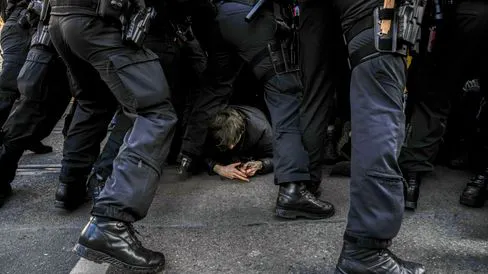
It was clear because – and we know this too – we have no leverage, neither in parliament nor on the streets. All this is therefore not wrong or pointless, but it must not be everything. The lack of leverage etc., is of course also due to the ‘overall shit’ – bans on demonstrations, escalating police violence against people who take action, charges, prison sentences, the completely indiscriminate use of terrorism laws and investigations in the context of ‘forming criminal organisations’, ever more extensive powers of surveillance and control, work bans... the list is almost endless. Nevertheless, it is important to be visible, to literally stand in the way, to be active and at least try to resist.
My criticism is different: the radical left is no longer even attempting to find levers that work, to fight for them, to enforce them, to argue for them. The only lever the radical left has sought in recent years has been that of alliances, connectivity, majorities, and mass approval. There were a few moments when this search seemed to show signs of success, when we believed we could now pull the lever. These moments vanished into thin air with the coal package, with Danni and with Luetzerath. Nevertheless, the radical left continues and does not have the courage to finally let go of this ineffective lever and become aware of other levers. They do exist, but they do not go hand in hand with the desire to be loved by everyone, to convince everyone and to take everyone with us. There are levers that can force things to happen, that can at least get us moving forward again, but we don't even look for them; we deny them out of fear of reactions, headwinds, criticism and everything else that is already hitting us (in the truest sense of the word). Yet levers are actually tools for achieving something when not everyone is on board, dear radical left.

The problem of analysis
In addition to a lack of leverage, part of our crisis is an erroneous/incomplete analysis of the current situation and the failure to respond, adapt and change accordingly. The problem of accepting collapse, even among left-wing actors, is also still an issue and exacerbates our powerlessness. In the last weeks of the old year, I realised how big it actually is. When the current problems of the radical left are recognised, they are dismissed as the ‘usual ups and downs’ that are typical of movements, no cause for concern... NO, things are not as they always have been. Just a few examples: the climate catastrophe is rolling at full speed, ‘Antifa’ has been declared a terrorist organisation in several countries, an armed mob called ICE is grabbing people in the open street, Trump is kidnapping the president of a sovereign country after attacking it and openly saying that ‘we’ will now rule there for the time being, sea rescue is a criminal offence, Antifa members are being illegally extradited to fascist countries and not brought back, there is talk of using mines at the EU's external borders, and the Afghan embassy in Germany is officially staffed by the Taliban... Do you call that ‘business as usual’? Whether you want to call it collapse or not, it does not change the fact that we are in the midst of changes that are so big, far-reaching, rapid and diverse that they go far beyond ‘the usual’ and there is no end in sight; some upheavals are irreversible. The crisis of the radical left is embedded in these facts, whether you like it or not, and that is why this crisis of the radical left cannot be analysed within the framework of the ups and downs typical of movements. It is an extraordinary crisis, and denial only exacerbates it. When it comes to collapse and the collapse movement, it is like many things, including climate activism and even people who describe themselves as collapse-conscious. Yes, even ‘collapsists’ want to repress it and do so. We are the ducks in the pond with duckweed. We break the surface, but without constant movement, the plants immediately close it again. I have decided to be a kicking duck 😉, even if many of you prefer to give up kicking, settle into the status quo and go with the flow.

We want (climate) activism? Then let's do it differently – the problem of practice
But – and this is something that the last calls of the old year also showed me – our problems start way earlier, long before the question of accepting collapse. They start with the discussion about the usefulness of actions, forms of action and their design, about alliances (at any price) or autonomous small groups. If we want to continue with hopium in the form of civil disobedience and (climate) activism, then let's at least change or expand our practice. So don't jump over the collapse hurdle for my sake – fine! But then discuss the design of forms of action with me. Don't keep talking about ‘colourful, diverse and creative forms of action with which we express our protest’; have the courage to actually make them possible and/or implement them yourself. When radical left-wing activists talk about door-to-door canvassing as a form of action, I no longer know what we want to achieve. In a recent speech, Greta Thunberg asked some very good and important questions that we should all be asking ourselves and finding answers to: "What happens if we don't accept that? What happens if we fight back?" At best, it is high time to find out, dear radical left. At worst, it is already too late because we are too sluggish and, like everyone else, actively part of a society that represses reality.
The problem with failure
We must also understand that mobilisation is not the same as organisation. Nowadays, mobilisation is often even used to demobilise us. We go to large demonstrations, and that's good. We make combative speeches, and that's good. But we don't do anything. That is demobilisation, and it is intentional. We operate within a certain framework, there is great jubilation, democracy is alive and well, and then too many people go home patting themselves on the back. This behaviour is exacerbated by the undeniable crisis of the radical left and our structures and groups. Because attachment to structures, even if it is achieved through mobilisation in some cases, is far from being (‘meaningful’) organisation if these structures lack radical and revolutionary thinking with corresponding paths, ideas, courage and appropriate levers. This is where my criticism and my truly anguished cry come in, because I know how much work goes into preparing, mobilising and keeping groups going. But to be honest, this work too often fizzles out into nothingness. Doesn't that make you furious? Doesn't it make you sad? Aren't you tired of it too?
It is in the nature of things (and understandable) that organisations cannot admit that they have failed. Of course, they do not fail right from the start. But when the factors and circumstances within which they operate change, and when these changes are not taken into account and do not lead to a change in their own analyses, approaches and practices, then organisations fail. Denying this fact is understandable, because our structures do not, of course, arise overnight. It is a process, a lot of work, which ties up capacities and resources and is designed for the long term. It is about long-term funding, in some cases jobs, alliances and cooperation, and planning. Admitting failure means an organisation is questioning its own existence. The problems can be illustrated using the example of the largest and most important radical left-wing organisation, the Interventionist Left.
The problem using the example of the Interventionist Left
The IL can be classified as part of the post-autonomous spectrum, but before I go into that, it is worth taking a look at the name itself: Interventionist Left. What does ‘intervene’ actually mean? This term describes an attitude or policy that involves targeted interference or intervention in existing processes, systems or matters of third parties in order to control, change or influence them. So far, so good. How is interventionism going at the moment? My conclusion is rather sobering, and for me, the IL's post-autonomist approach has failed in and around the current political situation. To explain this, a brief historical overview is necessary. Post-autonomist groups such as the IL have their roots in the classic autonomist scene, but there are differences. Among other things, they criticise the strict hostility of the autonomists towards organisation and strive for alliances within and outside the radical left-wing spectrum. With the principle of ‘civil disobedience’, the Interventionist Left & Co. have attempted to mediate between radical and more bourgeois actors and, through broad consensus, ultimately to get parties and governments to take appropriate action. There have been successes, some progress has been made, or at least things have started to move. One of the most successful and, fortunately, still vibrant structures to emerge from the IL milieu is Ende Gelaende, where the spirit of disobedience and radicalism is currently most alive. Ende Gelaende has already emancipated itself in some respects and will hopefully continue to pursue this path radically.
The goal, which was appropriate and sensible at the time when post-autonomous structures were emerging, was to overcome social isolation in closed scenes of autonomous groups. Even though scepticism towards formal organisational structures continues to prevail, post-autonomists are characterised by supra-regional network-like structures, some of which also extend to other (European) countries. New paths are being taken through a commitment to and continuity of the organisation. A strong orientation towards public opinion cannot be denied, and the attention of the press is indispensable for the chosen form of action, civil disobedience. This is linked to the pursuit of alliances with actors who do not necessarily belong to one's own bubble, as well as the resulting imperative to focus one's own activities on good and broad opportunities for communicability and high connectivity. As one of the major post-autonomous structures of the present day, the IL significantly influences public perception of left-wing radicalism through its participation in major protest events. It is designed for short-term tactical alliances and long-term strategic alliance work. In addition to its radical left-wing networks, it has close ties to the Rosa Luxemburg Foundation, trade unions, NGOs and the Left Party, which is also the employer of some of its comrades. The IL, representing other, smaller post-autonomous actors, propagates an extra-parliamentary left that aims at self-empowerment and challenges the state's monopoly on violence in its actions because it questions the legitimacy of its own politics rather than their legality, without necessarily competing with the parliamentary left. At the time, this was a sensible attempt and approach. But now times have changed dramatically, and unfortunately the path taken by the IL and others does not take this into account, which is why we are stuck in ineffectiveness. If this is not to become irrelevance, something must happen.
Thomas Seibert, an important voice in the IL, locates it with its practice of civil disobedience in the ‘radical currents of the majority left’ and identifies the ‘minority left revolt’ as its antithesis, as it harbours the danger of ‘fundamentalist violence’ that speaks out ‘against society – not in favour of another society’. The IL ‘warns the majority left’, however, and is therefore the raised index finger, which, especially now in the midst of collapse, a shift to the right and fascism, achieves just as much as a raised finger – nothing. If the radical left sees its function as warning, it proves the correctness of my headline all by itself. But even aside from that, there is a lot in Seibert's assessment that, on closer inspection, is certainly open to criticism, which makes me angry the more I think about it. But that's not the point here.
It is undisputed that the chosen form of protest, above all occupation and blockade actions through civil disobedience, sought from the outset to explicitly distance itself from autonomous militancy. It is about the non-violent breach of a legal norm in reference to a higher, mostly constitutional right, such as human rights or moral principles. Civil disobedience, however, can and must be understood in a radical sense, as Robin Celikates repeatedly makes clear, according to whom civil disobedience itself is an expression of a political practice ‘whose goal and function is to keep the dialectic of constituent and constituted power in motion or to restart it, the shutdown of which is pursued by the state, if not intentionally, then at least incidentally.’ For Celikates, civil disobedience is ‘deliberately unlawful and principled collective protest action pursued with the political aim of changing, preventing or enforcing certain laws, measures or institutions.’ In the context of the discussion about the legitimacy of civil disobedience in climate protests, Celikates said: ‘Properly understood, civil disobedience in a democracy cannot be reduced to purely systemic protest.’ Wow! And further: "To assume that civil disobedience only pushes for minor corrections or reforms here and there, while accepting the system as a whole, misses its historical and contemporary role and its potential for democratic transformation. The transformative power of disobedience is much more fundamental, without calling into question its democratic legitimacy. This can be clearly seen in the relevant historical examples, which are still considered paradigms of civil disobedience today. The US civil rights movement – as it is identified today, in particular with the thinking and actions of Martin Luther King, Jr. – stands for the discourse and practice of civil disobedience, but at the same time was extremely radical, especially in its objectives. It was about much more than a minor change to this or that law: it was about a fundamental transformation of US society, namely its political, economic and cultural constitution. This shows that one cannot simply say: the protest calls for a change of system, so it is not civil disobedience. This is particularly true when the crisis to which the disobedience is responding is of such a fundamental nature." This makes me wonder: where do we see this kind of civil disobedience today? In my opinion, it is not confined to campaigns and a consensus on action, but more on that in the next section.
We see and practise civil disobedience in a form that, from a radical left-wing, autonomous perspective, is fundamentally flawed from the outset because its use goes hand in hand with a fundamental affirmation of the prevailing legal and social order. This is again done with an eye to external perception, because practices that can be framed as civil disobedience in this form are considered an effective means of promoting ‘strategic alliances for a politics of breaking with capitalism and radicalising self-empowerment in action,’ as they are much easier to gain acceptance for outside the radical left than for clear practices of violence. This path was therefore taken; it was right and important at the time, and it has brought us a long way forward. With adjustments, it can still take us further within certain limits or at least ensure that we do not lose any more ground (without a fight). However, it is now imperative to draw an honest conclusion and – more importantly – to venture an honest outlook, including a sober, realistic analysis, to reinterpret civil disobedience in the spirit of Celikates, and to criticise the current form, as well as the IL, which only allows this one form.
Criticism and its justification and accuracy
People who do this repeatedly express criticism, for example, regarding the organisational and content-related development of the IL, which has stalled. Resignations from local groups indicate that there is dissatisfaction with the results of the post-autonomy concept and its implementation. Former comrades-in-arms criticise that too much emphasis is placed on reforming the existing system, thereby stabilising it, instead of working to overcome it with more than just words. This debate (reform vs. revolution) is one that has accompanied radical left-wing structures that see themselves in opposition to the system since the 19th century. According to critics, activities such as supporting the ‘Deutsche Wohnen & Co. enteignen’ campaign promote the adaptation and “containment” of radical left-wing activists rather than pushing for a break with ‘the system’. This is a criticism that we as radical leftists have already expressed ourselves when, in the context of the climate justice movement, there were repeatedly individuals who went on to hold party positions and seats in parliament. Now we ourselves are affected by this criticism and it becomes more difficult to accept it 😉 We react with resistance and defence, because dishing it out is much easier than taking it. However, this does not diminish the relevance and justification of this criticism.
After all, critics are increasingly struggling with the practice of protest, because disobedience has now become ritualised. The framework for this is a left-wing set of rules with an action consensus, which the IL and affiliated structures also stand for. Whether it's the end of the road or resistance - everything is controlled to the maximum to be connectable, to keep the consequences manageable, etc. This is understandable and of course it must always be about protecting activists and our structures as best as possible! However, there must be more protective measures than just acting in such a way that nobody has a problem with us, we only cause minimal disruption and our actions do not produce any (permanent or at least lasting) results. We have no solutions and no ideas for this, but if we don't think about it, we won't find them. In this context, an honest analysis also includes the fact that, despite minimal effects, we are no longer protected from state violence of any kind. We are trapped in our own rules and a paralysing consensus of action, an ordering factor that sets and manages rules and ultimately contributes to pacification. "Civil society exists to pacify antagonistic conflicts. We are now part of this civil society," as it is already said in a brochure entitled "The IL runs the risk of having become history". To a certain extent, however, a radical left must also stand alongside civil society, alongside majority-left positions, if it wants to be an alternative and to point this out. "Alongside" must not be confused with "opposite/on the other side", even if it is often framed in the same way in order to stir up fear in one's own ranks and to prevent radicalism.
The IL has now become for the Left (and the majority Left) what Fridays for Future is for the Greens – a preliminary stage, legitimation and alibi. However, the IL is more intellectual, more solid, older and more established than the students and young people at FFF, who often organised and engaged politically for the first time ever. And that is precisely why the IL is much more to be criticised for its current actions, for its voluntary incorporation into this tacit agreement of paralysis and balance, for its contribution to maintaining the status quo. The IL, with all its experience, should know better and should want more. The radical left itself should want more. It is time to prove that this is the case and that it can still do it or do it again. If our struggles become rituals that only serve our own self-deception, then things will become bleak, then there will be more appearance than reality, but certainly no radicalism.
In the face of all the problems - now what?
The IL continues to be important and is needed as a large left-wing structure in which people can organize themselves. Their campaign work and their broad connectivity continue to have their benefits, although in my opinion within a limited framework, as long as there is no radical change in strategy and tactics. I actually don't see them coming, so we have to be careful and/or talk about the fact that the IL no longer determines and defines what is radical left in a de facto monopoly position, whether internally or externally. We need alternatives. There is a need for emancipated groups and structures that are not fenced in the IL circle and that independently and consistently define their form of radicalism on a wide range of topics and focal points. From Ende Gelaende to Widersetzen - the names are different, but the forms of action are identical, and they are defined by an almost identical consensus of action, coined by the IL. The radical left must break up this to regain relevance. For as long as IL = left-wing radicalism in Germany, there is no left-wing radicalism in Germany. If we want to finally implement the phrase of the action consensus of colourful, creative protest, if we want to take ourselves seriously again and be taken seriously, we first need a colourful, diverse and creative breadth of structures, large and small groups and actors who can (can) act independently of the IL and rediscover and conquer the big wide world of left–wing radicalism.
Autonomy is needed instead of or at least in addition to post-autonomy. It does not always have to and should not always be called either or, be it in the case of forms of organization, the ideological framework, the forms of action and their design, or the topics that leftists and left-wing radicals take up. There is a lot going on and a lot is needed instead of an (over)powerful actor, who exercises power of definition. Then perhaps it would also be possible to minimize the numerous inner-left conflicts in which, in addition to our own dilemma and the now unmanageable number of tasks and problems, we would still rub ourselves up, disperse and distinguish ourselves from each other.
Date
January 15, 2026
Topic
English
0 comments
Would you like to be the first to write a comment?
Become a member of disrupt! and start the conversation.

