(2109 words)
Previously:
The malaise afflicting our democracies (Öffnet in neuem Fenster): ‘The Unfinished Contract — Our Democracies Must Learn or Die (Öffnet in neuem Fenster)’ (1771 words)
Currently, there are about c. 6k subscribers to the Cognitive Republic (Öffnet in neuem Fenster). The open rates for each piece, delivered approximately every two weeks, are close to 50% (way above average).
This piece follows up on the previous ones, and proceeds by examining why the various fixes and patches on offer - abundance, watchdogs, and all the rest of them – are falling short, because the proposed fixes and patches are not adequate to the profound job of cognitive democratic repair we must engage in to survive and adapt to the present moment, and to prosper in the future. Things are moving fast, we have few new useful ideas on the table, and the ones we have to hand are pretty poor, as I discuss below.
Snippets (to learn more, please subscribe): (Öffnet in neuem Fenster)
1. Our default political response: ‘let’s patch and repair our operating systems, muddle onwards, share things, hope that something turns up to solve our problems.’ This is frankly not good enough, and it’s not going to work. To push the software analogy: democracies are running legacy firmware in a high-velocity and fast-changing world of social media, identity polarisation, brittle state capacity, and planetary risk (to name just a few.)
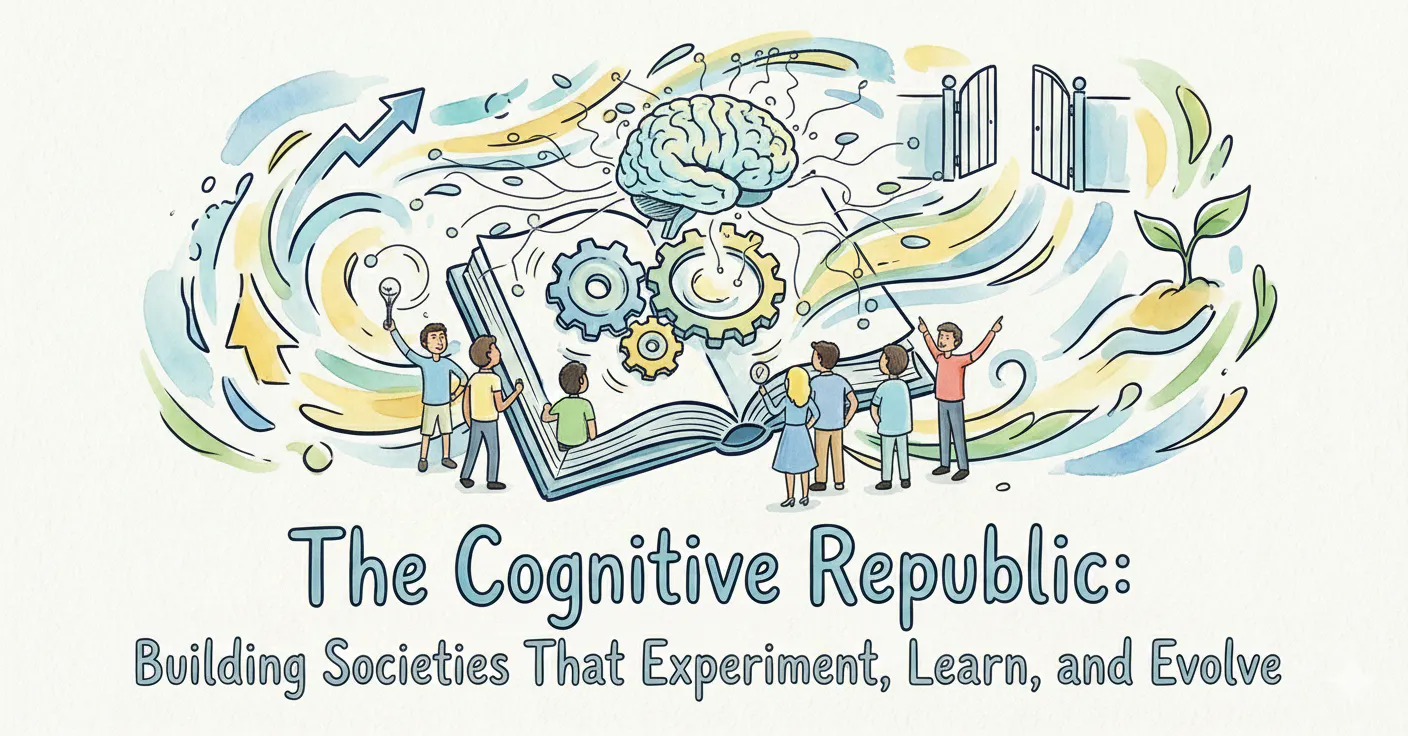
2. I argue we need to reboot our democracies, top-to-bottom from cognitive first principles:- sensing/attention, learning, prediction, adaptation, measurement, falsifiability/correctability, and collective (institutional) memory coupled to government-by-experimentation (policy trials, feedback loops, error-correction; institutions designed to learn across time (past/present/future); legitimacy maintained through transparency, participation, and safeguards against capture)– all to allow us to rethink liberal democracy as an adaptive learning and governance system. And this, I argue, is how we are going to save ourselves and save our futures.
Abundance treats material scarcity and state incapacity as the spark of zero-sum politics. Shared-prosperity adds that distribution and workplace power are the ignition source: growth without good jobs fuels the very resentments autocrats tap. Rule-of-law actors believe you must constantly police the edges because opportunists exploit every soft spot; electoral reformers contend that structural rules determine whether opportunists ever gain the leverage to do real harm. Watchdog politics can become performative or demoralising if it doesn’t connect to material gains; the solution is pairing rule-of-law defence with abundance/competence so voters see both integrity and delivery. Information reformers think the cognitive commons is the master variable; deliberative democrats argue that identity conflict can be transmuted if people reason together under fair procedures; anticorruption assumes autocracy is a business model that must be made unprofitable. Micawberism hopes that something will turn up!
These various democratic defenders share a deeper assumption: that our democratic systems are in fact fundamentally sound, and just need some tweaks and some patchwork repairs here and there, and everything will be as it was. Yes, these defenders recognise democracy is under pressure (from scarcity, capture, manipulation, disinformation, polarisation), but generally think the underlying core operating principles remain intact and continue to work in principle – there are just some operating glitches to be rectified. The recipe therefore is patch; repair; reinforce; restore; then we can return to the old ways, and all will be well with the world, and all will be for the best in the world (or some such Panglossian nonsense).
Next week for members only: a detailed critique of one of the most disappointing (and yet widely-lauded) books I have read in a while – Abundance by Ezra Klein and Derek Thompson. Whatever abundance is, it’s not the cure for what ails us.
Our Uneasy Present
Datum
07.01.2026
Kategorie
Cognitive Republic
0 Kommentare
Möchtest du den ersten Kommentar schreiben?
Werde Mitglied von Cognitive Republic und starte die Unterhaltung.