A history of the Republican Party – Part I: From anti-slavery origins to white conservative domination, 1850s to 1990
By Thomas Zimmer, March 8, 2026
This is Part I of a two-part series on the history of the Republican Party. Not a total history of the GOP and the American Right since the 1850s, of course – but an attempt to identify some key moments and dynamics and come up with something that may serve as a framework for how to think about that crucial question: How the hell did we get here?
The extended intro to this piece is free for everyone. If you want to read more than the preview or gain access to the audio version of the essay, please consider becoming a paid member of Democracy Americana, which is solely funded by readers and constitutes my main source of income as an independent writer.
Without your support, I will not be able to continue this work. Please know that I am immensely grateful for your generosity!
Not ready yet for a paid membership? You can subscribe to the free version of the newsletter:
It was such a deranged spectacle. On February 24, Donald Trump delivered a speech to a joint session of Congress that combined delusional ravings about his many imaginary achievements with vile threats against MAGA’s enemies – especially against the enemy within, the Democratic Party, who Trump derided as “sick people.” The longest State of the Union address in history – one hour and forty-five minutes of unhinged raging by a bigoted authoritarian with an unsound mind.
And the party that elevated this man to the most powerful political office in the world? They ate it all up. Congressional Republicans reacted with standing ovations, cheers, and aggressive chants of “U-S-A! U-S-A!” They joined Trump’s vile attacks on Democrats with jeering, booing, and heckling. A party defined by an authoritarian cult of personality. No trace of any residual sense of commitment to something even remotely recognizable as a democratic political culture.
There are many reasons why the U.S. political system is under pressure, why societal frustration is so widespread, why the trust in the traditional institutions of American political and civic life has been plummeting (Öffnet in neuem Fenster). But if we want to understand why the republic is on the brink, we must start with the fundamental reality of American politics today: The struggle over whether or not the country should actually be a pluralistic democracy maps onto the conflict between the two major parties. Democracy itself has become a partisan issue. As of right now, the Democratic Party is the country’s sole (small-d) democratic party – while the GOP is firmly in the hands of an ethno-nationalist movement and oligarchic interests that are determined to impose their reactionary vision by increasingly authoritarian measures.
It is difficult to remember now, but it wasn’t all that long ago that prominent Republican leaders warned against indulging the Trumpian temptation in stark terms: “If we nominate Trump, we will get destroyed,” Republican senator Lindsay Graham infamously posted on Ex-Twitter (Öffnet in neuem Fenster) in May 2016, when Trump was already certain to emerge from the GOP primaries as the Republican presidential nominee, “and we will deserve it.”
Almost a decade later, Donald Trump is still dominating the Republican Party. He has been the undisputed standard bearer of the American Right for over ten years. And Lindsay Graham? He is still in the Senate and strongly supports Trump. Like most of the Republican officials and operatives who were initially skeptical or even downright hostile towards Trump, Graham quickly fell in line; those who didn’t either retired, retreated from public life, or were swiftly ostracized from the party.
Today’s GOP is defined by a grotesque cult of personality, bizarre conspiracy theories, and pervasive extremism on all levels – from the base up to the party’s leadership. About two thirds (Öffnet in neuem Fenster) of Republican voters say they are convinced Democrats “stole” the 2020 presidential election. The „Great Replacement“ theory (Öffnet in neuem Fenster) – a conspiracy postulating that sinister leftist, “globalist” elites are orchestrating a nefarious plot to “replace” white people, to conduct a “white genocide,” mostly by bringing non-whites to America via uncontrolled immigration, by interracial marriage, by discriminating against whites in general, has long been mainstreamed in the party. Open white supremacism and neo-Nazi (Öffnet in neuem Fenster) ideology are widespread, particularly among a younger cohort of Republican (Öffnet in neuem Fenster) staffers and operatives. They are only following the example set by their leaders. Vice-president JD Vance has close personal ties not only to far-right intellectuals (Öffnet in neuem Fenster) who fantasize about restricting the franchise to men and reintroducing slavery, but also to the extremist online scene.
The boundaries between the mainstream and the extreme Right have always been porous – but in the Trump era, they have been obliterated completely. Trump himself never left any doubt that he considered the extremists a vital part of his movement. Not when he refused to reject (Öffnet in neuem Fenster) the endorsement of David Duke, the former grand wizard of the Ku Klux Klan, during the Republican primaries in early 2016; not when he signaled sympathy for the neo-Nazis (Öffnet in neuem Fenster) who violently marched through Charlottesville, Virginia under the banner of “Unite the Right” in the summer of 2017; not when he pardoned the insurrectionists who had stormed the Capitol on January 6, 2021 on his first day back in office. The Republican Party’s political culture, identity, personnel, and ideology are now fully dominated by MAGA.
I think we can safely ignore the idea that Trump’s rise was merely the result of a temporary delusion, just an accident, a momentary aberration. It has been a while. And the Republican Party steadfastly refuses to take any of the off-ramps that have presented themselves. There was a brief moment of hesitation among party elites after January 6 – but even then, it didn’t take long for Republicans to close ranks behind the man whose months-long attempt to nullify the results of a democratic election had just ended with a violent assault on Congress.
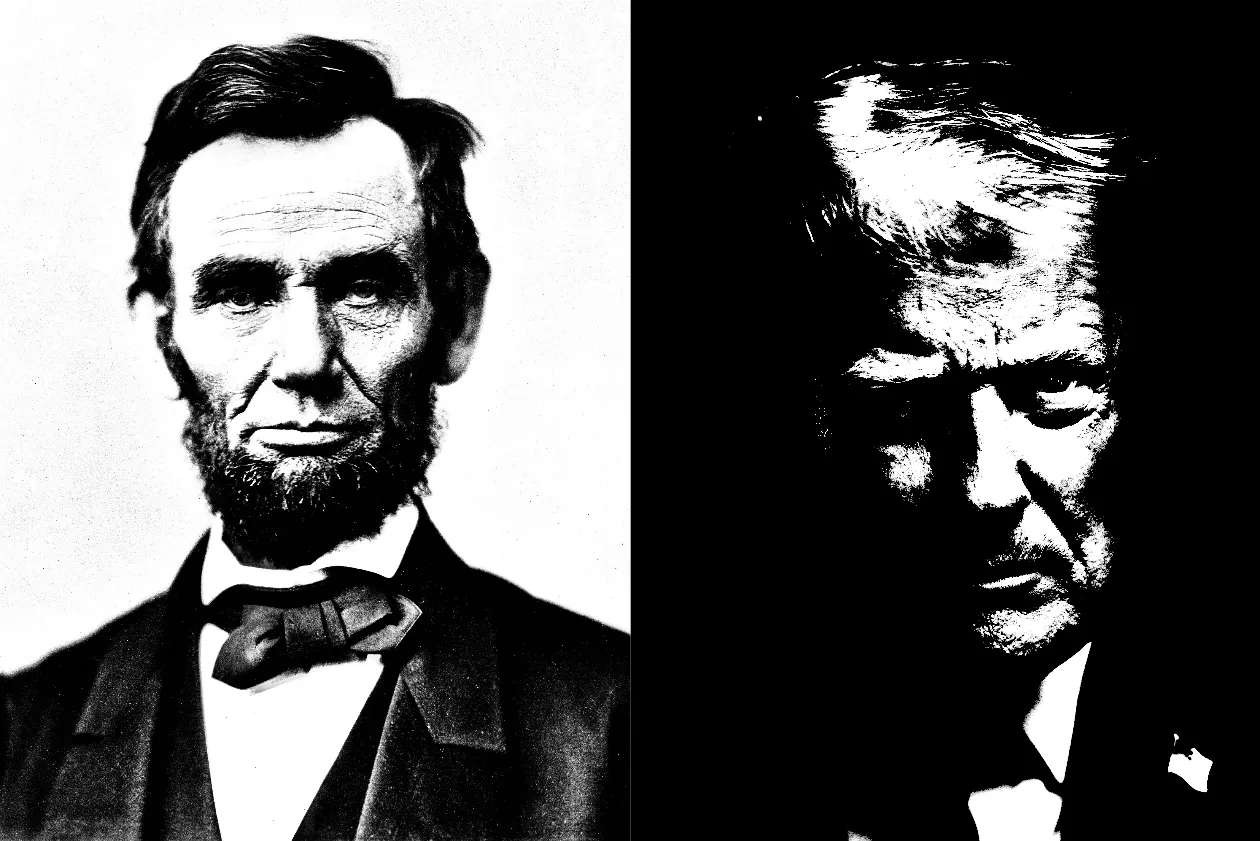
How did we get here? Or, as an editor at the newspaper Die Zeit put it to me a while ago, as we were discussing the most pressing issues I should be tackling in a regular column I am writing for a German audience: How the hell did the Republican Party go from Abraham Lincoln to Donald Trump?
I like being confronted with such big-picture questions because they force us to zoom out and step all the way back from the eternal chaos of the Trump experience. It demands perspective, that thing we too often neglect. From Lincoln to Trump. Or, as my friend and fellow historian Seth Cotlar put it in January (Öffnet in neuem Fenster): From “Radical Republicans ca. 1871: We’re sending federal troops into states in order to curb the power of white supremacy” – to “Radical Republicans ca. 2026: We’re sending federal troops into states in order to advance the cause of white supremacy.”
It really is quite the trajectory: The party that was founded to fight slavery in the middle of the nineteenth century is now fully in the hands of a white nationalist movement devoted to restoring and entrenching white Christian patriarchal domination across all spheres of American life.
My goal is obviously not to provide an all-encompassing answer or a total history of the Republican Party and the American Right since the 1850s. Let’s identify some key moments and dynamics – something that may serve as a useful framework for how to think about that crucial question: How the hell did we get here?
This is the story of how a party with anti-slavery origins first became a “big tent,” then came to be dominated by Modern Conservatism, and has since gone the way of the conservative movement: Taken over by extremists who had always been part of the rightwing coalition, but never so powerful. This outcome was not determined. The anti-democratic tendencies that have come to dominate the GOP have pulled the party to the right for decades. But there were alternative paths available. Republican elites, in particular, had agency – but chose to go along with or actively further the rise of extremism.
And here we are now, with a Republican Party that has pushed the republic to the brink.
“Grand Old Party“
For about a century and a half, the Republican Party has carried the moniker “Grand Old Party.”
Datum
08.03.2026
3 Kommentare
Möchtest du die Kommentare sehen?
Werde Mitglied von Democracy Americana und diskutiere mit.