January 2023
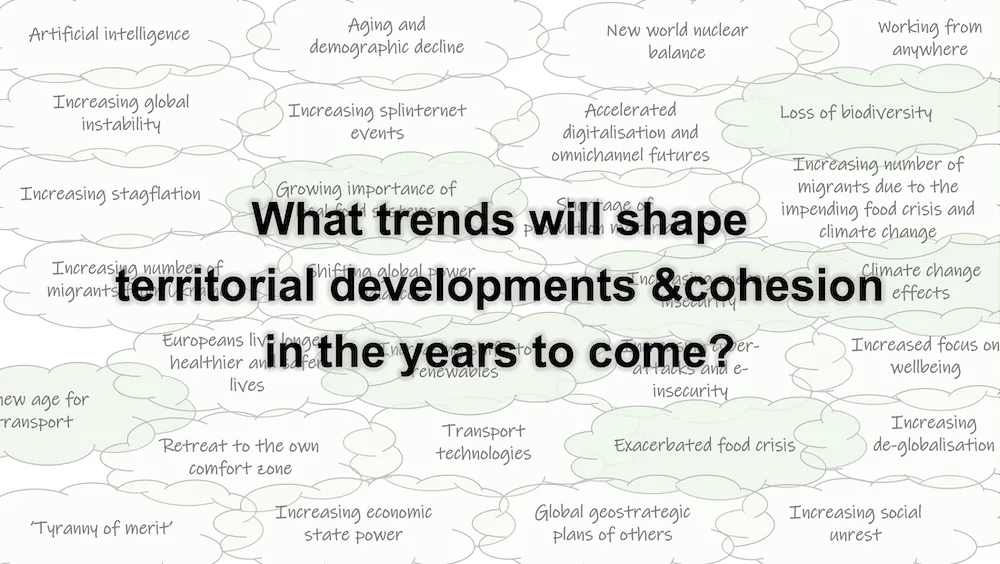
Following up on the blog post on technological trends (Öffnet in neuem Fenster) shaping territorial cohesion, this blog post addresses a collection of environment related trends. The collection is based on various studies addressing mega-trends which we have conducted during 2022, e.g. for the European Parliament (Öffnet in neuem Fenster), the European Committee of the Regions (Öffnet in neuem Fenster) or ESPON (Öffnet in neuem Fenster). Bringing together the various pieces of trend analysis provides a rich picture about possible developments which may shape territorial development and cohesion in Europe. Therefore, we have brought them together in a series of blog posts (to be published between December 2022 and February 2023) addressing societal, technological, economic, environmental and political trends.
Trends considered to have the strongest impacts on territorial development and cohesion include exogenous technological trends (e.g. digital society, post-carbon and circular economy), social change (e.g. migration, aging, fluid social institutions and shifts in values), environment (e.g. adapting/mitigating climate change and managing scarce resources), and economic (e.g. slowbalisation, peak of everything, working from anywhere). Also political trends play an important role, both political developments in Europe, as well as those in other parts of the world which affect development prospects in Europe.
The combined picture which emerges from this suggests that future trends are likely to exacerbate spatial and societal fragmentation, interdependencies and policy mismatches. In many regards the trends point to a risk of increasing concentration on urban areas with growing territorial imbalances and inequalities, which may translate into social fragmentation and increasing discontent. This also risks to increase perceptions of uncertainty and vulnerability in a world of disruptive changes leading to ‘pervasive uncertainties’.
Environment related trends
The Anthropocene, i.e. the era where we humans are responsible for climatic changes, causes dramatic consequences for the environment. At global level, climate change has been an emerging issue for decades. The long-term impacts of climate change will change development perspectives in the decades to come, as it increases the frequency of extreme and intense events such as floods, droughts, forest fires and increased earth and sea temperatures, damaging both nature and people. Most of this has not at least been discussed in the context of the COP27 in Sharm El-Sheikh.
In addition, the loss of biodiversity, pollution of the seas and other developments will become ever more relevant. All of this has disruptive effects undercutting the basis of livelihoods, the economy and spatial development. Human activities leading to pollution and soil sealing have caused a continuous and rapid decline in biodiversity. Current extinctions are 100 – 1,000 times higher than the baseline, and many ecosystems have been degraded beyond repair or are at risk of ‘tipping points’. In addition, the threat of pollinator extinction due to environmental pollution, climate change, intensive agriculture and land use change poses risks for the production of food, cotton, linen, biofuel, construction material. Insects are vital for 78% of wildflower species and 84% of crop species seed production.
The underlying drivers include increased growth, overproduction and overconsumption, overexploitation of natural resources, pollution and high energy demands.
Besides these overarching trends, there are also subsequent trends related to energy issues, agricultural production and behavioural changes:
Increasing energy insecurity. The energy shocks caused by Russia´s war on Ukraine are profound. The war has reversed the trend of lower energy prices and shown the high dependency of the EU on Russian energy. This may impact EU climate policy and carbon neutrality plans for 2050, as high energy prices could reduce the capacity and willingness of consumers and businesses to cover the energy transition costs. Further negative effects regard the delay in the green transition, with several member states prolonging coal production.
Increasing shift to renewables. On the other hand, these developments might also have an opposite effect and accelerate the green transition. The shift towards more renewable energy production finds itself at a ‘make or break’ point. The EU has already published a plan, RePowerEU, aiming to reduce energy dependency on Russia, increase the uptake of renewable resources, accelerate hydrogen production and decarbonise industry. Such investments and actions should consider biodiversity, as energy installations and infrastructure may pose risks to natural habitats.
Exacerbated food crisis. Food security is also a higher risk. Although this is already challenged by climate change, extensive droughts and intense agriculture, the war has exacerbated the risk. Ukraine is a key food basket providing the EU and large parts of the world with cereal. Exports and production are currently limited, while Russia is a key exporter of both cereal and fertilizers but faces sanctions. This may cause a global food crisis, with higher food prices and inflation also in the EU.
Growing importance of local food systems. During the pandemic mobility was restricted and many shops closed so people often turned to local producers who developed their offer for local customers, sometimes starting local delivery services. This change initiated in consumer behaviour and producers reorganised their businesses. Shorter agricultural production chains and local circuits could continue, especially if this is supported by local policies.
A new age for transport. Driven by our behavioural changes, scenarios project important transformations in transport. A decrease in road passengers while the market for electric vehicles is projected to grow by 65% over the next decade. In such a scenario, electric vehicles would constitute 16% of the fleet by 2030. The trend could be mitigated by an expected decline in private car ownership. Air passenger transport is projected to decrease by 21% by 2030 compared to a no-pandemic scenario. This would be due to energy efficiency and declining activity, as technological innovation in aviation such as electric or hydrogen powered aircraft is expected to have an impact only from 2030 on.
Mega-trends related to the environment point to territorial implications at global level including climate change implications, loss of biodiversity, changing agricultural production (what can be grown where), etc. This has not at least been a hot issue of the COP27 in Sharm El-Sheikh.
However, they also have strong implications at lower scales affecting territorial development and cohesion also in Europe, with an overhanging risk of increasing regional disparities. Most importantly, however, these mega-trends are expected to have effects on our behaviour and behavioural patterns to mitigate undesired impacts or adapt to them.
by Kai Böhme
https://steadyhq.com/en/spatialforesight/posts/81662208-b7b9-4956-b88d-9fe96b13042d (Öffnet in neuem Fenster)
Datum
09.01.2023
Kategorie
Trends
0 Kommentare
Möchtest du den ersten Kommentar schreiben?
Werde Mitglied von spatialforesight und starte die Unterhaltung.