March 2026
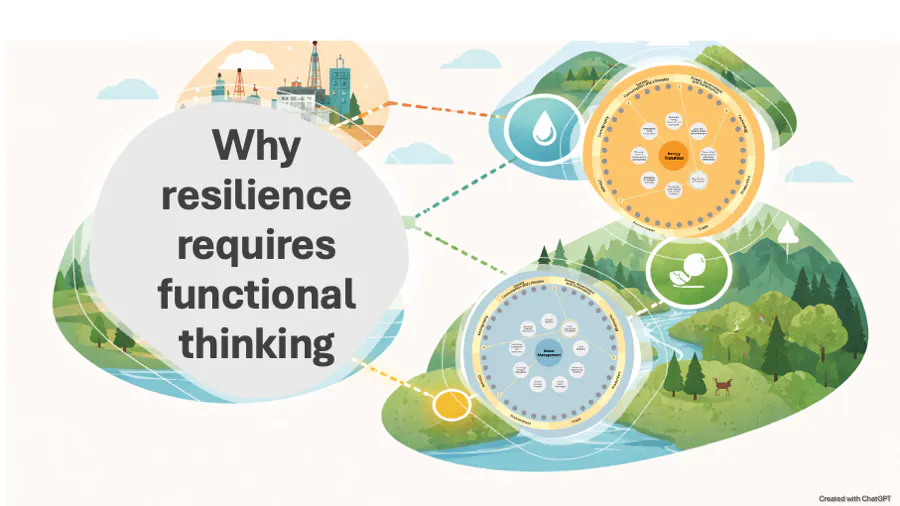
Resilience has become a central reference point in European policy debates. From droughts and floods to pandemics, supply chain disruptions, geopolitical risks and energy shocks, public authorities are confronted with cascading risks that are systemic rather than isolated. Yet a fundamental question remains insufficiently addressed: are our territorial governance structures aligned with the spatial logic of the risks we seek to manage?
In an interconnected world, vulnerabilities do not respect administrative borders. Consequently, resilience, if taken seriously, compels us to look beyond inherited administrative territories and to engage more systematically with functional geographies, corresponding to the spaces of flows, ecosystems, infrastructures and communities. Functional geographies are not optional; they are becoming structurally unavoidable.
The Analysis and infographics of trends and drivers of change developed by the ESPON study on territorial governance of non-standard geographies (NoStaGeo) make unmistakably clear: across policy domains, the dominant trends and drivers systematically undermine the adequacy of purely administrative territorial thinking. If governance is to become more anticipatory and adaptive, it must engage more deliberately with functional geographies. Check out the detailed infographics developed by the project (Öffnet in neuem Fenster). They have inspired this blog post.
Resilience as a spatial question
Resilience is often considered in terms of specific sectors: water resilience, energy resilience, health system resilience and industrial resilience, for example. However, the NoStaGeo infographics illustrate that resilience challenges are consistently spatial in nature.
Take water management, for example. Droughts and floods are shaped by hydrological systems, not municipal boundaries. Upstream retention measures influence downstream flood risks. Groundwater extraction in one area affects availability in others. Therefore, functional areas for drought or flood resilience emerge as the sum of areas within which indispensable actors for meaningful dialogue operate. Anticipatory governance in this field requires alliances on a basin scale.
Energy transitions display a similar logic. The expansion of renewable energy, smart grids and cross-border interconnections reconfigure the geography of production and consumption. Decentralised energy communities generate new local functional spaces, while hydrogen infrastructure and TEN-E corridors create transnational ones. Concerns about energy security, exacerbated by geopolitical tensions, further emphasise the need to diversify supply and redesign networks beyond national borders.
In biodiversity policy, traditional protected area models are increasingly inadequate. Climate change-driven habitat shifts demand ecological connectivity and landscape-scale approaches. Functional geographies are shaped by corridors, land–sea interactions, and ecosystem processes that transcend administrative boundaries.
The message is consistent across domains: resilience operates at functional scales.
Functional geographies: more than technical delineations
Approaches to functional areas are sometimes treated as technical tools for delineating labour market areas, transport catchments, or river basins. However, the NoStaGeo infographics suggest something deeper.
Functional geographies are increasingly multi-scalar. For example, energy communities may operate at a neighbourhood scale, while hydrogen corridors or electricity interconnections link countries. Health service provision may be reorganised around the daily mobility patterns of ageing populations, while European Reference Networks connect specialised providers across borders.
Functional areas are not purely infrastructural. They are also socio-cultural. Water bodies shape local identities and community engagement. Indigenous and local knowledge systems structure biodiversity governance in culturally embedded territories. Nature tourism aligns economic development with ecological and cultural assets.
Financial mechanisms are increasingly operating at functional scales. Green bonds, public-private partnerships, and performance-based contracts require actors with sufficient capacity and territorial reach. This influences the spatial organisation of water infrastructure, renewable energy projects and restoration initiatives.
Functional thinking is therefore not just about creating new maps. It is also about recognising that governance, finance, technology and identity co-evolve in spatially differentiated ways.
Who governs these processes? How can accountability be ensured when decision-making spans multiple administrative units? And how can participatory processes, which are so central to ecosystem-based and community-led approaches, be embedded in cross-border functional governance?
3 governance dilemmas emerging from functional scaling
The NoStaGeo infographics highlight the need for more functional approaches in the face of major transformation. Below the examples of climate change, geopolitical tensions and digitalisation.
Climate change as a systemic driver of spatial reorganisation
The above can be illustrated, for example, by the issue of climate change. The implications of climate change are visible in areas such as water management, energy systems, biodiversity preservation, agriculture and urban development.
More severe and frequent droughts are reshaping the availability of freshwater and intensifying competition between households, agriculture, industry, and energy production. At the same time, increased flood risks – riverine, coastal and pluvial – are stressing interdependencies between upstream and downstream areas that cannot be managed within single jurisdictions. The key drivers here are not only the physical impacts of climate change, but also the uncertainty surrounding future precipitation regimes. Anticipatory governance must therefore operate at the scale of river basins and incorporate the activities of those who affect shared hydrological systems.
In biodiversity policy, climate change and habitat shifts necessitate greater connectivity between protected areas. Ecological corridors and landscape-scale planning are functional responses to a driver that disrupts static conservation models. Similarly, marine ecosystems are affected by rising temperatures, acidification and habitat destruction, which reinforces the need for integrated coastal and land–sea approaches.
Climate change is therefore not only an environmental driver. It is also a territorial restructuring force.
Geopolitical tensions reconfiguring economic geographies
Another cross-cutting driver is the increase in geopolitical tensions and the pursuit of 'open strategic autonomy'. The pandemic, the war in Ukraine, and global trade disputes have exacerbated concerns about supply chain vulnerabilities and critical dependencies.
This is evident in reindustrialisation processes, reshoring and friendshoring strategies, as well as the identification of strategic industrial ecosystems. Industrial transitions are increasingly framed around resilience, supply security and technological sovereignty. In this context, functional geographies are shaped by supply chains, cluster networks and corridor infrastructures that transcend regional and national borders.
Energy security is another area in which geopolitical factors influence territorial organisation. The REPowerEU initiative and the diversification of energy sources aim to reduce dependence on fossil fuel imports. The expansion of renewable energy, hydrogen infrastructure and cross-border electricity interconnections is creating new spatial configurations of production, storage and distribution.
In this context, anticipatory governance requires mapping vulnerabilities across networks and designing functional cooperation spaces that enhance resilience against external shocks.
Digital transformation as integrative and divisive force
Technological innovation, particularly digitalisation, is a pervasive driver across sectors.
In water management, for example, the deployment of sensors, Internet of Things (IoT) technologies and digital twins enables the simulation of system behaviour and the optimisation of resource allocation. In biodiversity policy, remote sensing, AI, and advanced monitoring tools enhance data-driven decision-making and enforcement capabilities. In healthcare, telemedicine and data interoperability are reshaping service provision geographies. In industry, smart manufacturing and digital supply chains are redefining production networks.
Digital transformation strengthens functional integration by connecting territories through data flows and real-time coordination. However, the uneven deployment of high-speed infrastructure and 5G corridors could create new digital divides.
The driving force here is not technology alone, but rather the combination of technological advances, open data policies, and the strategic push towards digital sovereignty. Functional geographies are increasingly emerging from digital connectivity patterns rather than physical proximity alone.
From Identifying Drivers to Governing Functionally
Across the areas of water, energy, industry, health and biodiversity interdependencies are intensifying and the spatial mismatch between risks and governance structures is becoming increasingly apparent. Resilience may ultimately depend less on funding instruments and more on Europe’s willingness to rethink territoriality itself.
In such a context, anticipatory governance requires:
Understanding the geography of systemic risks.
Mapping infrastructure, ecosystem and supply chain interdependencies.
Designing cooperative frameworks that operate at functional scales.
Ensuring that digital, financial and institutional capacities align with these scales.
Safeguarding cohesion and democratic legitimacy within cross-border arrangements.
Resilience may ultimately depend less on funding instruments and more on Europe’s willingness to rethink territorial governance. Governance must evolve in an interconnected world. The effective scale of action is increasingly defined by function rather than formal jurisdiction.
If you want to dive deeper into the findings of the ESPON NoStaGeo project (Öffnet in neuem Fenster):
Trends and Drivers of Change Infographics (Öffnet in neuem Fenster)
European Territorial Governance Dashboard (Öffnet in neuem Fenster)
 (Öffnet in neuem Fenster)
Datum
05.03.2026
Kategorie
Resilience & transition
0 Kommentare
Möchtest du den ersten Kommentar schreiben?
Werde Mitglied von spatialforesight und starte die Unterhaltung.