January 2026
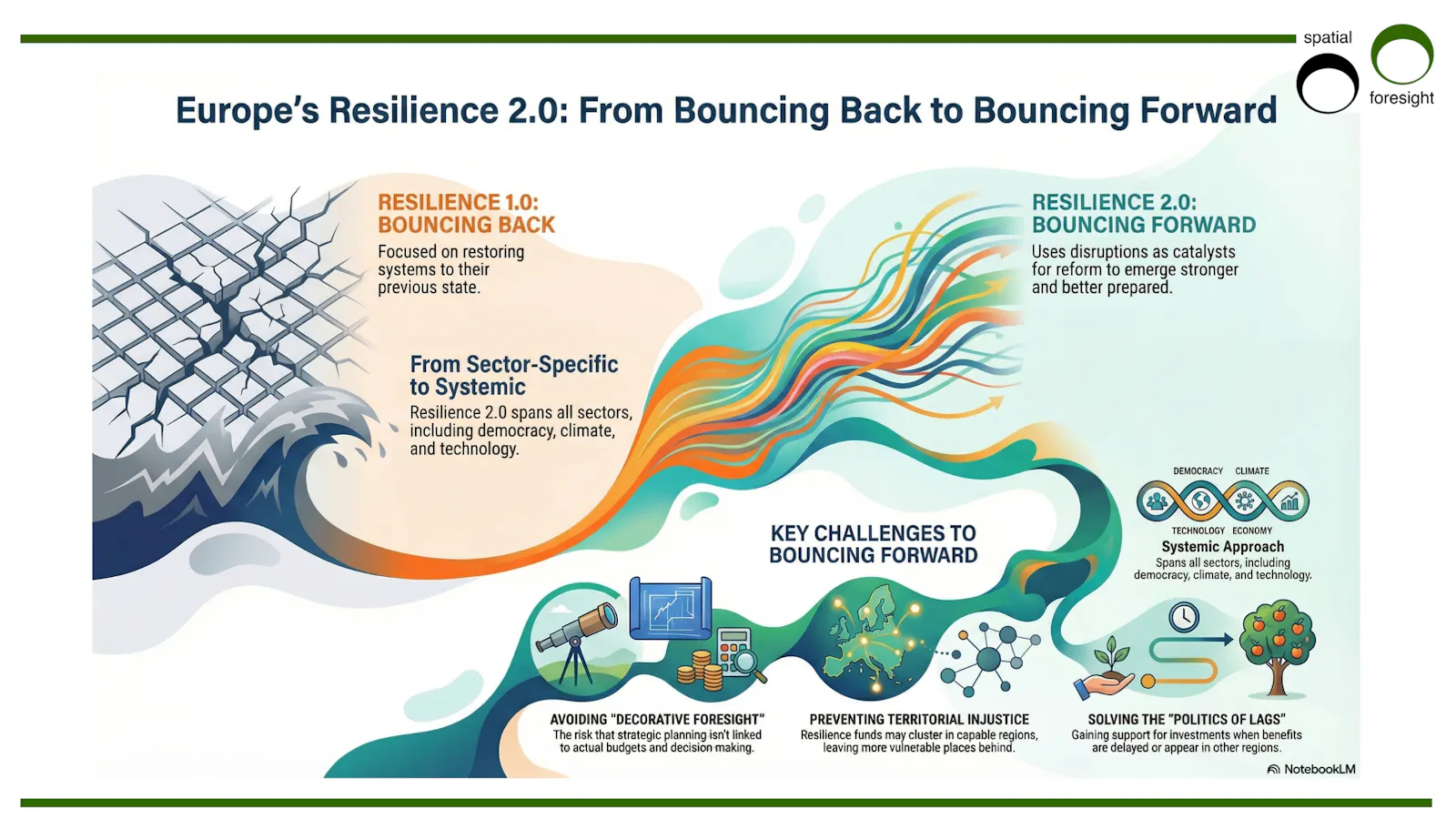
Europe has entered an age of permanent volatility. From pandemics to energy crises and disruptions in global trades, shocks are no longer exceptions; they are becoming structural. In each crisis, 'resilience' became the watchword: the ability to withstand pressure, adapt, and continue functioning.
However, resilience is not just about preparing for the last crisis. By definition, it must address the unexpected, i.e. shocks that disrupt established routines and demand new responses. Crucially, resilience is not about 'bouncing back' to a previous equilibrium. It is about finding new equilibriums adapted to a changed reality, often under conditions of uncertainty. See also an earlier blog post on territorial resilience (Öffnet in neuem Fenster).
The European Commission’s 2025 Strategic Foresight Report (Öffnet in neuem Fenster) proposes a shift under the banner of 'Resilience 2.0'. But what does this mean in practice, and how might it play out across Europe’s diverse territories?
From bouncing back to bouncing forward
The Commission defines Resilience 2.0 as shifting from reactive crisis management towards a more proactive, anticipatory and transformative approach. The traditional concept of resilience focused on absorbing shocks and restoring systems to a steady state. In contrast, Resilience 2.0 calls for 'bouncing forward': a type of resilience that is transformative, proactive, and forward-looking. Resilience 2.0 is about more than just absorbing shocks; it involves anticipation, adaptation, transformation and strategic positioning in a turbulent world. The aim is for the EU to not only weather shocks, but also to emerge stronger and better aligned with long-term goals such as the competitiveness, strategic autonomy, green transition, digital sovereignty and social inclusion.
This implies that the ambition behind Resilience 2.0 is systemic. Resilience is no longer the responsibility of individual sectors, such as energy, health or finance, but rather spans across sectors and broader dimensions, including democracy, geopolitics, climate, technology and society. It is intended to guide Europe's long-term trajectory.
There is power in this idea of Resilience 2.0. However, it is also ambiguous. While 'proactive’, ‘forward-looking’ and ‘transformative' are attractive labels, they risk remaining merely rhetorical unless they are translated into operational governance, budgets and decision-making frameworks.
Key challenges for Resilience 2.0
Taking a structured approach, there are several core dimensions characterising Resilience 2.0 in the way it is currently outlined, each with its own set of challenges.
Proactive preparedness and anticipation
Rather than waiting for crises, actively scan, horizon scan, issue early warnings, conduct stress tests and develop scenario plans.
Challenge: institutionalising long-term foresight within short electoral cycles and avoiding paralysis by 'what-if overload'.
Transformative response: bounce forward, not back
Use disruptions as catalysts for reform (e.g. accelerating the energy transition, achieving digital sovereignty or mastering demographic change) rather than restoring the status quo.
Challenge: manage social, political and regional disruptions and the risk of exacerbating inequalities or creating uneven territorial effects.
Robustness and adaptability
Design systems that can absorb shocks and adapt dynamically rather than rigid ones that collapse under unexpected stress.
Challenge: risk of overoverengineeringcreatingrisk of overengineering or creating inflexible 'resilience traps'.
Embed foresight and scenario governance
Foresight becomes a standing feature of policymaking, rather than ad hoc. From 2026 onwards, the annual Strategic Foresight Reports will be informed by a robust foresight process, including exploring alternative possible future scenarios.
Challenge: ensuring that foresight meaningfully shapes budgets, regulatory frameworks and institutional incentives, rather than being merely decorative.
Democratic resilience and values protection
Recognising threats to democracy such as disinformation, polarisation, and external interference, the aim is to protect democratic institutions, the rule of law, and social cohesion.
Challenge: hard to measure or ‘stress test’ democracy, and there is tension between resilience and surveillance or control measures.
Global vision and geopolitical anchoring
Having a coherent external posture (norms, alliances, defence and multilateral reform) to ensure that internal resilience is not undermined by external shocks e.g. in the area of geopolitical and global trade relations.
Challenge: balancing ambition with capacity, resisting overreach and aligning the foreign policies of member states.
Taken together, these dimensions show that Resilience 2.0 is not just a technical issue, but equally a political and a governance challenge. Achieving its goals will require new forms of coordination and decision-making, as well as long-term commitment, at all levels of government.
Places matter for Resilience 2.0
While the above dimensions outline the conceptual ambitions of Resilience 2.0, the picture is incomplete without acknowledging where resilience is actually realised. Shocks are experienced locally, responses are implemented regionally, and long-term transformations depend on the capabilities and constraints of specific territories. In other words, resilience is both an EU-wide strategic compass and a territorial practice.
Different regions experience different shocks and have different capacities and long-term trajectories. For example:
Border regions are exposed to geopolitical tensions and disruptions to mobility and trade.
Outermost regions and islands struggle with import dependence, connectivity gaps, and high climate vulnerability.
Shrinking rural areas are affected by demographic decline, an ageing population, and inadequate service provision.
Metropolitan hubs concentrate infrastructure and political functions, making them both innovation engines and systemic risk hotspots.
A one-size-fits-all approach to resilience will not work. Instead, Europe must recognise the diverse vulnerabilities and opportunities of its territories, in line with the call for a future for all places in the Territorial Agenda 2030 (Öffnet in neuem Fenster). How might Resilience 2.0 take shape across Europe’s diverse territories? Any answer must be tentative, since uncertainty and local contexts vary widely.
Moreover, resilience decision-making is complicated by lags:
Time lags, where costs must be incurred today but benefits only materialise decades later (for example, investments in water retention or grid flexibility).
Spatial lags, where investments in one region (e.g. flood management upstream) generate benefits in another (e.g. flood safety downstream).
These lags raise thorny governance questions: who pays, who benefits, and how can political legitimacy be secured when payoffs are delayed or displaced?
Resilience 2.0 is about innovation in governance
To make Resilience 2.0 more than just rhetoric, innovations in governance are needed. This requires further thought and strategic action on how to embed Resilience 2.0 in relevant policy and strategy documents at all levels, from local to European.
The proposed EU long-term budget (MFF) for 2028–2034, the National and Regional Partnership (NRP) plans envisaged in this context, and the European Semester Country Reports could all serve as a starting point. In any case, Resilience 2.0 must become an integral and natural part of policymaking, rather than an additional reporting system or policy pipeline.
Several pitfalls loom.
Decorative foresight: strategic talk without binding mechanisms. Unless the results of foresight trigger budgetary reallocations, Resilience 2.0 may remain merely rhetorical.
Territorial injustice: funds may cluster in metropolitan regions that are already capable, leaving vulnerable places behind.
Coordination overload: multi-level compacts can stall if roles and responsibilities are unclear.
Data gaps: rural, peripheral and cross-border regions often lack the granular data needed for effective stress testing.
Politics of lags: can governments and citizens commit to investments when the benefits may accrue elsewhere or decades later?
Outlook: buzzword or compass?
Resilience 2.0 shows promise as a strategic compass. However, its success will depend on its integration into place-sensitive governance, its responsiveness to uncertainty, and its willingness to engage with the politics of time and space.
Europe’s resilience will not be decided solely in by European or national policy makers. Rather, it will be forged in border towns managing new dependencies; in mountain valleys exposed to climate hazards; in industrial regions navigating painful transitions; in shrinking areas struggling to maintain essential services, etc.
Foresight approaches and anticipatory governance play a critical role here, connecting broad ambitions with territorial realities, making trade-offs explicit and helping territories design strategies that accept uncertainty, anticipate long-term risks and pursue new equilibriums.
The open question is whether Resilience 2.0 will become a lived practice of anticipatory, place-sensitive governance, or whether it will remain just another buzzword from Brussels. A concerted effort is needed to develop a tool for policy development at EU level as well as at local and regional level that can capture the Europe’s territorial diversity. It is important to gain practical experience at local and regional level on how to innovate governance of forward-looking resilience efforts.
by Kai Böhme
 (Öffnet in neuem Fenster)
Datum
13.01.2026
Kategorie
Resilience & transition
0 Kommentare
Möchtest du den ersten Kommentar schreiben?
Werde Mitglied von spatialforesight und starte die Unterhaltung.