Ten years ago, leading conservatives came out “Against Trump” – but soon let their disdain for “the Left” override all else. It is the story of Modern Conservatism in a nutshell.
By Thomas Zimmer, February 24, 2026
The first part of this piece is free for everyone. If you want to read more than the preview or gain access to the audio version of the essay, please consider becoming a paid member of Democracy Americana, which is solely funded by readers and constitutes my main source of income as an independent writer. Without your support, I will not be able to continue this work. Please know that I am immensely grateful for your generosity!
Not ready yet for a paid membership? You can subscribe to the free version of the newsletter:
For almost exactly a decade, Donald Trump has dominated the Republican Party and acted as the de facto standard bearer of American political conservatism, defining the identity of today’s Right. How did it come to that?
Two diametrically opposed tales quickly emerged in response to Trump’s rise: There is the story of Trumpism-as-aberration, according to which the venerable tradition of principled American conservatism has been hijacked by an utterly unprincipled demagogue; Trumpism, in this interpretation, is fundamentally not conservatism at all, its triumph an accident, the recent trajectory of the Right a departure from what came before. Conservatives were seduced, or they were cowards in the face of an insurrection, a hostile takeover of the true conservative tradition.
The counter-interpretation holds that Trump’s rise was really no big surprise at all: This is what American conservatism, at its core, had always been – a movement fueled and defined by racial and cultural grievance, held together by anti-liberal sentiment. Everything else was just a front, a veneer of intellectual depth and respectability; there had been no venerable tradition to begin with, rather a fairly straight line from William F. Buckley (or perhaps even much earlier than that) to Ronald Reagan to Pat Buchanan and Newt Gingrich to Sarah Palin to, finally, Donald Trump.
How did we get here? If we want to get the diagnosis right, the most plausible interpretation lies somewhere in-between these tales of either total aberration or complete continuity (though that does not mean exactly in the middle). The challenge is to grapple seriously with long-standing traditions and continuities while also acknowledging and investigating the more recent radicalization.
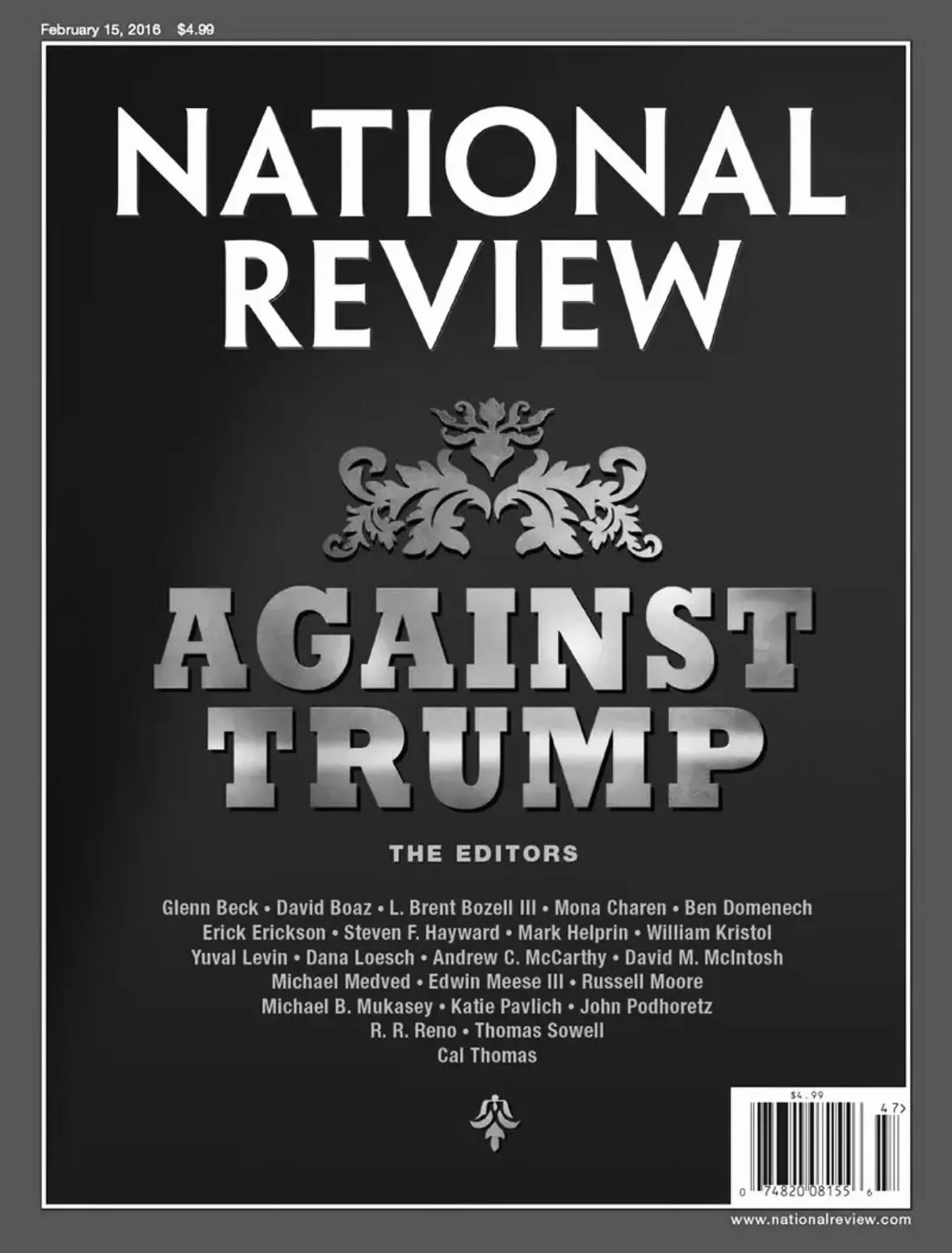
Let me take you back exactly ten years to investigate a very interesting moment in that story. On January 22, 2016, about a week before the Republican primaries were to start, the conservative magazine National Review came out “Against Trump” (S'ouvre dans une nouvelle fenêtre): That was the title of a special issue published first online and then, in mid-February, in print. National Review is widely regarded – or certainly regards itself – as the flagship of “serious,” high-brow conservative commentary. It has served as a central organ of Modern Conservatism since it was founded in 1955. As it was clear that Donald Trump, who led in the polls, was threatening to emerge as the Republican candidate, National Review, led by editor (now editor-in-chief) Rich Lowry decided to make a stand against the man they called, in a blistering editorial (S'ouvre dans une nouvelle fenêtre), “a menace to American conservatism.” To support the magazine’s stance, the editors also brought together twenty-two leading conservative intellectuals (S'ouvre dans une nouvelle fenêtre), media personalities, and activists to make the case “Against Trump” in essays of 300 to 500 words each.
“Against Trump” came out to great fanfare. Every major news outlet (S'ouvre dans une nouvelle fenêtre) and paper (S'ouvre dans une nouvelle fenêtre) in the country covered it like it was a big deal. Trump, who had zero political experience and had risen to prominence within the Republican Party as the chief proponent of the racist “birther” conspiracy theory, had obviously gotten very far. But perhaps this would, finally, mark the end of the line for him – the moment when honorable people on the Right stood up and said: Enough?
Some of the people who were part of “Against Trump” have indeed been steadfast in their opposition – with several of them, like Bill Kristol and Mona Charen, coming together at The Bulwark as the “Never Trump” conservatives’ central platform. But they were the exceptions.
Would you believe it, most of the people who contributed to “Against Trump” either quickly turned full-on MAGA or they committed to an aggressive anti-anti-Trumpism, a position that is often functionally indistinguishable from a more open endorsement of MAGA as it is devoted to making the case that Donald Trump’s opponents are at least as bad as whatever he may have to offer.
There are, to give you just a few examples, rightwing talk radio hosts and all-around-pundits Erick Erickson and Glenn Beck, who proudly proclaimed they, as “constitutional conservatives” (Beck) who took their “conservatism seriously” (Erickson) could not justify supporting Donald Trump… only to then start supporting him soon thereafter. Begrudgingly, of course, as Erickson would often emphasize, at least when he was talking to (S'ouvre dans une nouvelle fenêtre) mainstream media outlets; or perhaps not so begrudgingly, as Beck has praised Trump (S'ouvre dans une nouvelle fenêtre) rather effusively since.
Or take L. Brent Bozell III., a prominent rightwing commentator at the time who, in “Against Trump,” declared “Trump might be the greatest charlatan of them all.” Bozell comes from conservative royalty: His father was L. Brent Bozell Jr., the ghostwriter of the 1960 book “The Conscience of a Conservative,” a core text in conservative history published under the name of Barry Goldwater, which helped catapult the Arizona senator to rightwing stardom and ultimately the Republican presidential nomination in 1964; his mother was Patricia Buckley Bozell, sister of National Review founder William F. Buckley, the godfather of the modern conservative movement. Bozell III. has since, uhm, reconsidered his position on Trump the charlatan, declaring in the fall of 2020 (S'ouvre dans une nouvelle fenêtre) that “the Left” was preparing to “steal the election” from Donald Trump, planning to “usher in totalitarianism.” Bozell currently serves as Trump’s ambassador to South Africa – where he certainly has no issue representing the regime’s white nationalist agenda, as he always opposed the anti-Apartheid movement.
Finally, there is National Review editor-in-chief Rich Lowry himself, the driving force behind “Against Trump.” By the time his 2019 book “The Case for Nationalism” came out, Lowry was pretty much all in on America First, declaring that (S'ouvre dans une nouvelle fenêtre) “Trump instinctively believes in our country first and our interests first.” Lowry was also impressed how Trump had supposedly “delivered” on all the key issues: “On some really important matters of substance to conservatives of long-standing, he’s been a rock.” And in typical anti-anti-Trump manner, Lowry also decided that the “Left” was simply worse. So much so that, in August 2024, he made the case in The New York Times that “Trump Can Win on Character” (S'ouvre dans une nouvelle fenêtre) – an area where Lowry claimed Trump had the advantage over his Democratic opponent Kamala Harris.
As we just passed the tenth anniversary of “Against Trump,” I believe it is very much worth revisiting this document that can provide a window into a key moment in the Right’s radicalizing trajectory – and the permission structures that have governed rightwing politics for decades.
“If Trump were to become the president, the Republican nominee, or even a failed candidate with strong conservative support,” National Review asked in its 2016 editorial, “what would that say about conservatives?” It’s an excellent question, isn’t it?
To some extent, the answer is rather banal and boring, of course. There is quite a bit of careerism and cynical opportunism at play here, combined with a hefty dose of hypocrisy. Whatever noble principles the “Against Trump” contributors may have invoked in early 2016: To most of them, they evidently weren’t all that fundamentally important – certainly not important enough to be a deal-breaker once Trumpism rose to power.
But there is a story here not just about ignoring principles – but about a radicalizing tendency inherent in the defining principles of Modern Conservatism itself, in the way the political identity of Modern Conservatism, the movement that coalesced in the middle decades of the twentieth century, was defined from the beginning not as small-c conservatism in the colloquial sense, but by a reactionary devotion to anti-liberalism and fueled by disdain for “the Left.”
For a political movement so constituted, the question has always been: Is there a limiting principle – or just a principled commitment that demands you do whatever it takes? Is there a line a “Modern Conservative” (as opposed to a small-c conservative) is not permitted to cross in the struggle against the forces of leftism, even if it meant accepting the liberalization and pluralization of American life?
The answer the leaders of the modern Right have given themselves and us, over and over again, is: No, there is not.
Date
24/02/2026
4 commentaires
Souhaitez-vous voir les commentaires ?
Devenez membre de Democracy Americana pour rejoindre la conversation.