Once upon a time, hardware was considered “low-margin and slow.” But now, margins are rising and velocity is accelerating, thanks to hardware-software integration and platform economics.
Today’s winners aren’t just chip fabricators — they’re ecosystem builders.
Take NVIDIA: its success didn’t come from selling GPUs alone, but from owning the software layer (CUDA) that made developers dependent. The same dynamic is emerging across the KI Hardware landscape.
Investment takeaway:
The next generation of hardware leaders will capture both the hardware margin and the software moat.
Look for companies that combine custom chips with proprietary software stacks, developer tools, or vertical ecosystems.
🏗️ Key Sectors Driving the AI Hardware Boom
1. AI Infrastructure (Chips & Accelerators)
NVIDIA (NVDA) remains dominant, but valuation is sky-high.
AMD (AMD) and Intel (INTC) are fighting back with aggressive AI chip roadmaps.
Emerging players like Cerebras, Tenstorrent, Groq, and Graphcore are building domain-specific architectures for training and inference.
Investor angle: Look for firms with differentiation in energy efficiency and vertical specialization (e.g., edge AI, robotics, autonomous vehicles).
2. Edge & Embedded Systems
As data moves closer to devices, edge computing hardware becomes critical.
Key names: Qualcomm (QCOM), NXP (NXPI), Marvell (MRVL), and Arm Holdings (ARM).
Investor angle: Edge computing will power the Internet of Things, autonomous vehicles, and industrial automation. Margins improve as chips become application-specific.
3. Quantum Computing Hardware
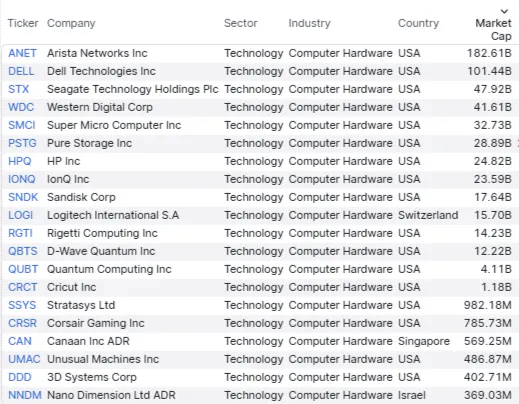
Still early stage, but IBM, Rigetti (RGTI), and IonQ (IONQ) are public plays.
Private companies like PsiQuantum and D-Wave could go public as capital returns to deep tech.
Investor angle: Treat as venture-style bets. High risk, long horizon, but asymmetric upside.
4. Robotics & Automation Hardware
Demand for labor-replacing machines is skyrocketing, particularly in logistics, manufacturing, and defense.
Key players: Boston Dynamics (Hyundai), Symbotic (SYM), Rockwell Automation (ROK), ABB (ABB), and Fanuc (FANUY).
Investor angle: Focus on firms that control both the robot and the AI stack — not just mechanical parts.
5. Memory, Interconnect, and Energy Systems
Bottlenecks in AI workloads are increasingly about memory bandwidth and power delivery, not compute alone.
Watch Micron (MU), SK Hynix, Samsung Electronics, and companies building liquid cooling and data-center power systems.
Investor angle: These are the picks-and-shovels of the AI gold rush — less glamorous, but crucial.
📈 How to Invest Strategically in the Hype Cycle
Like every tech trend, AI Hardware Hype follows a predictable emotional curve: euphoria → correction → consolidation → dominance.
Here’s how to play it:
Don’t chase the top performers blindly.
NVIDIA’s success story is already priced in. Look for the second-order beneficiaries — component suppliers, cooling system providers, AI server manufacturers, or even data-center REITs.Diversify across the value chain.
Instead of betting on one chipmaker, create exposure across designers, fabricators, infrastructure providers, and end-users.Use ETFs for diversified exposure.
Examples:SOXX (iShares Semiconductor ETF)
SMH (VanEck Semiconductor ETF)
ROBO (Global Robotics & Automation ETF)
QTUM (Defiance Quantum ETF)
Watch for geopolitical catalysts.
The semiconductor race between the U.S., China, and EU is reshaping global supply chains. Subsidies and export bans can make or break certain companies overnight.Identify the “Picks and Shovels.”
The surest way to profit from any boom isn’t to mine for gold — it’s to sell the tools. Think ASML (lithography), Applied Materials (AMAT), Lam Research (LRCX) — the companies that every chipmaker depends on.Focus on power efficiency.
The future isn’t just faster — it’s greener. AI data centers are energy-hungry, and investors are rewarding hardware firms that prioritize performance per watt and carbon reduction.
💣 Risks You Can’t Ignore
Every hype wave hides landmines. For AI Hardware investors, beware of:
Supply-chain fragility: Political tensions, chip shortages, or rare-earth constraints can hammer production.
CapEx drag: Hardware firms require heavy upfront investment — not every startup can survive long R&D cycles.
Tech obsolescence: A breakthrough architecture can wipe out incumbents overnight.
Market saturation: Once hype peaks, valuations may correct hard before stabilizing.
Smart investors hedge by mixing growth exposure with infrastructure plays that benefit from long-term adoption (e.g., data-center REITs, energy cooling providers).
🌎 The Bigger Picture: Hardware as a National Strategy
Here’s why the Hi Hardware Hype isn’t fading soon:
It’s not just a market trend — it’s a matter of national security and economic independence.
The U.S., EU, Japan, and China are all pouring billions into chip sovereignty, quantum R&D, and automation infrastructure.
Hardware innovation is now a geopolitical priority — and that means government funding, tax incentives, and protected supply chains.
That’s why investors who position early — before retail FOMO floods the sector — stand to benefit most.
🏁 Final Word: Hype or Hard Reality?
Hi Hardware Hype is both.
Yes, valuations will overshoot. Startups will fail. And headlines will scream about “AI hardware bubbles.”
But beneath the noise lies an undeniable truth: the world is running out of compute.
The next trillion-dollar winners won’t just write smarter code — they’ll build smarter machines.
As an investor, your job is to identify who’s building the picks, shovels, and energy grids for this new industrial era.
Because when the hype fades, the hardware remains.
Date
08/10/2025
Sujet
Growth
0 commentaire
Vous voulez être le·la premier·ère à écrire un commentaire ?
Devenez membre de Dividend Growth Stocks🚀 et lancez la conversation.