September 2022
As energy prices rise, mobility becomes increasingly more expensive. This affects in particular areas where people need to travel longer distances to get to work or cover their daily needs. In other words, geography matters.
For that reason, we went back to an internal exercise we run at Spatial Foresight in 2019 to see how connectivity features affect different types of territories with geographical specificities, mainly mountain areas, islands and sparsely populated areas. In many regards the rationale still holds today.
Today´s growing interdependencies between places in economic, social and environmental regards translate into a growing connectivity of people and enterprises in Europe. People but also things (e.g. Internet of Things) are increasingly more connected through various digital channels and through improved infrastructure and means of physical transport. In particular when it comes to physical transport, energy costs, environmental concerns and sustainable transport play an important role.
There is a risk that increasing connectivity benefits – in relative terms – more those places that have already good connectivity than others, and thus further accelerate economic and demographic concentration tendencies. This risk is further accelerated by increasing energy prices and transport costs. Therefore, geography might matter again more in the context of increasing connectivity costs, as it might be particularly challenging for various mountain areas, islands and sparsely populated areas.
Connectivity challenges
Increasing connectivity needs (due to growing economic and social interdependencies) paired with increasing energy prices (due to the war in Ukraine), might become particularly challenging for places with low levels of connectivity already today. In many of these areas it is already challenging to provide basic transport services for these areas. Already today many places in mountain areas, islands and sparsely populated areas suffering from poor connectivity. This concerns physical transport but also digital connectivity with high speed internet and the full range 5G mobile phone coverage in a foreseeable future. Often areas with more challenging geographical conditions – incl. e.g. remote, rural areas, sparsely populated areas, islands, mountain valleys – face higher costs for ensuring competitive levels of accessibility both as concerns physical and digital accessibility, which are now further accelerated by increasing energy prices. Furthermore, for place with limited critical mass and larger distance to the nearest urban agglomeration the transition to sustainable means of transport becomes more challenging.
Connectivity potential
For already highly connected places, an increasing importance of connectivity of people and things and transport costs will offer additional competitive advantages and also increase its attractiveness as centre for a larger region. Less central places which can ensure sufficiently high level of digital connectivity may benefit from the decentralisation potential of new technologies based on high levels of digital connectiveness for the delivery of services and also in the production (e.g. additive manufacturing). Less connected places with high quality living environments might actually benefit from counter trends focusing on e.g. on de-connected alternative lifestyles or sustainable tourism.
Connectivity nexus and intervention logic
Despite the wide range of ways in which territories may be affected by increasing physical and digital connectivity recurring patterns may be identified. The above rationales have been brought together in an connectivity nexus to illustrate how the characteristics of mountain areas, islands and sparsely populated areas could lead to policy actions which either soften energy transition challenges or make better use of existing potential. 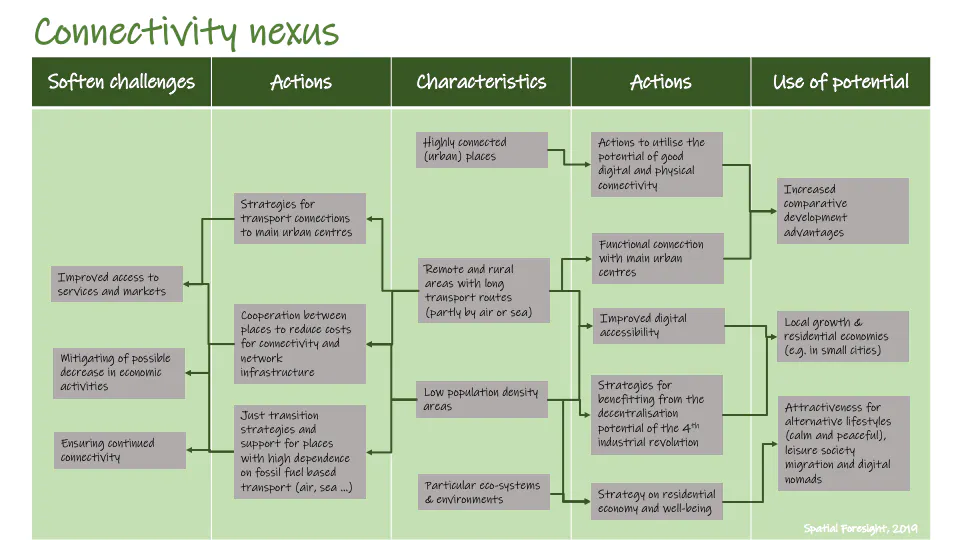

Taking the ideas of the transition nexus one step further towards a policy intervention logic, the graphic illustrates what territorial contexts the connectivity discussion meets in areas with geographical specificities, which actions could be taken and how that might affect the connectivity in the areas.
The figures and inputs are certainly only first ‘brain teasers’. Still, they show that in the light of transport costs, Europe needs to think place based to make better use of existing potential and soften place-specific challenges.

by Kai Böhme
https://steadyhq.com/en/spatialforesight/posts/c25f4743-c7f2-436f-b94a-8afa4764f5a8 (S'ouvre dans une nouvelle fenêtre)
Date
26/09/2022
Sujet
Territories
0 commentaire
Vous voulez être le·la premier·ère à écrire un commentaire ?
Devenez membre de spatialforesight et lancez la conversation.