What you can expect
This is my new home for a new mission: a book-length project written online, in public - a new and scary experience for me, and I hope an exhilarating experience for you - the reader.
You know me from my substack - BrainPizza (Si apre in una nuova finestra). The substack will continue, and I will continue to write there on brain and behaviour. And I want to thank you for your support over the years there - it has been a very enjoyable experience. But after c. 250 pieces, and c. 500k words, I want to take the time for a separate new identity here and for a new and focused project:
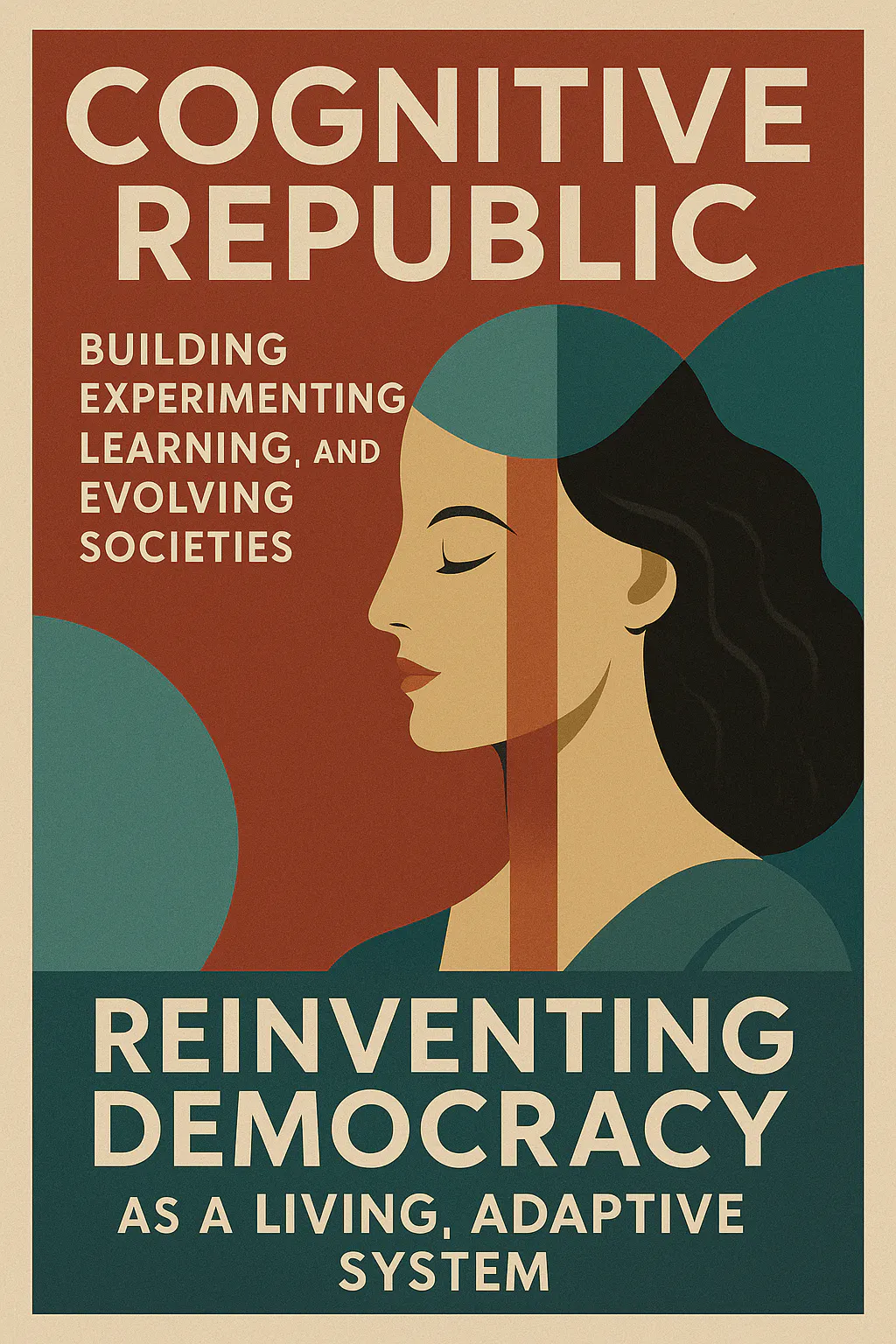
Cognitive Republic: Building Societies That Experiment, Learn, and Evolve.
Reinventing Democracies as Learning, Adaptive, Systems
Cognitive Republic started life as a book proposal: I have decided instead to release it here piece-by-piece to test the arguments and to engage in thinking in public.
You can become a member by hitting the button below. There are several tiers available. Subscribers will receive occasional free posts and snippets; members will get full chapters and more besides
Why this? Why now?
The alarm bells are ringing loudly and clearly: democracies everywhere are in polycrisis – simultaneous crises of trust, legitimacy, and governance; crises caused by political stasis in the face of rapid technological, financial, and other changes; crises of belief and confidence caused by the rise of new online media, tools, and techniques shaking the foundations of what we know.
And there’s so much more: there are the lingering effects of the major financial shocks of the past few decades – of debt, inflation, and banking collapses; the acute crises caused by new and lethal communicable diseases spreading rapidly through our globalised world; the many wars, insurgencies, and civil conflicts taking place; the crises caused by the populist authoritarians offering simple, beguiling, but catastrophically wrong, solutions to the problems besetting us. And everywhere there are mental health crises, with anxiety, social isolation, and burnout widespread and draining potential from even the richest societies.
To use an old-fashioned phrase, anomie, feelings of disconnection, of loss of meaning, of loss of agency, is everywhere, affecting everyone.
Our democracies seem ill-equipped to handle these multiple crises and challenges. We need new, out-of-the box, thinking to solve our problems in ways that have public buy-in and confidence.
In a world where traditional institutions are brittle, authoritarianism resurgent, and democratic trust eroding, the Cognitive Republic reinvents democracy as learning, adaptive, systems.
This project can only be a success if you join me here - so I invite you to do - there are differing tiers of membership available:
Here are the initial sections - and there’s many more to come.
Introduction: The ‘Cognitive Republic’ and the Global Collapse of Democratic Faith
1 — The Unfinished Contract: Why Democracies Must Learn or Die
2 — The Cognitive Republic: A Manifesto for a Learning Democracy
3 — A General Theory from First Principles
4 — The Compounding KPI: Learning Rate
5 — A New Civic Humanism: Philosophy & Values
6 — Identity Engines: How Brains Make “Us”
7 — Institutions That Think: Enhancing the Civic Brain
8 — The Hybrid Agora: Where Pixels Meet the Public Square
9 — Preference Rich Democracy: Beyond Binary Choices
10 — Markets That See
What’s this all about?
Liberal democracy does not need more moral rhetoric or further arguments about liberals versus conservatives or big versus small government; these arguments are tedious, care-worn, and fruitless. They are getting us nowhere. We need to move on from this way of doing business.
To adopt the language of information technology: our democracies need a new operating system, one capable of regularly updating itself so that it always remains appropriate to the challenges we face.
I argue here we need a radically new democratic philosophy – one appropriate to the complex and uncertain times we find ourselves in, and which, upfront, admits that many of the difficulties and problems we face do not admit of obvious and easy solutions, but solve them we must.
Redesigning our democracies as learning systems – capable of testing, adapting, evolving, learning, and delivering, can renew the faith and trust of the public, and surmount the complex challenges we will inevitably face.
This approach builds upon findings in psychology, neuroscience, and evolutionary biology. When our brains encounter surprising or unexpected inputs, they update their models of the world, learn, and adapt; when societies face unexpected crises, they too must learn, unlearn, and relearn.
I call this approach the ‘Cognitive Republic,’ where we all, together, build an experimenting, learning, evolving society. Cognitive Republic offers a radical reframing of democracy for the twenty‑first century as a thinking and learning system—an ecosystem of experiments, heuristics, and feedback loops, not just a system of checks and balances.
Data
12/11/2025
0 commenti
Vuoi essere la prima persona a commentare?
Abbonati a Cognitive Republic e avvia una conversazione.