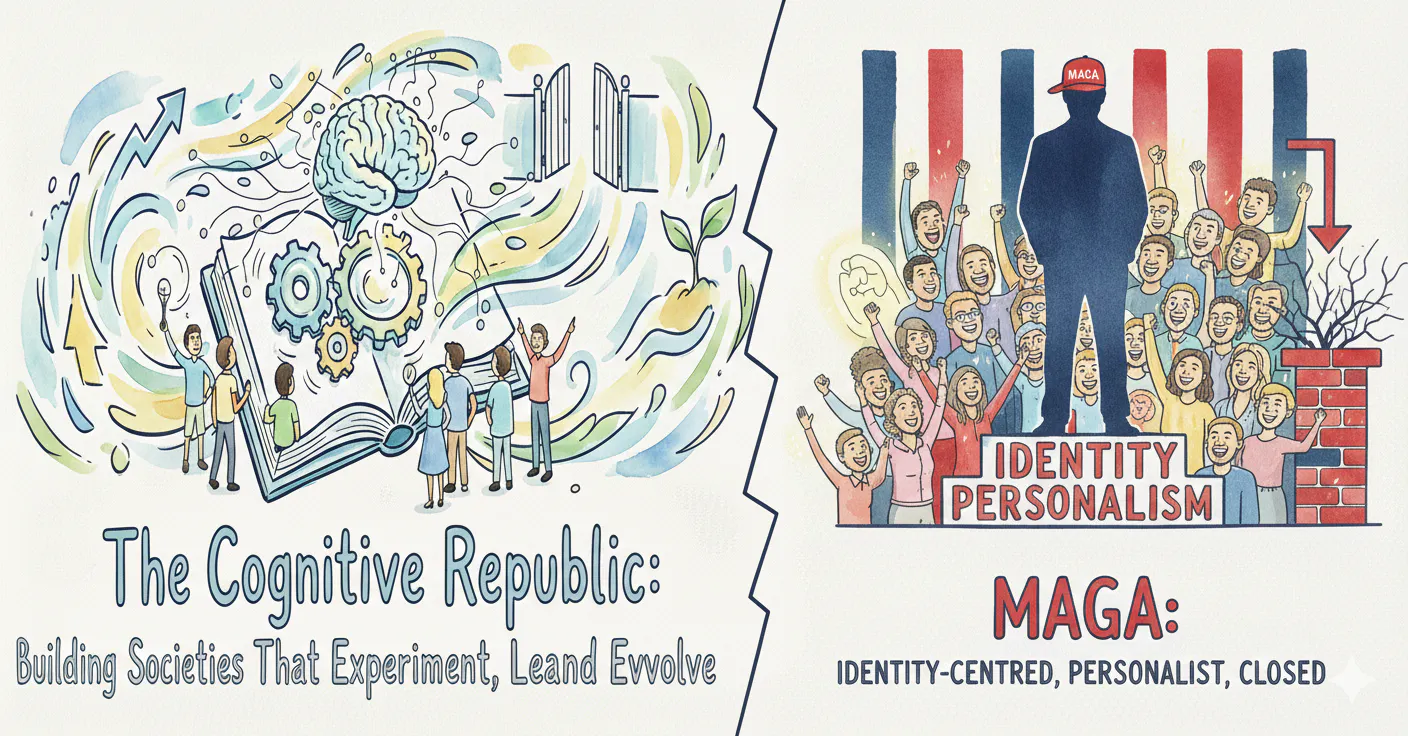
MAGA is usefully analysed less as a coherent ideology and more as an identity-centred political form.
We should take MAGA very seriously indeed. You might wonder why. It is the dominant political orientation of the current US government and of a significant fraction of the US population. Famously, Leon Trotsky allegedly said: “You may not be interested in war, but war is interested in you”. Well, you might not be interested in MAGA, but MAGA is interested in you, and MAGA impacts you. The US National Security Strategy and National Defence Strategy are both clear about who the in-group and out-group members are. If you’re European or Canadian or whoever, then you’re in the out-group for sure.
Gerry Adams, formerly President of Sinn Fein, and allegedly IRA Army Council member once remarked when asked ‘what about the IRA?’ ‘They haven’t gone away, you know’. Well, notwithstanding the US Supreme Court decision, the tariffs on friendly nations haven’t gone away, nor have the threats to annex territory of a NATO ally. Nor have the visits to those who threaten the integrity of the EU gone away, nor the promises of US government funding for so-called ‘patriotic parties’ - but don’t assume this embrace will be reciprocated, as Janen Ganesh of the FT argues here (Si apre in una nuova finestra).
And the Munich Security Conference speeches by VP Vance and SoS Rubio, while varying in their stridency and emollience, are directionally similar in their underlying thrust - Europe is in the out-group, it’s committing civilisational suicide, and all the other empirically-unmoored hyperbole decorating these kinds of speeches.
We’re seeing something new coming out of the US; something we haven’t seen before. We find ourselves looking at a president making economic warfare on the US’s closest neighbours and friends - for no reason at all. We see a USA which seems to be transforming into something new: no longer a reliable friend, a constant ally, the backbone of the international order - despite the many mistakes it has made over the decades.
Instead, we hear the crazy, acquisitive, imperialist, talk of taking Canada, Greenland, Panama; of rows with the Prime Minister of Denmark (fgs), of arbitrary tariffs because of the tone of voice of the Swiss PM (39%). The swingeing tariffs on India (Si apre in una nuova finestra) surely drove it to purchase 114 Rafale jets from France (Si apre in una nuova finestra) - especially as the EU has just concluded a huge trade deal with India (I assume this is why Ireland has done a likewise defence deal with France, citing a ‘trusted partner’ (Si apre in una nuova finestra)). And there’s still meaningful no focus on the major adversaries of the democratic order at all – the USA turning away from its role since 1945. The whacks are directed at friends.
And there is the whining too: seeing the multimillionaire Howard Lutnick saying without shame, insight, or embarrassment at the WEF that the last 80 years have been a disaster for the US – seemingly not at all conscious that the USA became the richest, most powerful, technologically-advanced and militarily strongest country in the world – nay, the known Universe – over that time!
What counterfactual case is he considering? Hard to know, to be honest - but really all he is demonstrating he is part of the MAGA in-group, unafraid to stick to those lousy out-group foreigners.
MAGA’s current organising logic is personalist and, in important respects, patrimonial. “Personalist” here is locating political legitimacy from impersonal rules and procedures to an embodied leader, where authority experienced as personal someone rather than impersonal something. “Patrimonial” captures the tendency (in personalist systems) for offices and enforcement to be treated as instruments of loyalty and spoils rather than as neutral constraints.
Start Here for the Cognitive Republic (Si apre in una nuova finestra)
What is going on? I think there’s an answer, and it’s an answer with universalist roots, drawing deep on underlying, all-too-human, cognitive, affective, and social processes. For my present purposes, I’ll focus less on the particular policies (these change quickly – often in the course of an hour), and more on the shared psychological processes underpining MAGA. And to be clear, I see these processes not as something peculiarly and oddly American. There are differing versions of MAGA all over the world, and people the world over more or less possess these self-same psychological traits making them more-or-less susceptible to MAGA-style politics.
an ‘identity-centred political form’
I contend here MAGA is usefully analysed less as a coherent ideology than as an identity-centred political form—a coalition held together by belonging, status, and shared antagonisms toward a variably-defined outgroup, and much less by a stable set of policy propositions.
This way of looking at MAGA, this kind of framework for thinking about this political phenomenon, draws on social identity theory: the idea that people derive part of their self-concept from group membership, leading them to cherish and defend their in-group standing, and interpreting their social life through “us–them” distinctions that can become emotionally and morally charged. In conditions of high identity salience, “politics” is secondarily a debate over policies and programmes, and more as a contest over recognition, hierarchy, and threat perception.
The key point here is that stepping back and trying to identify some of the underlying psychological processes allows us to understand a bit more of what might be going on at a deeper level, and stops us engaging in a useless game of mutualised opprobrium.
An extensive body of work in social psychology on group identity, motivated reasoning, and affective polarisation suggests political allegiance is a vital and important source of belonging and status for some/many individuals, where identity comes first, and policy commitments come second.
We have known for at least forty years that (Si apre in una nuova finestra):
“policy attitudes generally do not have strong cognitive representations, are eminently changeable, and once they are changed, an individual's cognitive autobiography is revised so as to render the changes invisible.”
The University of Michigan tracks these perceptions (Si apre in una nuova finestra):
Partisan differences in consumer attitudes and expectations are well documented and date back to at least the Reagan administration. The data consistently showed that consumers affiliated with the political party in the White House tend to have higher levels of sentiment and more favorable expectations than those whose party is not. These differences are not limited to attitudes, and in fact, scholarly research has documented similar partisan patterns in consumer spending and entrepreneurship. Like sentiment, these behavioral outcomes also flip for Democrats and Republicans when the White House changes party.
 (Si apre in una nuova finestra)
I think some think this inconsistency is shocking: that the lack of policy consistency reveals some deep hypocrisy. It might do, or it might simply be that requiring policy consistency forces you to continue fighting old battles when people have clearly moved on, and don’t care anymore.
Currently, there are about c. 6k subscribers to the Cognitive Republic (Si apre in una nuova finestra). The open rates for each piece, delivered approximately every two weeks, are close to 50% (way above average) - click here to start (Si apre in una nuova finestra).
Gotcha politics based on attacking a group for the apparent hypocrisy of ‘revised policy attitudes’ will simply not have traction. People move on. Moreover - all the shouting in the media by journalists regarding ‘gotcha’ moments over apparent inconsistencies in people’s attitudes and political positions over time is just that - howling into the void. People do change their views through time - and why not? Life changes you.
The purpose of our memories is not to accurately log the past: instead, our memories are designed to allow us to adapt to the present and anticipate the future (Si apre in una nuova finestra).
Beyond that, we do not - repeat, do not - have a specialised cognitive faculty which tracks changes in our memory through time, comparing what we thought at time A to time B to time C, and which allows us to rationally account for those changes in memory.
Orwell nails it - from 1984:
“The past was alterable. The past never had been altered. Oceania was at war with Eastasia. Oceania had always been at war with Eastasia.”
change dynamics
The dynamics here are subtle, because individuals may form deep parasocial relationships with the leader (perhaps less with the party), loyalty to a leader becomes moralised, even sacralised in some deep way, and manifest absurdities become important loyalty tests (‘yes, I believe, contrary to evidence and common sense, that the election was stolen, and I choose not to consider how the leader who was in office at the time, allowed it to be stolen in the first place’), and hostility toward an outgroup supply in-group cohesion even when policy preferences are internally diverse (‘yeah, not too certain about these tariffs, but look, we all really hate those guys who told us tariffs were going to make stuff more expensive, because they oppose what the leader wants, so yes I support tariffs actually’).
The outgroup category will remain broad and adaptable, not by design, but because elastic boundary-marking allows new events to be integrated into a stable ‘us–them’ frame. This is consistent with a model in which shared narrative and group reinforcement sustain a common ‘reality’ within the coalition, while institutional constraints are treated as conditionally legitimate—binding when convenient, illegitimate when constraining the in-group or its leader.
The underlying psychological point is not that every supporter consciously endorses these ideas, but that the movement’s practical, pragmatic, social and decisional ecology encourages conditional rule-legitimacy: constraints are experienced as legitimate when they bind opponents and illegitimate when they bind the in-group or its leader. Hence the Trumpian rage when the Supreme Court said no to the tariff policy, or the demand to ‘discipline’ economists for not following the party line (Si apre in una nuova finestra) (the point here being not these economists are empirically-correct, but that they disagree! -independence of thought is undesirable, it would seem.)
As the famous line puts it: ‘there must be in-groups whom the law protects but does not bind, alongside out-groups whom the law binds but does not protect’ (‘Wilhoit's law (Si apre in una nuova finestra)’). This is obviously an unstable and untenable long-term equilibrium; people really do care about fairness (perhaps not so much inequality). The law needs to apply equally without fear or favour to all.
stability
Can we specify the cognitive mechanisms by which such a form holds together despite internal policy diversity? Here’s a framework.
First, the evidence on motivated reasoning suggests our reasoning often serves identity and goal-protection as much as it does an attempt at empirical accuracy: we humans selectively search, credit, and interpret information in ways defending our desired conclusions and preserving our social standing.
Second, research on identity-protective cognition suggests we can and do unconsciously discount evidence threatening our affiliation with a valued group (‘honestly, we don’t cheat – it was just a little infraction of no consequence’).
Third, the literature on affective polarisation shows that partisan animus can intensify even when policy preferences are not maximally extreme; hostility itself becomes a driver of cohesion. It just doesn’t matter too much what the policies are: these are mere vehicles for driving extremes of behaviour.
Put these strong tendencies in our thinking in combination, then it is unsurprising contradictions are not falsifiers or error signals, but are instead loyalty tests—moments where the primary question is not “is it true?”, but “how do I show my loyalty to the leader?” And a willingness to abase yourself by stating things that are manifestly, empirically untrue is also important: the rewards of office, status, and shared belonging, or just the simple shared feeling that ‘our side has triumphed/beaten/smashed the other lot’ which can then be picked over, time and again, in mutually-affirming conversation.
The deep fissures within these kinds of personalist movements will really only be exposed by succession – especially if the leader takes an ‘Après moi, le déluge (Si apre in una nuova finestra)’ attitude of indifference to who takes over afterwards, there will be a slug-fest to ascend to the throne.
constructing an enemy
Outgroups in identity-driven politics can be broadly and variably conceived and changing over time, not because there is any centrally-planned strategy of enemy identification, but because elastic boundary-marking solves a coordination problem: it allows new events, institutions, and actors to be assimilated quickly into a stable moral schema (“they are doing this to us”) without requiring doctrinal or policy consistency. These are just clothes to be worn and discarded, as needed.
Affective polarisation research also suggests outgroup dislike can function as the strongest common denominator across heterogeneous in-group policy bundles. The result is a movement whose coherence is less propositional than relational - "coherence-found-through-antagonism”.
The leader-follower relationship adds another stabiliser: parasocial attachment. Repeated media exposure can generate the felt intimacy of a relationship without reciprocity - of “intimacy at a distance.” Under conditions of high salience and constant mediated presence, attachments can fuse with individual and group identity, amplifying protective devotion to the leader and in group, and give rise to a kind of moralised loyalty.
Identity-fusion research provides a useful lens to understand this intensification: in certain contexts, people can experience a visceral oneness between personal self and group, enabling unusually strong pro-group commitment. The analytical claim is not that all supporters are “fused,” but that movements of this kind can contain a core in which attachment to leader-and-group becomes identity-defining, while a periphery is more instrumental or episodic.
epistemically – what is happening?
These dynamics converge on what can fairly be called epistemic closure: a social-psychological process in which in-group reinforcement, motivated reasoning, and threat sensitivity reduce openness to disconfirming evidence and elevate conformity to the demands of the group as stated and required by the leader.
Neurocognitive work cannot, should not, be used to claim there is something like a distinctive “movement brain.” But such work does support a general point: competition in intergroup contexts reliably recruits mechanisms of attention, valuation, and empathy that bias perception and learning toward in-group favouritism and outgroup suspicion.
In a politics organised around a permanent war against ill-defined outgroups, these biases are a recurring and governing feature of thinking, and as the outrage against one group necessarily wanes, it is necessary to find another enemy, and another, and another.
implications
Two implications follow, and these are uncomfortable for liberal democrats1 precisely because they deny the usual comforting remedies.
First, fact-checking and procedural sermons are category errors. Where identity-protective cognition dominates, more information can backfire or be assimilated as further evidence of outgroup manipulation. You can’t assume mere information provision will solve what’s happening. If it did, there wouldn’t be any smokers or antivaxxers.
Second, MAGA cannot and should not be treated as a pathology, for it is an all-too-recognisable form of governance, cropping up time and again. MAGA competes successfully as an alternative legitimacy regime, offering a ‘cognitively efficient’ civic experience: one of moral clarity, belonging, and an evolving if stable map of blame—at a time when pluralist democracies often feel cognitively expensive, slow, and humiliating. And the reality of human history has been that patrimonial, personalist systems organised around in-group/out-group differences have been very common indeed - all you need to do is look at the history of European monarchies.
a design diagnosis
The Cognitive Republic frame offers a design diagnosis. The core democratic vulnerability is a degradation of collective cognition: the public system’s capacity to remember (policy memory surviving turnover), imagine (anticipatory capacity that binds decisions), learn (feedback that is intelligible and timely), and correct (reversal without stigma). When those functions fail, politics defaults to “trust me” (whether offered by a personalist leader or by a technocratic administrative class) because citizens are left as spectators rather than co-participants in inference and correction.
A Cognitive Republic (Si apre in una nuova finestra)response therefore competes on the terrain MAGA exploits without imitating its authoritarian form, replacing appeals to trust with visible correction:
forecasts with ranges,
measurable commitments,
and pre-declared conditions for stop/go/reverse
thereby institutionalising falsifiability (Si apre in una nuova finestra) as shared civic learning and respect. Moreover, the Cognitive Republic (Si apre in una nuova finestra) ethos lowers identity temperature, not by asking people to abandon attachment, but by offering a new, non-tribal, belonging through shared projects that ‘close the loop’ into policy forecasting and policy revision:- a form of participation designed for bounded attention rather than heroic civic labour.
The Cognitive Republic (Si apre in una nuova finestra) hardens institutions against personalist takeovers by building an “automatic spine” of conflict-of-interest tripwires, procurement transparency defaults, and protected oversight - so democratic resilience does not depend on individual episodic courage (expecting cowards to stand up to bullies is not a recipe for safeguarding democracy, now is it? Better to have defaults to punch back with).
And the Cognitive Republic (Si apre in una nuova finestra) does not compete for the cognitive commons by policing belief, or by requiring acts of public obeisance; it competes by altering our incentive architectures to focus on provenance, transparency, and institutional reasoning chains making governance legible enough to be judged by collectively-agreed, empirical standards.
The bet here is simple: if MAGA’s strength lies in coherence-through-loyalty and epistemic shelter, then liberal democracy must rebuild something new, grounded in public method, measurable competence, and corrigibility. The point is not to “restore trust” as a mood, but to earn trust as an outcome of systems that can learn in public, correct without humiliation, and give citizens a meaningful role in the ongoing work of shared reality.
The Cognitive Republic (Si apre in una nuova finestra) is an argument for a different democratic operating system. Liberal democracies were built to legitimise power through procedures: fair elections, free parties, independent courts, and inalienable rights. And these all remain indispensable.
But the world we’re in is different now: complex and complicated, and procedures alone no longer guarantee competence, nor do they sustain legitimacy when error is inevitable and reality changes faster than institutions can adapt. Invocations of the ‘rule-based order’ aren’t helping either when the game has definitively changed (next time I’ll discuss the Cognitive Republic alternative to the rules-based order - the need for a methods-based order).
The Cognitive Republic (Si apre in una nuova finestra) begins from a new and different premise: democracies must reinvent themselves as learning systems—explicitly experimental, measurement-disciplined, and publicly correctable—designed around cognitive first principles: attention, prediction, learning, adaptation, falsifiability, and institutional memory.
Legitimacy, in this view, does not demand trust; legitimacy is earned by showing the work:- forecasts with ranges, denominators and timelines, and pre-declared conditions for revision when reality contradicts intention.
Democracy thus becomes less a periodic ritual of voting, and more of a continuous practice of collective cognition:- a system of adaptive governance system that corrects itself without humiliation and learn across time. It does mean that we will need a new operating language, and a new way of thinking, as I will elaborate here over the coming weeks and months.
More next time, and if you enjoyed this piece, then choose your membership (Si apre in una nuova finestra)!
I mean this phrase in the generic political sense, not the narrow US sense. ↩
Data
25/02/2026
Argomento
Cognitive Republic
0 commenti
Vuoi essere la prima persona a commentare?
Abbonati a Cognitive Republic e avvia una conversazione.