It’s apple time! A paradise of colours in regions with traditional “Streuobstwiesen”, a very special form of meadow orchards meanwhile becoming rare in Europe. In earlier times, they were collectively maintained and harvested by a village. The unmown meadows served as pastures for animals, shaded by fruit trees against the summer heat. The animals in turn naturally fertilised the trees with their manure.
And these animals influenced the rich biodiversity of wild herbs: Depending on whether sheep or cows grazed there, or poultry pecked in between, all these animals acted as gardeners. By selecting their food, transporting seeds in their fur, or simply because certain insects felt at home in their dung. And you could taste this rich biodiversity in every cheese. You had even a different taste of spring or autumn cheese depending on the plants.
Podcast NatureMatchCuts: When Gardeners Run Wild I. (Si apre in una nuova finestra)
Podcast NatureMatchCuts: When Gardeners Run Wild II. (Si apre in una nuova finestra)
The trees also lived quite wild in those days. Apart from necessary, professional pruning and the hands of the villagers during harvest, they were never touched for being sprayed. The old varieties (some meanwhile extinct) were tough, and their diversity evened out extreme weather conditions. These orchards were a paradise for children: you could climb the trees, play in the meadows, discover insects, and big animals.
And, of course, everyone was waiting to taste the first ripe fruits! Even in later times, when the orchards had become private property, we had a special law. While fruit was not allowed to be stolen, the so-called ‘Mundraub’ (petty theft of food) was not punishable, if the orchard was freely accessible. It was o.k. to take some windfall fruit. A reminiscence of times when orchards were still common land.
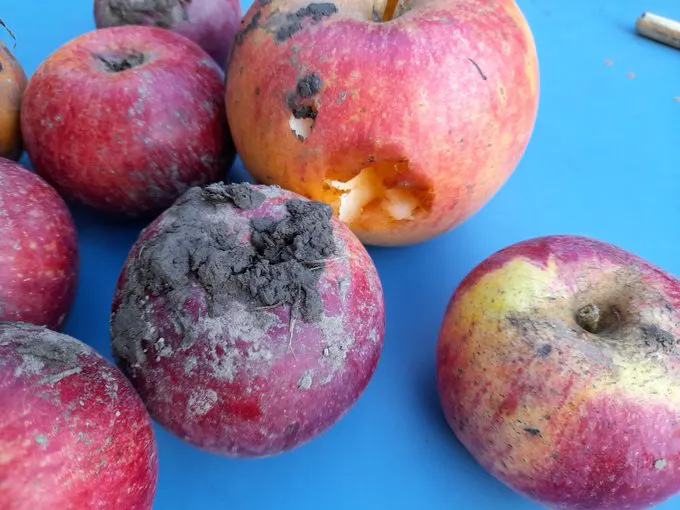
I still remember how, as children, we had bulging trouser and jacket pockets in autumn. They couldn't be big enough! At home, we would unpack our treasures: red-cheeked, earth-smeared apples, tiny hazelnuts, or pears with a few brown spots. We ate softer fruits such as prune and mirabelle plums straight from the tree.
 (Si apre in una nuova finestra)
Does anybody recall biting into a small pear, just out of curiosity: how would it taste? The sudden shock when the gums contracted! Sometimes the whole mouth felt furry. We didn't know anything about tannins back then. But we knew that the pear with the little shock had to be left until winter to turn into a fruity-sweet delicacy. And the ones that numbed the inside of our mouths for a long time were turned into something even harder: schnapps.
Apples with worm droppings on their skin? No problem. Jeans were used to rub all sorts of things clean. And if that wasn't enough, you spat on the fruit first. Brown spots, cavities gnawed by insects or snails, and wormholes? No problem, you could just bite around them! The rest was for the meadow insects. And sometimes you even got an extra bit of meat.
Support My Work
Autumn: time to pay for the heating. If you like my articles and work, you can contribute via Paypal or Ko-fi or become a member here.
 (Si apre in una nuova finestra)
At that time we didn’t know that we ourselves consist of a multitude of other living beings! Without our microbiome, we can not even survive. Modern science researches the interconnections of the traditional meadow orchard’s biodiversity and our own gut biodiversity. We learn that traditional methods of bread baking were connected even with that natural “dirt” of apples. Today, we wonder how this home-made bread and eating all these fruits had been a superfood for our microbiota. Now we learn that intensive and industrialised agriculture not only kills ancient apple varieties, but also leads to species extinction in our guts. And that leads to more allergies and diseases.
Podcast NatureMatchCuts: Sitting With Your Beloved Sourdough (Si apre in una nuova finestra) tells you more about these connections!
Autumn means pure happiness of taste in our region. Just a walk, and I tasted fruits, nuts, and yes, some dirt. And when the apples are so ripe that the sweet juice runs down my chin, I long for delicious apple juice and how flat the stuff from the supermarket tastes.
Making Apple Juice
So I was helping at a public apple juice pressing based on old traditions. Families with children were invited to watch and taste the juice. I washed the apples, fresh from the meadow, in the stone basin of an old well with a hand pump. There was no need to scrub off any herbicide or pesticide, they had never been sprayed. As in the past, I worked with an oversized ‘ladle’ made of a metal sieve on a broom stick: I turned the apples carefully so as not to damage them. And I moved them back and forth in the water. Using the same tool, they were then lifted out of the water into the press.
The children opened their eyes wide, these red-cheeked apples looked too delicious! Can I have one, asked a boy. Of course, I said and stopped working, you can choose one and I take it out of the water!
But no, he said. The water is dirty! My mom washes apples under running water, I may not eat dirty apples!
I explained him and his mom that our apples were not sprayed and what we wash was only some soil, sinking down in the stone bassin. We couldn’t wash every single apple under running water, not with hundreds of kilogram. The very sad boy was forbidden from picking an apple because soil would be so dangerous. You never know what might be crawling around in it. Bacteria, perhaps, his mother said.
The Culture Clash
Nowadays, so many children learn that natural soil (and nature) would be something dirty and dangerous. Nobody teaches them that they have many of these microbiota in their gut. Or perhaps they no longer have them and are becoming ill from the lack?
We experienced a culture clash. The happy children fishing an apple and smiling when dad or mom also looked for one. My smallest “client” who came to me several times with his empty cup, big eyes, and a “more juice, please!” He didn't notice me winking at his parents, because we had agreed to only pour a little bit at a time. Some children were asking their parents to take some bottles at home.
But some families made me sad. When the adults didn't dare to try the freshly squeezed juice. “You couldn't possibly know what was in it! At least the apples in the supermarket had been treated!”
More and more we have to explain the differences of fresh juice and bottled, preserved one. We show these people how lively fresh juice is, reacting with the air, working. After a short time, the bright golden liquid turns brown. The same thing happens when you leave a bitten apple or grated apples exposed to the air: oxidation. It is a chemical reaction in which mainly the polyphenol in apples oxidises to melanin. Melanin makes also our skin brown. Well, the process is a little bit more complicated (read here (Si apre in una nuova finestra)) but also fascinating: the same chemical reaction gives us the familiar brown color of tea, coffee and cocoa (read here (Si apre in una nuova finestra))!
Nothing bad, you can eat brownish grated apples or drink the fresh brown juice - thanks to the natural oxidation, it’s even better for your microbiome.
But freshly pressed apple juice is like Federweisser from grapes – after a while, it starts to ferment. And that's why it is stabilised for keeping it before that happens. Or processed further into cider.
The culture clash against “dirty nature” or even only fresh apple products is so weird that you find more tips on Google to throw them away than about their healthy impact. AI slop articles tell you nothing and are like the parents missing knowledge, automaticly paroting: Only buy at the supermarket …
My tip: take the chance if you find a dirty apple in nature, wipe it on your jeans and taste! And give your children a chance to taste fresh juice!
Data
27/10/2025
Argomento
Reconnect With Nature
0 commenti
Vuoi essere la prima persona a commentare?
Abbonati a Nature Match Cuts e avvia una conversazione.


