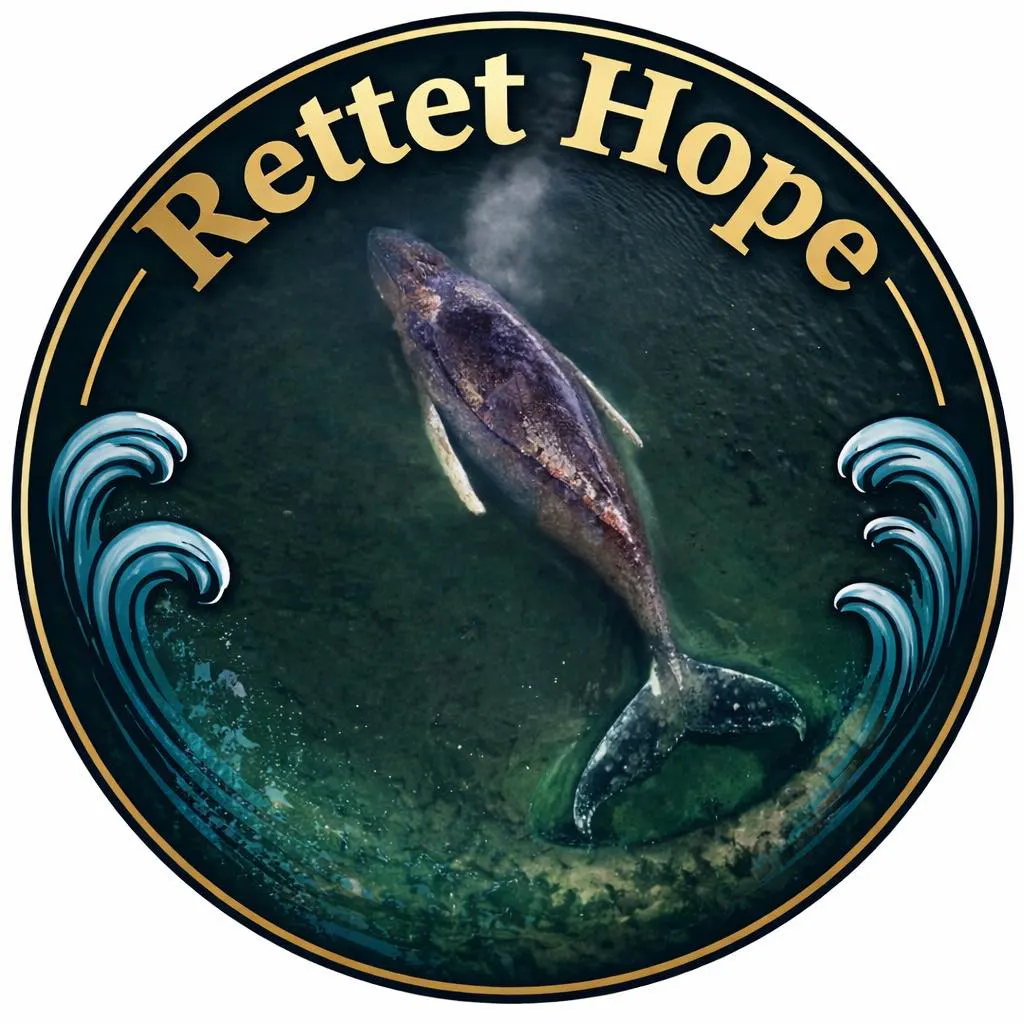
Protesters break through barriers; moronic animal-rights Nazi-rockers and spiritual whale whisperers dance to AI-generated songs for the ‘heart people’ in front of their TikTok screens; death threats are issued and complaints filed against politicians; and millionaire altruists take matters into their own hands – all because of the creature that has plunged an entire republic into a fever dream: Timmy the whale.
This fever dream ended on a poetic note last month, when the stranded cadaver of Timmy, whom we could follow bloating 24/7 on the live stream of a rather weird media outlet, was undergoing transubstantiation: The fatty parts of his body were turned into diesel. This poetic resolution of the narrative arc and the fact that it now completely vanished from the media gives us occasion to dwell a bit on this spectacle, the sheer scale of whose madness and stupidity is probably hard to imagine outside of Germany.
Looking back: The beginning hints at the end
The humpback whale first became stranded on a sandbank off Timmendorfer Strand (Baltic Sea) at the end of March 2026, which earned him the name ‘Timmy’. Looking back, the story behind this naming seems prophetic: it was the satirical journalist Horst Schlämmer (Hape Kerkeling) who came up with this name for the right-wing ‘newspaper’ Bild (Si apre in una nuova finestra) – “People love that sort of thing”. Indeed they do. Since the whale – following an initial successful rescue operation end of March and having survived several further strandings – was dragged to the North Sea over several days in which he had to endure said eso-Nazi morons hugging him (Si apre in una nuova finestra) to keep their spiritual connection with him, the ‘Timmy affair’ has become a parody of itself.
According to WWF estimates (Si apre in una nuova finestra), 25,000 other whales and dolphins worldwide have died in fishing nets this month as so-called by-catch – ‘waste’ that is an incidental by-product of fish meat production in the fishing industry. For decades, scientists and activists have been calling for a ban on fishing methods that result in particularly high levels of by-catch, fishing bans in high-risk areas and at high-risk times, and stricter monitoring of vessels. So far, no one was breaking through police chains in front of relevant EU-authorities. Why is that?
(In)competence and powerlessness
Of course, we all know how badly the ‘ocean’ as a habitat is faring – large-scale fishing, ocean acidification as part of the climate crisis, pollution from plastic and other waste. But this problem is so dreadfully vast, and the mechanisms for solving it so dreadfully abstract. What’s more, solutions would involve bans and regulations – which are not well regarded in a public sphere currently shaped by libertarian thinking, and which would entail economic sacrifices.
Timmy, on the other hand, is literally right in front of us. In his rescue, our sense of powerlessness in the face of destruction can be forgotten for a moment. It works much like a whale’s blowhole: all the pent-up, acidified air can finally be expelled – at last we can do something! The transport to the North Sea was celebrated as either a ‘miracle’ or a “Wahlelujah moment (Si apre in una nuova finestra)” [‘Wal’ is German for whale]. The many expressions of gratitude to the rescuers, which could be heard on NDR1 the day after the first successful rescue, already sounded correspondingly relieved.
Whilst the first rescue – with its YouTube biologist as coordinator and its unintentionally comical radio thank-yous – was still a light-hearted comedy, the incident in Wismar Bay turned into a bitter tragedy. Now this whale had actually had the audacity not to grant us even this moment of self-efficacy! Since then, these renewed feelings of powerlessness have been channelled into aggressive accusations of incompetence – in some cases escalating to death threats (Si apre in una nuova finestra) – against the authorities and scientists. A pattern already familiar from the Covid-19 and farmers’ protests, from the new-right peace movement and anti-migration resentment: There has to be malevolence and incompetence behind it all and it’s not mine!
A ‘sublime object’ from the deep sea
Timmy began to function as what Žižek, in his classic work of Ideologiekritik The Sublime Object of Ideology (1989), calls a ‘sublime object’: an entirely ordinary thing that is suddenly imbued with all manner of mystical meanings. According to the classical definition, something is ‘sublime’ when it transcends the limits of our imagination. The sea, the high mountains and the starry sky are the classic examples from 18th century aesthetics.
The whale is an excellent candidate for the sublime: a creature straddling the boundary between the ocean’s surface and the still largely unexplored deep sea. This opens up a dark abyss in which everyone can see what they want. The whale becomes a projection screen. Such screens are traditionally the domain of advertising. It is therefore not surprising that, following the scrapping of further government rescue measures on the advice of the scientists involved, a joint venture of millionaires was formed to take the rescue into its own hands: MediaMarkt co-founder Walter Gunz and the entrepreneur Karin Walter-Mommert, who earns her money in the trotting industry – not exactly known for its love of animals.
In doing so, they are placing themselves at the forefront of a carnival of emotions, ranging from a contemplative love of nature to far-right outrage at the government’s incompetence; a government which, moreover, “disregards the will of the sovereign, the people” – this is how the right-wing AfD rocker and animal welfare influencer (Si apre in una nuova finestra) ‘danny.firstclass’ (Danny Hilse) puts it. He was officially brought on board the rescue ship(s) by Gunz and Mommert. There, he is captured not only by his own smartphone, but also by the many cameras of the Epoch Times, a publication with roots in the Trump camp that was among the main outlets present at the Wismar bay 24/7 – alongside the slightly less right-wing, but immensely more sensationalist News5, that was broadcasting its being there 24/7, well… 24/7. Up to the very end when Timmys parts were disassembled to be turned into Diesel.
The rescue ship of danny.firstclass and other ‘heart people’ was then circling the abyss of the deep-sea projection screen. In the most successful of the AI songs mentioned (Si apre in una nuova finestra), a melancholic, whiny tone speaks of the mysterious ‘message’ that the whale has in store for us, provided we are willing to listen. Such mysterious messages are, in turn, the bread and butter of conspiracy theories (Si apre in una nuova finestra), which were not long in coming here either. Some believe the whale was deliberately driven into the Baltic Sea so that experiments could be carried out on it. Others believe efforts to rescue it were abandoned prematurely because influential people within the authorities had already struck shady deals with their friends – either at the museum or the university – so that they could get their hands on the skeleton.
The matter of Hope
In this mix of animal rights activists and right-wing outrage merchants, Timmy is no longer called ‘Timmy’, but ‘Hope’. This officially marks the transition from the comedic origins associated with Horst Schlämmer to tragedy. After all, tragedy always revolves around the hero who, despite everything, is able to bear his suffering and, in this ‘despite everything’, offers cause for hope.
And therein, perhaps, lies the crux of the problem around which the whole affair revolves. In a time of escalating crises – climate catastrophe, wars, the successes of the far right, soaring prices and shortages – all-too-simple hope becomes a problem. The drama surrounding Timmy does indeed convey a ‘message’, it’s just not quite mysterious but rather straightforward: Hope is the last thing we need.
Initially, the successful rescue still fuelled a comforting hope for beauty and enchantment. Sergio Bambarén, the ‘whale whisperer’ and author of spiritual wisdom who was also flown in by Gunz and Mommert, has the protagonist, Dolphin Daniel, express this hope in his debut novel Dolphin. Story of a dreamer (1995) as follows: ‘The sea that surrounds us, the sun that gives us life, the moon and the stars that shine in the sky – all these are true riches. They are timeless things that were given to us so that we might never forget the magic that surrounds us.’
And now this whale had been saved to remind us of that. A cause for hope that ‘humanity’ might not be lost after all, that, despite everything, ‘good’ still exists. The latest rescue into the North Sea lent the whole affair the magic of an absolute miracle: Hope has shown all the ‘experts’, who declared him virtually dead, what he’s made of (it was only discovered postmortem in the autopsy that Hope was actually a ‘she’)!
The problem with this sort of ‘magic that surrounds us’, this hope born out of the small things (or small gestures like the saving of an innocent creature lying helplessly on the beach), is made clear by Žižek:
“The problem is much deeper. It resides in the unreliability of our common sense itself which, habituated as it is to our ordinary life-world, finds it difficult to really accept that the flow of everyday reality can be perturbed. Our attitude here is that of the fetishistic split: ‚I know very well (that global warming is a threat to the entire humanity), but nonetheless … (I cannot really believe it). It is enough to see the natural world to which my mind is connected: green grass and trees, the sighing of the breeze, the rising of the sun … can one really imagine that all this will be disturbed? You talk about the ozone hole – but no matter how much I look into the sky, I don‘t see it – all I see is the sky, blue or grey!”11 (Si apre in una nuova finestra)
The true horrors of today are things one cannot experience – be it the climate catastrophe, the destruction of the ocean or the mass killings of whales. These are by their very nature structures that can only be thought: I can experience a flood or heatwave, but I can only think the climate catastrophe behind it via means of mathematics. I can experience a single whale dying on the beach or in a fishing net, but I can only think the sheer scale of industrialized murder of whales (and dolphins and …).
In light of challenges where experience fails, any hope born out of the ‘small things’, the little everyday magic, turns into giving up thought. Hope has a stupidifying effect on the all-too-well-meaning ‘heart people’. Refusing to think, they cannot but cling to their determined goal of a small wonder: This stupid whale has to be brought into the North Sea, I don’t care whether he dies, I need this. Their silence after the monumental failure of the ‘rescue mission’ is an admission to this obsession – a monument to the stupidity of hope.
Slavoj Žižek, In Defense of Lost Causes (Verso, 2008), 445. ↩
Data
01/07/2026