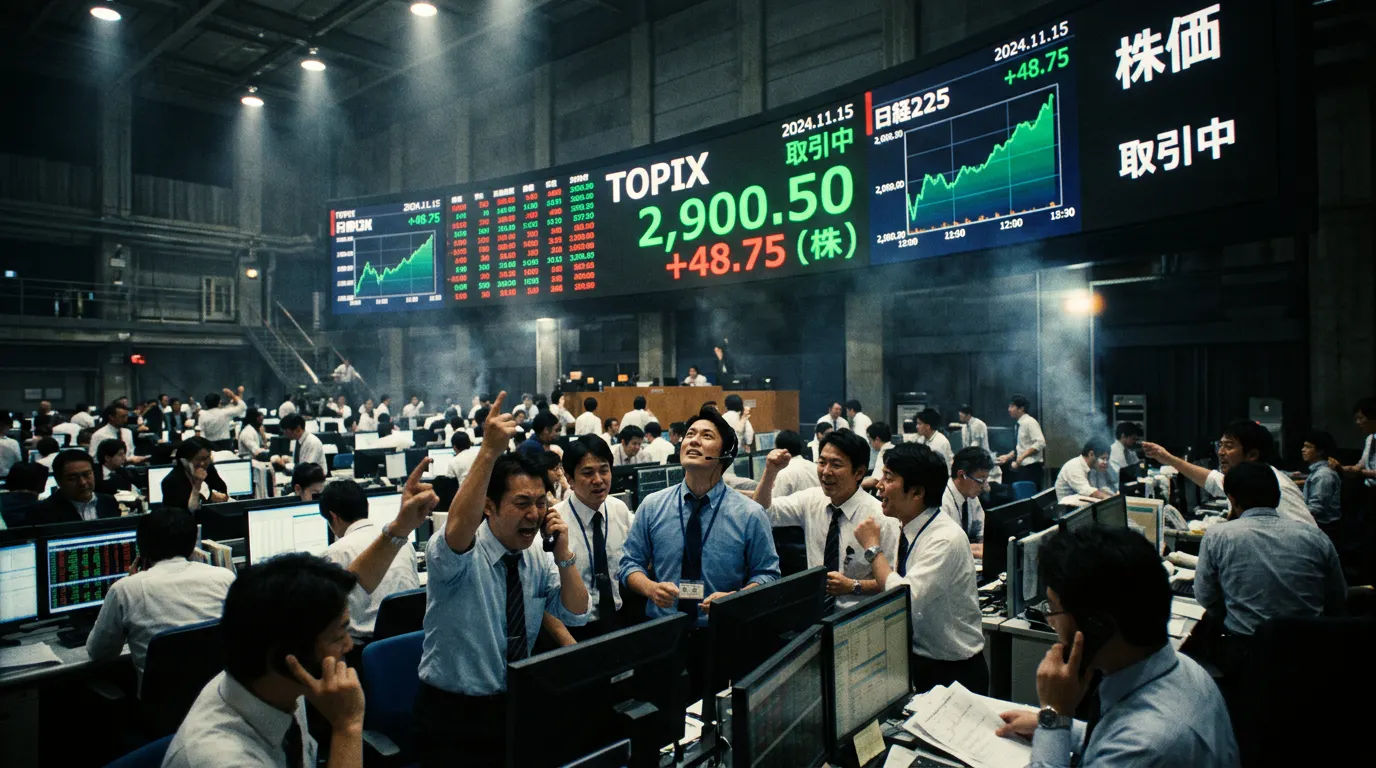
In August 2024, the Nikkei 225 cratered on carry-trade panic. Everyone had a theory. Most were wrong.
Twenty-two months later, that same index just touched 68,786. An all-time high. Up 69% year-over-year. And the dominant narrative—”AI money is pouring into Japan”—is only about 60% of the story.
The other 40% involves a failed ¥11.7 trillion currency intervention, the largest Japanese investor exit from foreign stocks in five years, Berkshire Hathaway quietly approaching 10% stakes in five trading houses, and Goldman Sachs raising its TOPIX target to 4,400.
Today we’re mapping the actual capital flows, stress-testing the earnings math, and building a framework you can use to decide whether this rally has legs—or if it’s another AI-themed sugar high.
Sponsor
The man standing next to Musk holds the exact unlisted U.S. partner ticker hoarding a multi-billion-dollar piece of this $1.75 Trillion SpaceX IPO.
Press play on the video right now to grab the partner's public stock ticker before the 10-day countdown expires. (Si apre in una nuova finestra)
The Three-Stream Capital Flow — Who’s Actually Buying Japan

There are three distinct capital streams converging on Japanese equities right now. Each has different motivations, different time horizons, and different risk profiles. Conflating them is how you get sloppy analysis.
Stream 1: Foreign AI-Theme Capital
This is the headline number, and it’s genuinely staggering. According to Japan Exchange Group data cited by Reuters, foreign investors were net buyers of Japanese stocks for eight consecutive weeks through May 23. Cumulative net purchases for 2026 have reached approximately ¥11.7 trillion.
For context, during the same period in 2025, cumulative foreign net buying was ¥742.1 billion. The 2026 figure is 15.8 times higher. Read that again.
The destination is not diversified. It’s concentrated. SoftBank Group rose 17.62% in a single week. Socionext gained 12.26%. The buying logic, per Reuters, traces directly to Nvidia’s earnings outlook boosting demand prospects for AI and semiconductors.
Here’s the flow:
Nvidia Earnings Beat → AI Semiconductor Demand Narrative → Foreign Capital Seeks Exposure → Japanese Chip/AI Proxies (Tokyo Electron, Advantest, Kioxia, SoftBank) → Nikkei 225 New Highs
This is theme-chasing capital. It’s powerful. It’s also the first to leave when the theme cracks.
Stream 2: Berkshire Hathaway’s Structural Position
Warren Buffett first targeted Japan’s five largest trading houses—Mitsubishi, Mitsui, Itochu, Marubeni, and Sumitomo—in 2019. The original investment was approximately $6.25 billion. Today, that portfolio is worth over $30 billion. A near 4x return in six years.
But Buffett’s play was never about AI. It was about undervaluation, dividend yield, and corporate governance reform. The Sogo Shosha trade is a classic value play dressed in geographic diversification.
Filing data from National Indemnity Company (NICO), Berkshire’s subsidiary, shows the holding is approaching the 10% mark across all five houses. Buffett’s 2025 shareholder letter estimated dividend income alone at $812 million annually from these positions.
And the strategy is expanding. Under new CEO Greg Abel, Berkshire invested $1.8 billion into Tokio Marine Holdings, acquiring a 2.49% stake with contractual rights to increase to 9.9% without board approval. A strategic reinsurance cooperation is planned between NICO and Tokio Marine.
Abel’s own words from a shareholder letter: he considers Japan investments “comparable to our most important US holdings in terms of significance and long-term value creation.”
The flow here is fundamentally different:
Undervalued Sogo Shosha → Dividend Yield + Governance Reform → Steady Accumulation Over 7 Years → $30B Portfolio + $812M Annual Dividends → Expansion Into Insurance (Tokio Marine)
This is patient, structural capital. It doesn’t panic on a 4.69% down day.
Stream 3: Goldman Sachs and Institutional Re-Rating
Goldman Sachs just raised its 12-month TOPIX target from 4,200 to 4,400. That implies over 11% upside from current levels. Their reasoning rests on three pillars:
• Fiscal 2026 EPS growth estimates revised upward from 7% to 11%
• Maintained 11% and 9% growth forecasts for fiscal 2027 and 2028
• Total shareholder returns for TOPIX companies reached ¥43 trillion in fiscal 2025
Goldman also notes that since April 2025, foreign investors have poured approximately ¥16 trillion (about $100.3 billion) into Japanese equities. That’s the broadest timeframe number and the largest.
The institutional logic chain:
Strong Earnings Season → EPS Upgrades (7% → 11%) → Buyback Announcements (¥43T Total Returns) → Target Raise (TOPIX 4,400) → More Institutional Allocation
What the three streams look like together:
• Stream 1 (AI Theme): Hot, concentrated, momentum-driven. ¥11.7T YTD.
• Stream 2 (Berkshire): Cold, diversified across value sectors, multi-decade horizon. $30B+.
• Stream 3 (Institutional): Warm, earnings-driven, 12-month horizon. TOPIX 4,400 target.
When all three streams flow in the same direction, you get a 69% year-over-year rally and all-time highs. When Stream 1 reverses—and theme capital always reverses eventually—the question is whether Streams 2 and 3 provide a floor.
That’s the structural question worth tracking. Not “will Japan keep going up?” That’s a guru question. The engineering question is: what happens to the Nikkei when AI-theme capital rotates out, but value capital and institutional re-rating remain?
We’ll build a framework for that in Block 3. First, let’s look at the other side.
The Counter-Flows — Japanese Investors Are Running the Other Direction
While foreign capital floods into Japan at 15.8x last year’s pace, Japanese investors are doing the opposite. They’re dumping foreign stocks at the fastest rate in five years.
According to Japan’s Ministry of Finance data reported by Reuters on June 8, Japanese investors divested a net ¥2 trillion ($16 billion) in foreign equities during May. That’s the highest net exit since April 2021.
The stated drivers: Middle East conflict concerns and worries that the technology-fueled global market surge had peaked.
The flow chart tells the story:
Japanese Domestic Capital → Sells Foreign Equities (¥2T net in May) → Buys Foreign Debt (¥2.9T net in May) → Risk-Off Rotation Within International Allocation
Trust accounts specifically withdrew ¥3.38 trillion from foreign equities while investing ¥3.16 trillion into international bonds. That’s a near-perfect swap from equity risk to fixed income.
Meanwhile, in the first four months of 2026, Japanese investors still acquired ¥1.91 trillion in US equities and ¥826.4 billion in European stocks. So the May exit represents a sharp reversal of a prior trend, not a continuation.
Why This Matters for Your Framework
Two things are happening simultaneously:
• Foreign investors are buying Japan because of AI
• Japanese investors are selling the world because of AI anxiety
This creates a fascinating cross-current. Japanese domestic capital is becoming more risk-averse at the exact moment foreign capital is becoming more risk-seeking in Japan. If you’re building a position, you need to understand which side of this trade you’re on.
The Yen Problem Nobody Solved
Now layer in the currency dimension.
On June 3, USD/JPY hit 160.44—a new high since July 2024. The yen is weak and getting weaker. CFTC data as of May 26 shows net short positions in yen futures reached 114,667 contracts. That’s an increase of 27,152 contracts from the prior week.
Speculative capital is increasing bets against the yen. Not withdrawing.
Japan’s Ministry of Finance responded with the largest single-round yen-buying intervention in history: ¥11.7349 trillion (approximately $73.6 billion). It failed to hold the 160 line.
Intervention (¥11.7T) → Failed to Defend 160 → USD/JPY Hits 160.44 → Yen Shorts Increase to 114,667 Contracts → Intervention Credibility Eroded
For foreign investors buying Japanese stocks, a weak yen is a double-edged blade. Japanese exporters benefit from weak yen (higher translated earnings). But your returns in dollar terms get eaten by currency depreciation unless you hedge.
This is the mechanical detail that AI-hype coverage consistently ignores.
The Rate Hike Variable Has Changed Its Sign
Here’s where it gets genuinely interesting from an analytical standpoint.
In July 2024, a Bank of Japan rate hike triggered a violent selloff. The Nikkei cratered. Carry trades unwound. Panic everywhere.
But the rate hikes in January and December 2025 were accompanied by the Nikkei rising from around 40,000 points to its current record above 68,000.
Same input (rate hike). Opposite output (rally instead of crash). What changed?
The answer, based on the capital flow data, is composition. In mid-2024, the marginal buyer was carry-trade-sensitive. Borrow yen cheap, buy assets elsewhere, profit on the spread. When rates rose, that trade reversed violently.
In 2026, the marginal buyer is AI-theme foreign capital. This capital doesn’t care about yen interest rates. It cares about Nvidia’s forward guidance and Tokyo Electron’s order book.
July 2024: Marginal Buyer = Carry Trade Capital → Rate Hike → Violent Unwind → Nikkei Crashes
2025-2026: Marginal Buyer = AI-Theme Foreign Capital → Rate Hike → Irrelevant to Thesis → Nikkei Rallies
This is a crucial distinction. The Nikkei’s sensitivity function has changed. It’s now more correlated with Nvidia’s earnings than with BoJ policy. That’s not inherently good or bad. It’s a regime change that demands a different risk model.
Investors still expect the Bank of Japan to raise rates later this month. If the 2025 pattern holds, the market shrugs. If the 2024 pattern reasserts—meaning carry-trade capital has quietly rebuilt positions—you get a different outcome.
The Volatility Snapshot
The recent price action illustrates the regime perfectly.
• Monday (June 8 session): Nikkei 225 dropped 3,123 points, or 4.69%, to close at 63,465.
• Tuesday: Nikkei climbed 2.17% to close at 65,416. Tech led the rebound.
• Tuesday’s leaders: Taiyo Yuden (+20%), Murata Manufacturing (+11.3%), Tokyo Electron (+8.9%), Kioxia (+6.4%), Advantest (+4.3%).
• Wednesday (June 10): Index fell 0.74% to 64,931.
A 4.69% drop followed by a 2.17% rebound led entirely by semiconductor and AI names. That’s not a broad-based recovery. That’s theme capital buying the dip in its favorite names.
If you hold a diversified Japan position, your experience of this volatility is very different from someone concentrated in chip stocks.
Hype vs. Reality — Stress-Testing the Japan Bull Case
Bull Claim 1: “Japan earnings are accelerating.”
Goldman revised fiscal 2026 EPS growth from 7% to 11%. That’s meaningful. They maintain 11% for FY2027 and 9% for FY2028.
But here’s the nuance. Trading Economics models project the Nikkei 225 at 65,865 by end of this quarter—essentially flat from current levels. Their 12-month estimate is 56,393. That’s a projected decline of roughly 13% from today.
Goldman says up 11%. Trading Economics says down 13%. That’s a 24-percentage-point spread between two credible sources.
Goldman’s Case: EPS Growth 11% → TOPIX 4,400 → 11% Upside
Trading Economics Model: Macro Headwinds → Nikkei 56,393 → 13% Downside
When credible models diverge this sharply, the honest answer is uncertainty. Not conviction.
Bull Claim 2: “Foreign inflows are structural, not speculative.”
The ¥11.7 trillion in cumulative foreign net purchases this year is real. It’s 15.8x the same period last year. Goldman’s broader figure since April 2025 is ¥16 trillion.
But “structural” implies permanence. Let’s check the concentration. The top-performing stocks during the foreign buying surge were SoftBank Group and Socionext. Both are direct AI plays. The buying logic, per Reuters, traces to Nvidia’s earnings.
If Nvidia misses next quarter, or if AI capex guidance softens, does this capital stay? History says no. Theme capital follows the theme.
Buffett’s capital is structural. He said “10, 20 years.” His $30B position with $812M in annual dividends is anchored by yield and governance reform, not by quarterly AI narrative cycles.
The distinction matters for portfolio construction:
• If you’re riding Stream 1 (AI theme): Your position is a trade, not an investment. Size accordingly.
• If you’re replicating Stream 2 (Buffett’s value play): You need a multi-year horizon and currency hedging strategy.
• If you’re following Stream 3 (institutional re-rating): Goldman’s 12-month target is your benchmark. Reassess at each earnings season.
Bull Claim 3: “Buffett validates the Japan thesis.”
Partially true. Buffett’s $6.25B turned into $30B+. Abel is expanding into Tokio Marine. The strategy is clearly working.
But Buffett isn’t buying what the AI-theme crowd is buying. His five Sogo Shosha positions are trading houses—commodities, logistics, infrastructure. Tokio Marine is insurance and reinsurance. None of these are semiconductor or AI plays.
Buffett’s Japan ≠ AI-Theme Japan
Using Buffett’s success to validate a position in Tokyo Electron or Advantest is a category error. Different assets. Different thesis. Different risk profile.
Bull Claim 4: “Corporate governance reform makes Japan a long-term winner.”
This one has the most substance. Total shareholder returns for TOPIX companies hit ¥43 trillion in fiscal 2025. Buyback announcements during the latest earnings season were robust. The Tokyo Stock Exchange’s ongoing pressure on companies trading below book value is producing real results.
Governance reform is genuinely structural. It doesn’t reverse on a bad Nvidia quarter. This is the foundation that Buffett bet on, and it’s the element most likely to provide a floor if AI-theme capital rotates out.
A Framework You Can Actually Use
Here’s a simple diagnostic for evaluating your Japan exposure:
• Step 1: Identify which stream your position belongs to (AI theme, value, institutional).
• Step 2: Match your time horizon to the stream. Theme = quarters. Value = decades. Institutional = 12 months.
• Step 3: Stress-test against the reversal scenario. What happens if Nvidia misses? What happens if BoJ hikes aggressively? What happens if yen strengthens 10%?
• Step 4: Check your currency exposure. A 69% equity gain means less if yen depreciates 15% against your home currency.
• Step 5: Monitor the divergence between Goldman’s target (TOPIX 4,400) and Trading Economics’ model (Nikkei 56,393). When consensus narrows, conviction increases. While it’s wide, position sizing should reflect uncertainty.
Kira’s Tracker Note
I hold no direct Japanese equity positions currently. I’m watching the Buffett-style value play with interest but haven’t pulled the trigger. My hesitation is entirely currency-related. Until I see a credible yen stabilization—or until I’m willing to pay for a hedge—I’m on the sideline.
That’s not a recommendation. That’s transparency.
The Bottom Line
Japan’s market just printed an all-time high. The mechanics behind it are more complex than any single narrative allows.
Three capital streams are converging: hot AI-theme money (¥11.7T YTD), patient Berkshire value capital ($30B+), and institutional re-rating (Goldman’s TOPIX 4,400). Meanwhile, Japanese domestic investors are rotating out of foreign equities at the fastest pace in five years. The yen is weak despite a record ¥11.7T intervention. And the Nikkei’s sensitivity has shifted from BoJ policy to Nvidia earnings.
None of this is inherently bullish or bearish. It’s structural information. What you do with it depends on which stream you’re swimming in, your time horizon, and whether you’ve stress-tested the reversal.
The five-step framework above isn’t a prediction. It’s a diagnostic. Use it before your next allocation decision.
If the AI theme holds through Q3 earnings season, Stream 1 keeps flowing. If governance reform continues producing ¥43T in shareholder returns, Streams 2 and 3 provide a floor. If both falter simultaneously, the 69% YoY gain becomes a very tall cliff.
Data
10/06/2026


