
If you're looking to build a reliable stream of passive income, Dividend Aristocrats are one of the best places to start.
These companies have demonstrated something very few businesses can achieve: they have increased their dividend every year for at least 25 consecutive years. This level of consistency usually reflects strong business models, disciplined management, and the ability to generate cash across different economic cycles — recessions, oil shocks, the dot-com bust, the 2008 financial crisis, the pandemic, and the recent inflation and rate-hiking cycle.
But not every dividend aristocrat stock is automatically a great investment. Some companies trade at expensive valuations, some carry sector-specific risks, while others offer far more attractive long-term opportunities relative to their price.
In this guide, you'll learn:
What Dividend Aristocrats are and how the Dividend Aristocrats Index works
The requirements a company must meet to become a Dividend Aristocrat
The complete Dividend Aristocrats list for 2026 — all 69 companies
Dividend Aristocrats by sector and what that means for diversification
The highest-yielding Dividend Aristocrats right now
How Dividend Aristocrats' performance compares to the broader S&P 500
Dividend Aristocrats vs. Dividend Kings — what's the real difference
How to evaluate Dividend Aristocrats and which metrics matter most
Common mistakes investors should avoid
You may also like: 200 Best Yielding Dividend Stocks from the USA That Could Make You Rich in 2026 (Abre numa nova janela)
What Is a Dividend Aristocrat?
A Dividend Aristocrat is a company that meets a specific, strict set of quality requirements defined by S&P Dow Jones Indices through the S&P 500 Dividend Aristocrats Index.
To qualify, a company must:
Be a member of the S&P 500 Index
Increase its dividend for at least 25 consecutive years
Meet minimum float-adjusted market capitalization requirements (generally at least $3 billion)
Meet minimum average daily trading liquidity requirements (generally at least $5 million)
Continue fulfilling the index methodology at each annual rebalancing, which takes place every January
These requirements make Dividend Aristocrats some of the most established dividend-paying companies in the U.S. stock market. A business that can raise its dividend every single year for a quarter of a century has, by definition, survived multiple recessions, market crashes, and shifts in interest rates without ever cutting or freezing its payout. That is an extraordinarily high bar, and it's exactly why so many long-term investors treat the dividend aristocrats list as a starting point — not an ending point — for research.
Many investors view Dividend Aristocrat stocks as the foundation of a long-term dividend portfolio, particularly investors who are approaching or already living in retirement and want dependable, growing income rather than speculative growth.
How Many Dividend Aristocrats Are There in 2026?
As of 2026, there are 69 companies on the Dividend Aristocrats list, representing roughly 13-14% of the S&P 500. This is a record high for the index. Three companies joined the list in 2025: FactSet (FDS), Erie Indemnity (ERIE), and Eversource Energy (ES). Southern Company (SO) is on track to potentially join in 2026 after reaching its 25th consecutive year of dividend increases.
The number of Dividend Aristocrats fluctuates from year to year. Companies are removed immediately if they cut, suspend, or simply fail to raise their dividend during the trailing twelve months — even a flat dividend is enough to trigger removal. Recent examples of aristocrats that fell off the list after freezing or cutting their payouts include Walgreens Boots Alliance and 3M.
Why Investors Love Dividend Aristocrats
Dividend Aristocrats offer several structural advantages over the average dividend-paying stock.
Reliable Dividend Growth
Companies that have increased their dividend for 25+ years have already proven they can navigate recessions, inflation, financial crises, and changing interest rate environments without breaking their commitment to shareholders. That track record is difficult to fake and even harder to sustain by accident.
Financial Strength
Maintaining a growing dividend for decades requires healthy free cash flow, a manageable debt load, and disciplined capital allocation. Companies that mismanage their balance sheets eventually get forced into a dividend freeze or cut, which is exactly why the aristocrat screen is so effective at filtering out lower-quality businesses.
Long-Term Wealth Creation
Historically, companies with consistent dividend growth have often delivered attractive long-term total returns while providing investors with steadily increasing income — a combination that is especially valuable for retirees or anyone building a passive income stream that needs to keep pace with inflation.
Lower Volatility
Because Dividend Aristocrats skew toward defensive sectors like consumer staples, healthcare, industrials, and utilities, the group as a whole has historically exhibited lower volatility than the broader market, even in years when it doesn't outperform on a total-return basis.
Complete Dividend Aristocrats List (2026)
Below is the full Dividend Aristocrats list for 2026 — all 69 S&P 500 companies with at least 25 consecutive years of dividend increases. The list is sorted by dividend growth streak, from the newest members to the longest-tenured dividend growers. Yields and streaks are approximate as of mid-2026 and will shift with share price movements and the annual January rebalancing, so always verify current figures before investing.
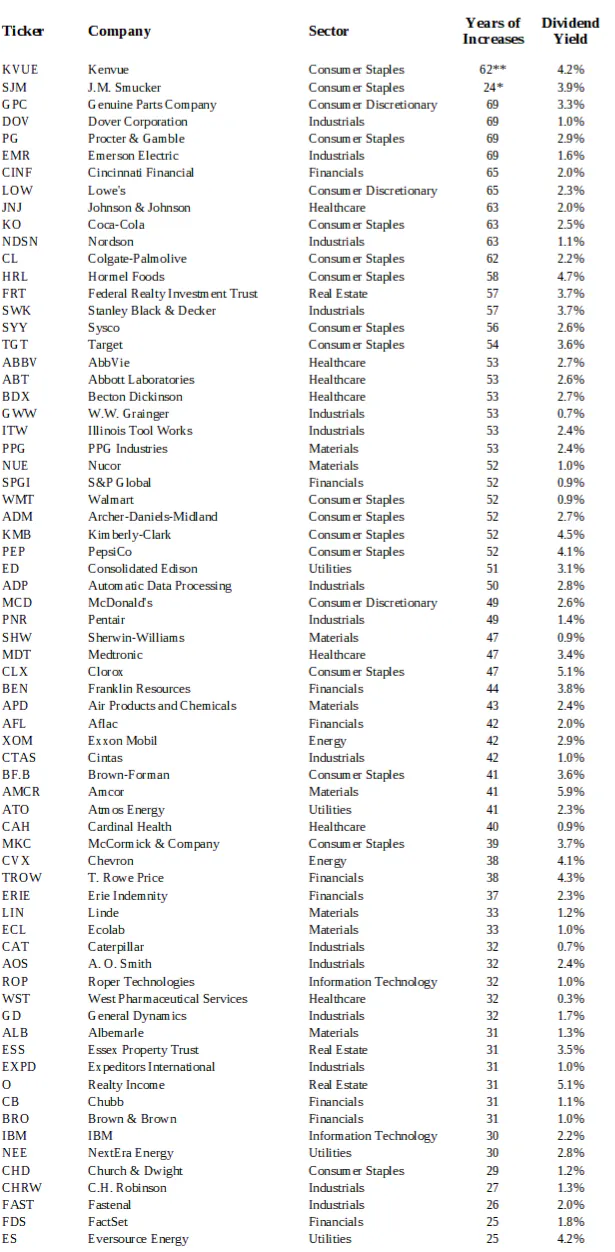
J.M. Smucker was added to the index in January 2023 with a 21-year streak at the time; the company itself points to an uninterrupted payout dating back to 1972 aside from a brief freeze in the 1990s.
*Kenvue was credited with parent company Johnson & Johnson's dividend growth history when it was spun off in 2022 and added to the index in 2023.
Yields and streaks are approximate as of mid-2026 and change daily with share price movements. Always confirm current data with your broker or a live data provider before making an investment decision.
Dividend Aristocrats by Sector
One of the most useful ways to think about the dividend aristocrats list is through a sector lens, because the group is heavily concentrated in a handful of defensive industries.
Consumer Staples is the largest sector by far — companies like Altria (Abre numa nova janela), Procter & Gamble (Abre numa nova janela), Coca-Cola (Abre numa nova janela), PepsiCo, Colgate-Palmolive (Abre numa nova janela), Walmart (Abre numa nova janela), Target, and Hormel Foods sell products people buy regardless of the economic cycle.
Industrials is the second-largest group, including names like Illinois Tool Works, Emerson Electric, Dover, Linde Plc (Abre numa nova janela), Caterpillar, and Automatic Data Processing.
Healthcare includes Johnson & Johnson, AbbVie, Abbott, Medtronic, and Becton Dickinson — businesses with durable demand tied to aging demographics.
Financials features insurance and asset-management businesses such as Chubb, Aflac, T. Rowe Price, BlackRock (Abre numa nova janela) and Cincinnati Financial.
Materials includes industrial gas and specialty chemical companies like Linde, Air Products, Ecolab, and Sherwin-Williams.
Utilities contribute regulated, low-volatility cash-flow businesses such as NextEra Energy, Consolidated Edison, and Atmos Energy.
Energy, Real Estate, Information Technology, and Consumer Discretionary round out the list with a smaller number of representatives each — Exxon Mobil and Chevron in energy, Realty Income and Federal Realty in real estate, IBM, Microsoft (Abre numa nova janela) and Roper Technologies in tech, and McDonald's and Lowe's in consumer discretionary.
Notably, growth-oriented sectors like Communication Services are entirely absent from the dividend aristocrats index, and technology is represented by only two companies. This sector concentration is exactly why the group tends to lag the broader, tech-heavy S&P 500 during strong bull markets — but it's also why the index has historically held up better during downturns.
Highest-Yielding Dividend Aristocrats
If income today matters more to you than income growth tomorrow, it's worth knowing which dividend aristocrat stocks currently offer the highest yields. Based on current data, Amcor, Realty Income, Clorox, Hormel Foods, Kenvue, PepsiCo, Kimberly-Clark, and Chevron are among the highest-yielding names on the list, with yields roughly in the 4-6% range.
A word of caution: the highest-yielding dividend aristocrats are not automatically the best dividend aristocrats to buy. A yield that's meaningfully above a company's own historical average, or well above its sector peers, can be a signal that the market has priced in slower growth, rising risk, or even a potential future dividend cut. Always pair yield with an assessment of payout ratio, balance sheet strength, and earnings trends before assuming a high yield is "free money."
Dividend Aristocrats Performance
Over most long-term periods, the Dividend Aristocrats Index has delivered total returns roughly similar to the S&P 500, but with meaningfully lower volatility — a rare and valuable combination for long-term investors who want smoother rides through market cycles.
That said, in recent years the group has lagged the increasingly tech-heavy S&P 500, largely because the broader index has become dominated by mega-cap technology and AI-related companies, several of which pay small or no dividends. Since the dividend aristocrats index looks nothing like the modern S&P 500 — heavily weighted toward consumer staples, industrials, healthcare, and utilities rather than technology — this performance gap during growth-led bull markets is a structural feature of the index, not a sign that quality dividend growers have become worse businesses.
On the dividend side, the group has delivered average annual dividend growth of roughly 6% over the last decade, a pace that comfortably outstrips inflation over most periods and steadily compounds an investor's income stream year after year.
Dividend Aristocrats ETF Options
Investors who want exposure to the entire group without picking individual stocks can use a Dividend Aristocrats ETF rather than buying all 69 companies directly. The best-known option tracks the S&P 500 Dividend Aristocrats Index itself, holding all qualifying companies in a single fund. This approach offers instant diversification across sectors and removes the risk of any single dividend cut derailing your income stream, though it also means accepting the sector concentration and lower yield profile of the index as a whole. For investors who want targeted exposure — for example, only the highest-yielding aristocrats, or only those in a specific sector — individual stock selection or a more specialized fund may be a better fit.
Dividend Aristocrats vs. Dividend Kings
Dividend Aristocrats are often compared to Dividend Kings, and the two groups are frequently confused.
Dividend Aristocrats must be S&P 500 members with at least 25 consecutive years of dividend increases, and must meet minimum size and liquidity requirements.
Dividend Kings require at least 50 consecutive years of dividend increases, but do not need to be members of the S&P 500 — meaning the Kings list includes smaller-cap and even micro-cap companies that would never qualify as aristocrats.
Some companies, like Procter & Gamble, Coca-Cola, Emerson Electric, Dover, and Genuine Parts, hold both titles simultaneously. Every Dividend King with S&P 500 membership and sufficient size is automatically also a Dividend Aristocrat, but the reverse isn't true — plenty of aristocrats haven't yet reached the 50-year mark.
Neither designation is automatically "better." Dividend Aristocrats status guarantees membership in a large, liquid, well-known index, while Dividend King status simply reflects an even longer streak, sometimes in smaller or more niche businesses that aren't part of the S&P 500 at all.
How to Become a Dividend Aristocrat
For a company to eventually earn a spot on the dividend aristocrats list, it must:
Raise its dividend every single year for 25 consecutive years without a single freeze or cut.
Grow large enough and become liquid enough to join the S&P 500 and satisfy the index's market-cap and trading-volume thresholds.
Maintain that streak through the annual January rebalancing, since even one missed increase resets the clock to zero.
This is a genuinely difficult combination to achieve. It requires decades of consistent earnings growth, disciplined capital allocation, and a management team and board culture that treats the dividend as close to sacred. That's precisely why new additions to the list — like FactSet, Erie Indemnity, and Eversource Energy in 2025 — are notable events for dividend growth investors, and why the market often applauds when a familiar name like Southern Company approaches the 25-year threshold.
How I Analyze Dividend Aristocrats
A long dividend history is only one piece of the puzzle. Plenty of aristocrats have gone on to become dividend traps, and plenty of non-aristocrats have gone on to become excellent dividend growth investments. When I evaluate dividend aristocrat stocks, I focus on five key areas.
1. Dividend Growth
I prefer companies that consistently increase their dividend faster than inflation. A 2% annual raise barely keeps pace with rising costs, while a company compounding its dividend at 7-10% annually meaningfully grows real purchasing power over time.
2. Financial Strength
Strong balance sheets — reasonable debt levels, solid interest coverage, and investment-grade credit ratings — reduce the risk of future dividend cuts, especially during recessions or periods of rising interest rates.
3. Profitability
Metrics like Return on Invested Capital (ROIC) and operating margins help identify high-quality businesses with real competitive advantages, rather than companies simply riding a favorable cycle.
4. Valuation
Even great companies can become poor investments if purchased at excessive prices. Comparing a stock's price-to-earnings ratio, free cash flow yield, and dividend yield to its own historical range and to sector peers helps avoid overpaying for quality.
5. Long-Term Growth
Growing earnings ultimately support growing dividends. A company that can't grow its underlying business will eventually be forced to slow, freeze, or reverse its dividend growth, no matter how long its current streak.
Are Dividend Aristocrats Worth It?
For most long-term, income-focused investors, yes — dividend aristocrats are generally worth serious consideration, though they shouldn't be the only tool in the toolbox. The combination of a 25-year (or longer) track record, S&P 500 membership, and minimum size and liquidity requirements filters out a large share of lower-quality dividend payers before you even start your own research. That said, "worth it" depends heavily on your goals: investors chasing maximum growth may find the group's defensive sector tilt too conservative, while income-focused investors and retirees often find exactly what they're looking for.
Best Dividend Aristocrats for Retirees
Retirees and other income-focused investors often gravitate toward dividend aristocrat stocks that combine a durable business model, a safer-than-average payout ratio, and a track record that has already survived multiple recessions. Companies frequently highlighted for this purpose include Procter & Gamble, Johnson & Johnson, Coca-Cola, PepsiCo, and Realty Income — all of which pair long dividend growth streaks with recognizable, defensive business models and relatively predictable cash flows. As always, "safest" is relative; every stock carries some risk, and diversification across sectors remains one of the best tools any retiree has.
Safest Dividend Aristocrats
The "safest" dividend aristocrats generally combine a low payout ratio, strong free cash flow generation, and a business model that's relatively insulated from economic cycles. Regulated utilities like NextEra Energy and Consolidated Edison, along with consumer staples giants like Procter & Gamble, Colgate-Palmolive, and Walmart, tend to appear near the top of most dividend safety rankings thanks to their recurring revenue and disciplined balance sheets.
Undervalued Dividend Aristocrats
Identifying undervalued dividend aristocrats requires comparing a company's current valuation multiples — price-to-earnings, price-to-free-cash-flow, and dividend yield — against both its own historical average and its sector peers. A stock trading meaningfully below its five-year average valuation, without a corresponding deterioration in its underlying business, can represent an attractive long-term entry point. This kind of screening changes constantly with market conditions, so it's worth revisiting regularly rather than treating any single list of "undervalued" names as permanent.
Dividend Aristocrats with High Dividend Growth
Some dividend aristocrat stocks stand out not for their current yield, but for how quickly they grow their payout each year. Companies in technology-adjacent and financial data businesses, along with several industrials, have posted some of the strongest multi-year dividend growth rates within the index, often in the high single digits or low double digits annually. For investors with a long time horizon, a lower starting yield paired with rapid dividend growth can ultimately produce more income than a higher starting yield with sluggish growth — a concept often referred to as "yield on cost."
Common Mistakes Investors Should Avoid
Many investors, especially newcomers to dividend investing, make these mistakes when evaluating the dividend aristocrats list.
Buying the highest dividend yield. A high yield can sometimes be a warning sign rather than an opportunity — it often reflects a falling share price due to deteriorating business fundamentals, not simply an attractive entry point.
Ignoring valuation. A wonderful company purchased at an unreasonable price may produce disappointing returns for years, even if the underlying business continues to perform well.
Focusing only on dividend income. Dividend growth is often more important than today's yield, especially for investors with a decade or more until they need the income.
Ignoring sector concentration. Because the dividend aristocrats index is so heavily weighted toward consumer staples and industrials, building a portfolio entirely from this list can leave you under-exposed to technology, communication services, and other growth-oriented sectors.
Assuming past performance guarantees future results. A 40- or 50-year streak is impressive, but it doesn't guarantee the next 10 years will look the same. Ongoing business analysis still matters.
Frequently Asked Questions
How many Dividend Aristocrats are there in 2026?
There are 69 Dividend Aristocrats as of 2026. The exact number changes over time as companies reach the 25-year threshold and join, or get removed after cutting or freezing their dividend.
Are Dividend Aristocrats safe investments?
They are generally considered high-quality companies with above-average financial discipline, but no stock is risk-free. Even long-standing aristocrats have been removed from the list in the past after cutting their dividend.
Are Dividend Aristocrats better than Dividend Kings?
Not necessarily. Dividend Kings require 50 consecutive years of dividend increases but don't have to be members of the S&P 500, meaning the Kings list includes smaller companies not found in the aristocrats index. Neither list is objectively "better" — they simply use different criteria.
What is the average yield of Dividend Aristocrats?
The average dividend yield across the group is generally in the 2.5-3% range, noticeably higher than the broader S&P 500's average yield, though individual yields range from under 1% to nearly 6% depending on the company and sector.
Which sector has the most Dividend Aristocrats?
Consumer staples has the largest representation on the dividend aristocrats list, followed by industrials, healthcare, and financials.
Final Thoughts
Dividend Aristocrats deserve a place on every dividend investor's watchlist. The group represents some of the most resilient, disciplined businesses in the entire S&P 500 — companies that have proven, year after year and recession after recession, that they can grow their dividend regardless of the economic backdrop.
However, a strong dividend history alone is not enough. Investors should also consider valuation, earnings growth, financial strength, sector concentration, and long-term business quality before making an investment decision. The best dividend aristocrats for your portfolio depend on your own goals, time horizon, and risk tolerance — not simply on how long a company's streak happens to be.
Throughout Dividends Paradise, you'll find independent stock research, dividend stock screens, and valuation-focused analysis designed to help long-term investors identify high-quality dividend growth opportunities.
This article is for informational purposes only and does not constitute financial or investment advice. Dividend yields, growth streaks, and index membership change frequently — always verify current data before making any investment decision.
Data
23/07/2026
Tópico
Dividend Growth
0 comentários
Gostaria de ser o primeiro a escrever um comentário?
Torne-se membro de Dividends Paradise🚀 e comece a conversa.