A synthesis of industry roadmaps and complexity science research suggests software engineering education is teaching the right skills—for the wrong paradigm.
Every few years, someone declares that software engineering is "fundamentally changing." Usually, they're selling a framework, a bootcamp, or a productivity tool. This is not that article.
Instead, I want to share a pattern I'm observing across three contexts where I work: redesigning computing curricula at Aalborg University, consulting with engineering organizations on AI adoption, and supervising graduate students entering the workforce. The pattern shows up as a mismatch—not a crisis, but a growing gap between what engineering programs optimize for and what organizations actually need from early-career engineers.
The mismatch isn't about technical depth. It's about paradigm. And it's driven by a structural shift that multiple industry frameworks—INCOSE Vision 2035 (Abre numa nova janela), Engineers 2030 (Abre numa nova janela), and complexity science research from institutions like the Santa Fe Institute (Abre numa nova janela)—are documenting independently.
Below, I'll translate what these frameworks reveal, explain why it matters for how we teach and hire, and offer a concrete starting point for universities and organizations navigating this transition.
The argument is straightforward: as AI increasingly handles routine implementation, the engineering value proposition is migrating toward orchestration, governance, and systems reasoning—and our education and hiring systems need to catch up.
The Transition: From Implementation to Orchestration
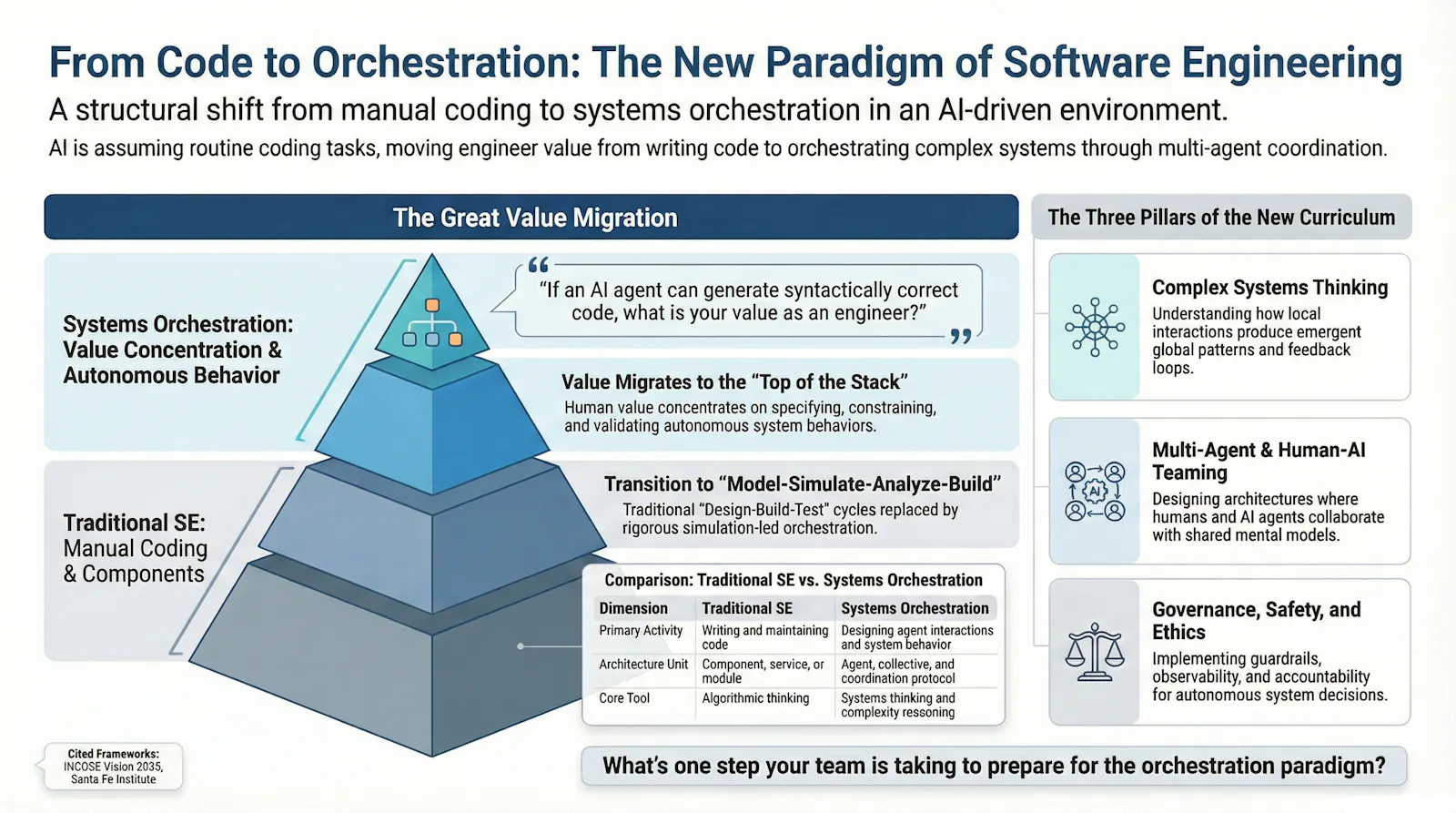
Consider a question I've started asking my students: "If an AI agent can generate syntactically correct code from a natural language specification, what is your value as an engineer?"
Answers typically cluster around three themes:
"I write better code than AI." (A claim with a shrinking half-life.)
"I understand the broader context." (Getting closer.)
"I can determine whether what the AI produced is actually what we need." (This is the shift.)
That third answer reflects a paradigm transition that is already underway in leading organizations. Traditional software engineering education is organized around a specific mental model: the engineer as creator of deterministic artifacts. You learn syntax, data structures, algorithms, and design patterns. You are assessed on your ability to translate specifications into code that behaves exactly as written. The workflow is Design → Build → Test, with success measured by code coverage and adherence to requirements.
But when AI agents can generate implementations autonomously, and increasingly, when multiple agents coordinate to complete complex tasks, the bottleneck shifts. The question is no longer "Can we write the code?" but "Can we specify, constrain, and validate what autonomous systems produce?"
The industry terminology for this is crystallizing. Here's how INCOSE Vision 2035 and Engineers 2030 frameworks describe the shift:
• Primary goal: Produce code artifacts → Design and govern interacting systems
• Core workflow: Design-Build-Test → Model-Simulate-Analyze-Build
• Engineer role: Individual coder/developer → Systems orchestrator/governor
• Key skills: Language syntax, data structures → Complexity reasoning, sociotechnical design
• Focus: Component connectivity → Emergent collective behavior
• Verification: Unit and integration tests → Simulation and behavioral monitoring
This isn't speculative. Organizations deploying multi-agent AI systems today are experiencing this transition firsthand: the engineering challenge is less about writing individual components and more about ensuring coherent collective behavior from autonomous entities with partial information.
Why This Matters: The Economics of Engineering Value
Two forces are converging to make this transition inevitable, and understanding both helps explain why it's not a matter of preference but of structural economics.
First, AI is rapidly assuming routine implementation work. Tools like GitHub Copilot already handle substantial portions of code generation. But the next wave—multi-agent systems capable of planning, delegating, and coordinating across complex tasks—shifts the bottleneck from implementation to specification and validation under uncertainty.
Second, organizations won't pay premium salaries for commodified skills. When AI can generate syntactically correct code at near-zero marginal cost, the market will value judgment under uncertainty: the ability to define what "correct" means when specifications are incomplete, to recognize when emergent behavior violates safety constraints, and to redirect systems drifting toward undesirable outcomes.
Here's where I see the horseshoe dynamic playing out in public discourse. On one extreme, enthusiasts proclaim that AI will eliminate the need for human engineers entirely, a techno-optimist salvation narrative. On the other extreme, skeptics warn of career destruction and expertise erosion, a catastrophic displacement narrative.
Both extremes share a flawed assumption: that the engineer's core value is typing code. In reality, code has always been a means to an end—a way to implement systems that deliver value under constraints. What's changing is the means (orchestrating agents rather than assembling lines), not the end (delivering valuable, reliable systems).
The professionals I speak with, both students and practitioners, often express a related anxiety: "What counts as 'real engineering' when routine coding disappears?"
This isn't only about skills. It's about professional identity and the stories we tell about what makes engineering work valuable.
Which brings me to a framework that helps make sense of this transition.
The Foundation: Why Complexity Science Matters
If the paradigm is shifting from deterministic artifacts to probabilistic ecosystems, our foundation must shift as well—from algorithmic thinking to systems thinking grounded in complexity science.
Complexity science, as developed at institutions like the Santa Fe Institute, studies how order arises spontaneously from local interactions. It moves beyond reductionism (analyzing components in isolation) to understand how macro-level patterns emerge from micro-level rules.
This framework isn't optional for the orchestration paradigm; it's the only coherent way to reason about systems where behavior cannot be predicted by analyzing agents individually.
Five principles from complexity research map directly onto multi-agent engineering:
Networks: Interaction structures shape system dynamics. In software, this determines communication substrates and topologies.
Emergence: Macro-level patterns arise from micro-level rules. System behavior is not the sum of code components but a novel property requiring different verification methods.
Self-Organization: Coordinated action without a central planner, how agent collectives reach consensus or allocate resources dynamically.
Feedback Sensitivity: Small perturbations can trigger outsized effects. Engineers must design mechanisms to dampen or amplify signals appropriately.
Agility: The system's capacity to absorb shocks and renew itself without cascading failure.
Central to this is the concept of the "Edge of Chaos"—the phase transition between rigid order and chaotic unpredictability. Engineering at this boundary enables systems to remain stable enough to function yet flexible enough to adapt.
This is not abstract theory. It describes the operational reality of any organization deploying multi-agent AI systems today, and it's fundamentally different from the deterministic, component-based reasoning that dominates traditional SE curricula.
Six Pillars for the Transition (Not a Revolution)
If the paradigm is shifting, what should engineering education and hiring optimize for? Based on the synthesis of the frameworks mentioned above and my work redesigning SE programs, I propose six pillars. Think of these not as a replacement for foundational skills but as the new context in which those skills operate.
Pillar 1: Complex Systems Thinking
Students must distinguish between "complicated" systems (decomposable and predictable) and "complex" systems (interdependent with emergent properties). A phone book is complicated. Mayonnaise is complex; its ingredients interact to form a substance with entirely new properties.
Pedagogical approach: Agent-based modeling (ABM) using platforms like NetLogo or MESA. Research from SFI shows that even students with limited programming backgrounds can build ABM simulations to observe how simple local rules create sophisticated global patterns, precisely the reasoning needed for multi-agent governance.
Pillar 2: Multi-Agent Architectures and Coordination Design
Engineers must master coordination mechanisms for autonomous entities with partial information:
Hierarchical orchestration (centralized delegation)
Peer-to-peer coordination (direct negotiation)
Blackboard architectures (shared state mediation)
Market-based mechanisms (auctions and bidding)
Key distinction: Traditional architecture focuses on static connections of services via APIs. Multi-agent architecture focuses on the dynamic realization of collective behavior through negotiation protocols.
Pillar 3: Human-AI Teaming and Sociotechnical Design
Following frameworks like Fraunhofer's Human-AI Teaming model (Abre numa nova janela), engineers must design for:
Trust calibration: Identifying conditions for over-trust (reliance despite high uncertainty) and under-trust
Shared mental models: Establishing role specification and interaction protocols
Premature convergence mitigation: Preventing AI-assisted teams from narrowing solution spaces too early
In my experience supervising student teams using AI assistants, this is where the biggest practical failures occur, not in technical implementation but in team dynamics and delegation protocols.
Pillar 4: Governance, Safety, and Observability
In systems where agent actions are inherently unpredictable, safety must be an architectural constraint:
Guardrails: Constitutional prompts and verifiers cascading through agent layers
Resilience: Timeouts, rollbacks, and budget constraints to bound autonomous action
Human-in-the-loop: Mandatory checkpoints with clear escalation paths
Observability shifts toward monitoring for behavioral drift—the gradual divergence of agent behavior from intended norms.
Pillar 5: Model-Based Systems Engineering (MBSE) and Simulation
The lifecycle shift from "design-build-test" to "model-simulate-analyze-build" places the conceptual phase at the heart of engineering. MBSE provides the formal substrate; simulation becomes the primary laboratory for identifying emergent properties before deployment.
Engineers must evaluate:
System coherence (alignment with global specifications)
Safety margin cascades (impact of constraints across agent layers)
Traceability (ability to trace actions back to requirements)
Pillar 6: Ethics, Accountability, and Responsible Deployment
When autonomous collectives allocate resources or make security-critical decisions, accountability is a design requirement, not an afterthought. Engineers must analyze the distribution of responsibility across designers, operators, and agents, and understand the sociotechnical implications of automation.
Following arguments from Andrew Ng (Abre numa nova janela) and Mehran Sahami (Abre numa nova janela), ethics must be woven into technical courses, not treated as an elective.
What This Means Practically: For Hiring, Onboarding, Curricula
The transition to systems orchestration has concrete implications for how we select, develop, and assess engineers.
For hiring managers:
Consider adding interview tasks that assess orchestration capabilities:
"Here's a system where three AI agents coordinate to generate quarterly reports. One agent occasionally produces summaries that contradict the raw data. Design a governance mechanism to detect and correct this."
"Specify the constraints an autonomous deployment agent should respect. How would you verify it's honoring them?"
These tasks reveal systems thinking and governance intuition, skills that won't be commodified by better code generation models.
For university programs:
A readiness checklist:
[ ] Introduce agent-based modeling in first year (not third year as an elective)
[ ] Replace some "build from scratch" labs with "explain, constrain, and safely modify" labs
[ ] Integrate ethics and governance into every technical course
[ ] Use portfolio-based assessment where students manage multi-agent deployments, not just syntax exams
[ ] Teach prompting as specification: treat prompts like micro-requirements with preconditions, constraints, and explicit non-goals
For individual engineers:
If you're navigating this transition yourself, focus on building the "verification and redirection" muscle:
When you use an AI coding assistant, practice articulating the constraints it should respect before you generate code
After it produces output, practice explaining why the output is correct (or not) in terms of system properties, not just syntax
Build simple multi-agent experiments (e.g., two agents negotiating task allocation) to internalize how coordination failures manifest
Evolution, Not Extinction
Let me be clear about what I'm not saying.
I'm not saying traditional programming skills are obsolete. Syntax, data structures, and algorithmic thinking remain foundational—they're the literacy required to understand what AI systems produce and whether it's sound.
I'm not saying this transition will happen overnight. Institutions move slowly, and for good reason. Curriculum changes require faculty development, assessment redesign, and industry partnership.
And I'm not saying that every engineer must become a systems theorist. Specialization will persist (especially for COBOL (Abre numa nova janela)). But the baseline expectation is shifting: even engineers who focus on implementation will need enough systems thinking to operate effectively in environments where their work is coordinated with autonomous agents.
What I am saying is this: the data from industry roadmaps, complexity science research, and my own work with students and organizations point to the same pattern. Engineering value is migrating toward the layers where human judgment under uncertainty remains irreplaceable—specification, governance, validation, and sociotechnical design.
Organizations and programs that treat this as a minor curriculum adjustment, adding a module on "AI tools", will find themselves misaligned with what the field actually needs. Those who recognize it as a paradigm shift requiring new intellectual foundations will produce the engineers who lead the next generation of systems.
Final Thought: What Engineering Has Always Been About
Here's a historical parallel that helps me keep perspective.
In the early 20th century, the transition from craft manufacturing to industrial engineering created similar anxieties. Skilled machinists worried that assembly lines would render their expertise obsolete. And in a narrow sense, they were right, the market for hand-crafted individual components did shrink.
But what actually happened was elevation, not elimination. The most valuable professionals became those who could design production systems, optimize workflows, and ensure quality at scale. The skills changed, but the fundamental value, applying technical knowledge to solve problems under constraints, remained.
The shift from code assembly to systems orchestration follows the same pattern. It's not a loss. It's a migration of engineering work to a higher level of abstraction—one that is, frankly, more interesting and more aligned with what engineers have always claimed to value: solving complex problems, not typing syntax.
So: How is your organization or program adapting to a world where code is increasingly an output of the engineering process, not the primary input?
If the answer is "we're monitoring developments," that's reasonable—but consider running a small experiment this quarter. Pick one hiring interview or one course module. Test whether candidates or students can reason about coordination, specify constraints, or identify emergent failure modes. Compare that signal to traditional coding assessments.
My hypothesis, based on the patterns I'm seeing: you'll find that the engineers who thrive in the orchestration paradigm are not always the ones who score highest on syntax fluency. And that difference will only become more pronounced.
Daniel Russo, Ph.D., is a Professor of Software Engineering whose research examines the intersection of human cognition and artificial intelligence. Through "Software Insights," he translates empirical research into actionable guidance for software practitioners and organizations.
Partner with Daniel to transform your organization through evidence-based approaches that bridge academic rigor with practical implementation. His consulting work helps organizations adopt scientifically validated practices that improve software development outcomes, team performance, and innovation capacity.
Learn more about his approach to evidence-based organizational change: https://www.danielrusso.org/evidence-based-organizational-change/ (Abre numa nova janela)
Data
24/02/2026


