July 2022
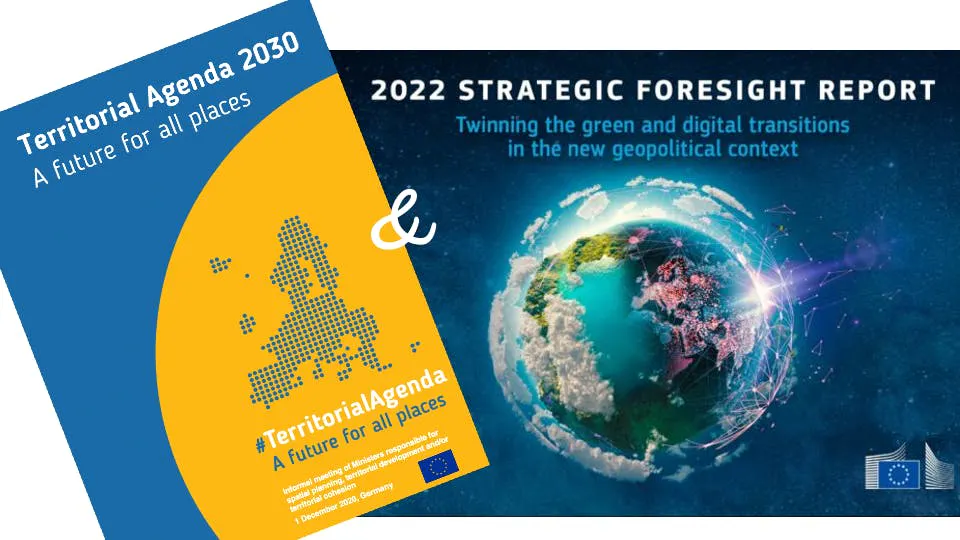
In June the EU published the ‘2022 Strategic Foresight Report’. The Strategic Foresight reports highlight key strategic areas and trends that are relevant for the future of Europe. This year’s report focuses rather on the digital and green transitions, highlighting the most important mega-trends affecting the digital transition and how they can support or be linked to achieve the green transition. It also underlines how Russia’s war on the Ukraine reinforces many of the mega-trends.
Trends & challenges
The digital mega-trends discussed comprise among others artificial intelligence, blockchain, internet of things, digital twins, quantum computing, sensors improving resource efficiency industries, micro-grids and self-organised grids, space-based services. Considering that these trends are not evolving in isolation but in mutual interdependencies, the report approaches them through a series of combined topics. This ranges from digitalised energy, greener transport with digital technologies, climate-neutrality of industries through digital technologies, green buildings through digitalisation, to smart and green agriculture. In the light of the shifting geo-political reality, there is also a strong focus on EU’s resilience and open strategic autonomy, including issues such as access to critical raw materials.
Overall, the report underlines the need to better understand interactions between various trends, but also between different societal transitions Europe is approaching. The report argues that the green and digital transitions need to be approached as twin transitions to exploit synergies and manage them in light of the above mega-trends and unforeseen events. Furthermore, the report argues that in the new geopolitical context, twinning the green and digital transition brings a forward-looking and comprehensive perspective on the interplay between the twin transitions towards 2050.
From twins to triplets
It might be worthwhile to even go one step further. What if we think transition in terms of triplets rather than twins? Next to green and digital transition this would also involve just transition and thereby a cohesion perspective.
Basically, a green and digital transition will not succeed if it does not strengthen at the same time also European cohesion. The risk is that a twin of green and digital transition will further increase disparities and fragmentations between places and people in Europe. Including just transition as a triplet will ensure the ‘cohesion spirit’ of the transition process and also strengthen integration and solidarity (see earlier blog post (Abre numa nova janela)).
Bringing the just transition to the equation and considering the debate about ‘places left behind’ or ´places that do not matter’ also points at the missing spatial or territorial dimension of the foresight report. Indeed, the discussions of mega-trends, challenges and policy solutions are all spatially blind. Still, we know that their impacts will vary between types of territories. As for instances shown in a recent scenario for a hyper digital Danube region (see earlier blog post (Abre numa nova janela)), the digital transition will not take place in the same way in all places. For instance, it can be expected that places that are innovation leaders or home to a high number of research centres of excellence would be first to benefit from a digital transition.
Spatial disparities of the benefits and challenges, that come with a green and digital transition, will be unavoidable. However, coupling them with just transition (or a cohesion dimension) reduces the risk that increasing spatial and social fragmentation drive people and places Europe further apart.
In the context of increasing geo-political uncertainty and disruptions, the cohesion dimension may even help to increase European resilience. In most cases a cohesion dimension will drive more decentralised or polycentric solutions. Decentralised approaches to a green and digital transition
are less vulnerable to disruptions than highly centralised solutions, as is currently illustrated in the field of energy,
offer opportunities and benefits to more places than highly centralised solution and thereby increase societal cohesion and resilience, and
are making better use of place-based potential which often allow for more sustainable solutions.
Territorial teasers
To be successful Europe needs a triplet transition including green, digital and just. Only then the major challenges posed by mega-trends and geopolitical uncertainties can be mastered in a forward-looking manner. This implies also that related foresight approaches and policy responses need to become more spatially nuanced to fully understand the territorial diverse impacts and transition potential. Enlarging the current foresight report with a territorial foresight dimension would be a first step in the analysis (see e.g. experience from a previous ESPON project (Abre numa nova janela)). For a policy triplet, the Territorial Agenda 2030 ‘A future for all places’ (Abre numa nova janela) offers a good starting point. Taking this as complementary reading to the 2022 Strategic Foresight Report allows to fill various of the territorial and cohesion related gaps, both as regards the challenges and the policy proposals.
by Kai Böhme & Maria Toptsidou
https://steadyhq.com/en/spatialforesight/posts/75c41b20-24f2-4593-8b08-532d1c9fb857 (Abre numa nova janela)https://steadyhq.com/en/spatialforesight/posts/ed32d1fa-a85c-4871-82e3-cde5f318900b (Abre numa nova janela)
Data
15/07/2022
Tópico
Resilience & transition
0 comentários
Gostaria de ser o primeiro a escrever um comentário?
Torne-se membro de spatialforesight e comece a conversa.