February 2026
In his special address at the World Economic Forum in Davos, the Canadian Prime Minister, Mark Carney, delivered a message that goes beyond macroeconomics or geopolitics. In a world marked by uncertainty, fragmentation and continuous transitions, he argued that the challenge is not to adjust to these disruptions, but rather to move forward collectively, so that we turn the page rather than clinging to familiar, but rather inadequate or outdated responses. In this framing, cooperation is all about creating those conditions that are necessary for shared progress.
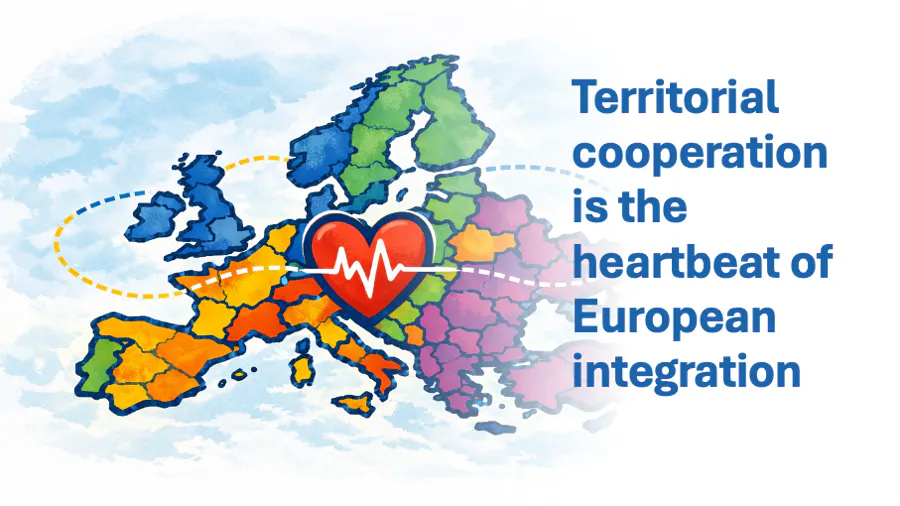
This insight is particularly relevant for Europe today with comparatively small countries in the geopolitical world division of powers. In an era marked by geopolitical instability, accelerating transitions and growing territorial inequalities, territorial cooperation has become even more critical. As we have long argued in our work and reports, ‘cooperation is a must, not a luxury’. Territorial cooperation is the heartbeat of European integration. It is not a technical add-on to EU policies. It is one of its most tangible and politically meaningful expressions. At its core, the European integration has always been territorial. It seeks to overcome the constraints of borders without erasing diversity, to integrate economies and societies while respecting local specificities, and to turn proximity into a shared asset rather than a source of fragmentation.
Europe’s legitimacy does not primarily rest on abstract principles or regulatory power, but on its capacity to improve living conditions across its diverse territories. Cooperation across borders, regions and governance levels is one of the few policy approaches that directly addresses the everyday spatial realities of European citizens: commuting across borders, shared labour markets, functional ecosystems, cross-border value chains, or common exposure to climate risks.
European territorial cooperation also goes beyond simply working together. Territorial cooperation also embodies a specific vision of Europe: one that recognises interdependence rather than only competition between places, and solidarity rather than zero-sum thinking between regions. At a time when national reflexes are resurfacing and when integration across borders is increasingly framed in terms of competitiveness, defence or strategic autonomy, territorial cooperation reminds us that Europe is not only a market or a geopolitical actor, but a shared living space.
In this sense, territorial cooperation is not only about making policies work better. It is about sustaining the European idea itself: a Europe that integrates through collaboration between territories rather than through centralisation, and that builds cohesion not by levelling differences, but by connecting them.
Understanding territorial cooperation: beyond Interreg
Territorial cooperation is often narrowly associated with Interreg programmes and cross-border projects. While Interreg has been instrumental in institutionalising cooperation, this understanding is far too limited for today’s challenges.
At a broader level, territorial cooperation refers to the capacity of people, businesses, public authorities and civil society to act collectively across administrative, sectoral and national boundaries in pursuit of shared territorial objectives. It is about aligning decisions, investments and behaviours in functional territories that rarely coincide with formal borders.
This includes cooperation:
between neighbouring regions and cities across national borders,
between urban and rural areas within and across regions,
along macro-regional and sea-basin geographies,
between public institutions, private actors and communities,
across territorially relevant policy domains such as transport, energy, health, innovation, education or environmental management.
Crucially, territorial cooperation is not limited to public authorities. It also concerns businesses organising cross-border value chains, workers navigating integrated labour markets, universities and research centres pooling knowledge, cultural actors building shared identities, and communities jointly managing natural resources. In many cases, cooperation emerges bottom-up, driven by necessity and proximity rather than by EU funding alone.
From a territorial perspective, cooperation is what allows Europe to function as a networked space rather than a mosaic of isolated units. It enables scale where needed, proximity where valuable, and diversity where beneficial. Without cooperation, European territories would remain trapped within administrative logics that do not reflect socio-economic realities.
Picture Europe as a giant, complex high-speed rail network. Each country has its own tracks, but only through territorial cooperation in the form of standardised signalling and gauging can trains move seamlessly from one nation to another. Without cooperation, trains would have to stop at every border and passengers would constantly have to change carriages. The entire system would become slow, expensive and eventually useless. Cooperation is not just an additional feature of the rail network; it transforms a collection of dead-end tracks into a functioning network.
What if there were no territorial cooperation?
Imagining Europe without territorial cooperation is a useful thought experiment. In such a scenario, borders would regain their full friction, even where economic and social integration is already deep. Cross-border workers would face increasing administrative barriers, shared infrastructures would be underused or duplicated, and functional regions would be fragmented by misaligned policies.
More fundamentally, the absence of cooperation would amplify territorial disparities. Stronger regions would be better equipped to internalise shocks and attract investment, while weaker or peripheral territories would struggle even more to compensate for their structural disadvantages. The result would not only be economic divergence, but also political alienation and social resentment.
Without cooperation, policy incoherence would become the norm. Climate adaptation measures upstream would undermine efforts downstream; transport investments would stop at borders; innovation ecosystems would be artificially segmented; and crisis responses would remain nationally bounded despite transnational impacts. In such a Europe, inefficiency would not be accidental, but systemic.
Perhaps most critically, the lack of territorial cooperation would erode trust. Trust between institutions, between territories, and ultimately between citizens. Cooperation creates repeated interactions, shared problem-solving and mutual understanding. Its absence would reinforce narratives of “us versus them”, both within and between Member States.
Territorial cooperation through a STEEP lens
In impact assessments and foresight processes we usually apply the STEEP framework, looking at Societal, Technological, Economic, Environmental and Political dimensions. A STEEP perspective helps illustrate why territorial cooperation is indispensable across multiple dimensions.
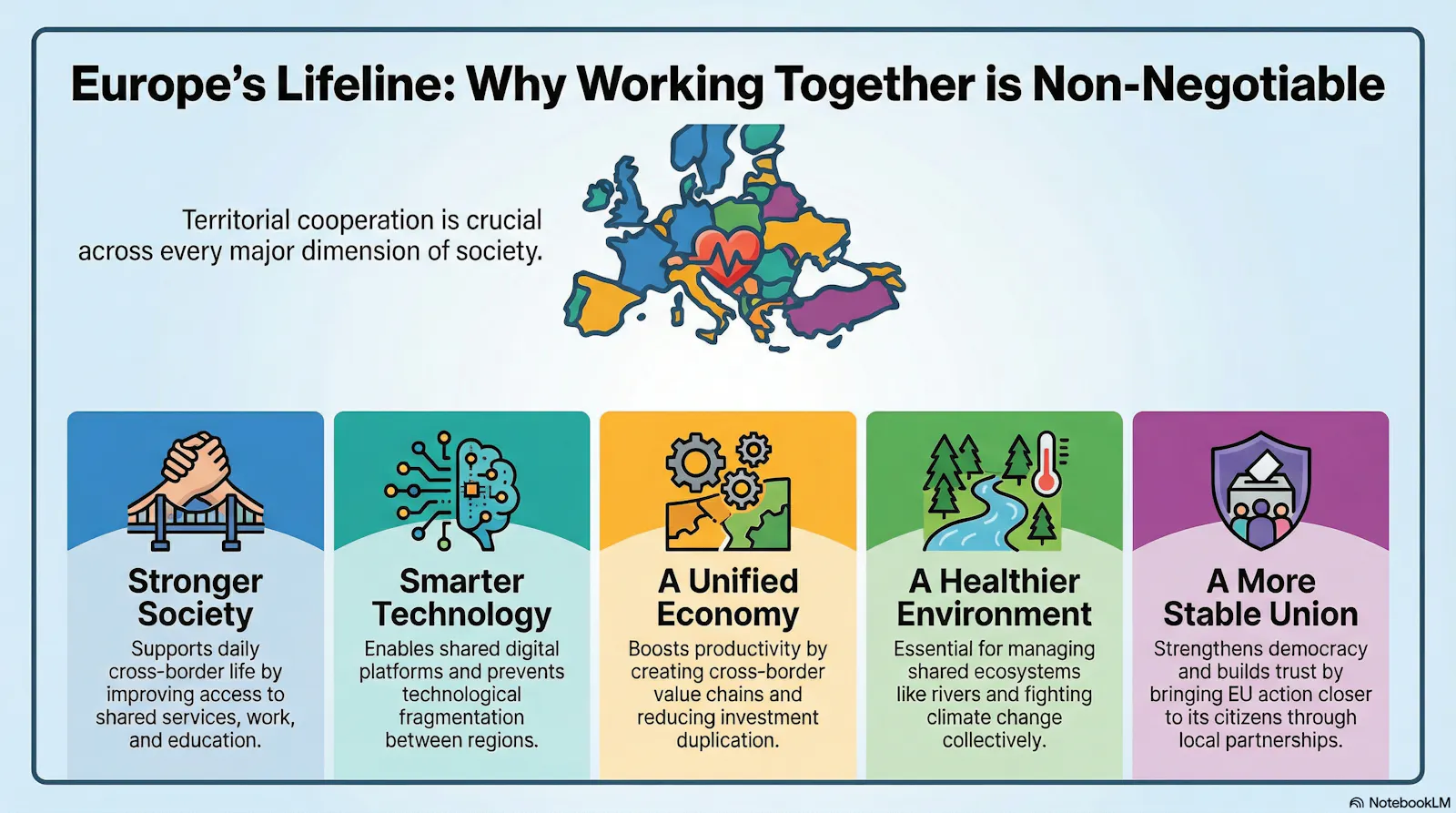
Societal. European societies are increasingly mobile, diverse and interconnected. Cross-border regions exemplify this reality, with daily mobility for work, education and services. Territorial cooperation supports social inclusion e.g. by improving access to services, recognising qualifications, and fostering shared identities. Without it, social rights and opportunities remain unevenly distributed across space.
Technological. Digitalisation, data infrastructures and emerging technologies operate at scales that rarely match administrative borders. Territorial cooperation enables shared digital platforms, interoperable systems and joint innovation ecosystems. It also helps avoid technological fragmentation, where different standards and capacities reinforce territorial divides rather than reducing them.
Economic. Europe’s economic geography is shaped by cross-border value chains, labour markets and functional regions. Cooperation enhances productivity by reducing transaction costs, pooling resources and enabling specialisation based on territorial strengths. Conversely, a lack of cooperation leads to duplication, suboptimal investment and lost economies of scale.
Environmental. Ecosystems do not respect borders. Rivers, seas, mountain ranges, ecosystems and climate systems require joint management. Territorial cooperation is essential for climate mitigation, adaptation and biodiversity protection, particularly in cross-border and macro-regional contexts. Fragmented environmental governance risks shifting problems rather than solving them.
Political. Politically, territorial cooperation strengthens multi-level governance and democratic legitimacy. It brings the EU closer to citizens by anchoring European action in concrete places and partnerships. It also provides a counterbalance to both excessive centralisation and uncoordinated nationalisation, offering a more nuanced governance model based on shared responsibility.
Conclusion: why Europe needs cooperation at its core
Territorial cooperation is not a marginal policy choice. It is a condition for Europe’s long-term viability. As Europe faces simultaneous green, digital, demographic and geopolitical transitions, no territory can succeed in isolation. Interdependence is not a weakness to be corrected, but a reality to be governed.
This raises a provocative but increasingly relevant question: should every euro of the EU budget be conditioned to cooperation? Not in a bureaucratic or symbolic sense, but as a guiding principle. EU funding could systematically incentivise cooperation across borders, sectors and governance levels, ensuring that investments contribute not only to national objectives, but to shared territorial outcomes.
Such an approach would reinforce policy coherence, maximise territorial impact and strengthen European added value. More importantly, it would reaffirm a fundamental message: Europe is built through cooperation between its territories, not merely through competition between them.
In a fragmented world, territorial cooperation remains one of Europe’s most distinctive and underappreciated assets. Preserving and strengthening it is not just a technical necessity, but a political choice about the kind of Europe we want to build; and the kind of shared future we are willing to imagine together.
by Kai Böhme
 (Opens in a new window)
Date
February 12, 2026
Topic
Territories
0 comments
Would you like to be the first to write a comment?
Become a member of spatialforesight and start the conversation.