Impacts of the energy crisis
September 2022
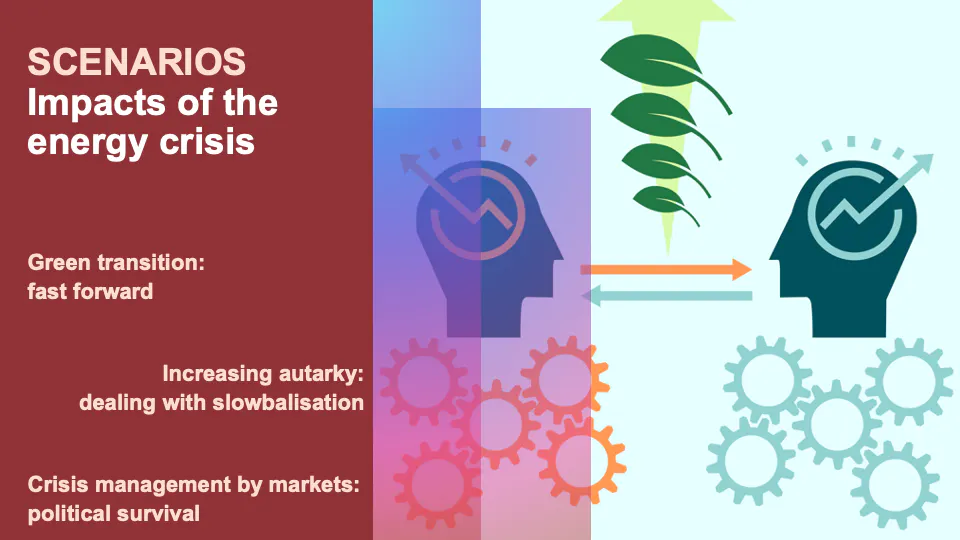
Rising energy prices and the emerging energy crises will also affect territorial and societal disparities in Europe. In a recent study for the European Committee of the regions (Opens in a new window), we have briefly sketched three scenarios:
What may happen if the EU decides to become more or less closed respectively open in the context of growing de-globalisation and protectionism and if pragmatic decision making or the idea of using the current crisis as a change to accelerate the green transition prevail?
Discussing possible scenarios along those lines make one thing clear: Our choices and the underlying ideas or visions that drive them matter to Europe’s development prospects. In rough terms, there is the risk that energy crises further increases Europe’s fragmentation and drives the EU, its places and people further apart, as decisions are taken on a “day to day basis” without a shared underlying overall vision. A quick summary of the three scenario sketches illustrates this (the full scenario texts can be found in the study report).
Scenario 1:
Green transition – fast forward
Facing energy crises and climate change, measures to accelerate a green transition are taken at EU level and in the member states. Substantial efforts are made to exploit energy saving potential in industry, households and transport also through behavioural changes. At the same time production of renewable energy and phasing out non-renewable energy sources is fast-tracked. This fast forward transition does not come without challenges. Rising energy costs and thus higher costs of living risk to lead to increasing social inequalities and unrest, as happened some years ago with the Yellow Vests (gilets jaunes) protests. Therefore substantial government support to households is provided. There are also various support measures to the energy supply and the production sector in general as they face considerable various hiccups during the course of the transition. The strong government support ensures a broad acceptance to approach the transitions necessary to deal with climate change and follow up on the UN sustainable development goals (SDGs). In that sense, the energy crises becomes a catalyst to increase societal awareness about the grand societal challenges of our time and helps changing mindsets and behaviours and served as accelerator for a green transition. As it turns out, more sustainable and decentralised solutions are also more secure and resilient in the light of external shocks.
Scenario 2:
Increasing autarky – dealing with slowbalisation
Energy shortages, increasing food prices and disruption of various international supply chains push the EU and its member states towards policies to reduce its dependency on third countries. Following on trends which started already in the wake of the COVID-19 pandemic, there is an increasing focus on the repatriation of various supply chains. Basically, the energy crisis sheds more light on how globalisation functions, exposes its risks and downsides and paves the way for new thinking about trade, international relations, economy and society. In doing so, it accelerates protectionism and introversion of countries. This includes an imperative to increase the use of own energy resources even if they are less green, or not green at all. Step by step this leads to an increasing protectionism which even involves stronger border controls for immigrations and refugees from third countries. The focus on the own country and possibly selective partnerships with likeminded countries alleviate challenges of isolation. This increasing autarky and slowbalisation brings about various social, technological, economic, environmental and political consequences. More importantly, it also comes at the cost for a faster green and just transition, as the need to reduce energy demand and increase energy savings is not addressed adequately.
Scenario 3:
Crisis management by markets – political survival
In this scenario, the focus is on pragmatic and often ad-hoc solutions, which do not require too much state intervention as public resources are limited. Following the logic of a free market economy, matching energy supply and demand is best solved by decentralised and market driven solutions. In other words, the market is best placed to master the energy crises, and the EU lets the free markets address the issues of energy shortage and increasing price levels. This forces businesses to reassess their profitability and households to reconsider their lifestyles in light of longer periods of high energy prices. As some sectors need to lay off and poverty increases all over in the EU, governments try to cushion the effects of increasing energy prices through various support measures. This in turn leads to debates on higher tax levels. Overall, there is a risk that in the short-term the overall situation deteriorates and becomes rather challenging. However, once the ‘valley of tears’ has been passed, the future might look bright, as a number of painful adjustments are made and finally will pay off. Through this transition, Europe remains open to global business and people, and even welcomes a migration wave due to increasing poverty in many African countries. Outmigration from Europe to other countries may also be a consequence. All this comes at the cost of substantially increased territorial and social disparities.
Conclusions
The energy crisis can point us different directions as shown by the above scenario sketches – and these are just some of a wide range of possible directions. Each of which has its own specific implications for Europe’s future spatial, societal, technological, economic, environmental and political development.
The above are mere some teasers to stimulate discussion, more details can be found in the CoR report (Opens in a new window).
by Kai Böhme
https://steadyhq.com/en/spatialforesight/posts/c25f4743-c7f2-436f-b94a-8afa4764f5a8 (Opens in a new window)
Date
September 14, 2022
Topic
Scenarios & visions
0 comments
Would you like to be the first to write a comment?
Become a member of spatialforesight and start the conversation.