2026/06/17
With Ukraine gaining the initiative on the battlefield, Putin returns to an old tactic that virtually never works in a full scale war: the terrorising of the population.
On the 15th of June Russia bombed the Kharkiv Art Museum - one of the oldest and most valuable art collections in Ukraine -, the Dovzhenko Film Studio in Kyiv - where they destroyed Ukraine’s oldest costume collection (Opens in a new window) counting 100,000 pieces -, and the Kyiv Pechersk Lavra - a UNESCO World Heritage site and the country’s most sacred monastery built in 1051, one century before Moscow was founded.
The target of these attacks was Ukrainian culture itself.
The following day as the G7 summit was underway in France a Russian warship fired intimidation shots (Opens in a new window) at a British yacht in the English Channel. On the same day it was revealed that Moscow was behind numerous arson attacks (Opens in a new window) targeting UK Prime Minister Keir Starmer.
These were part of Russia’s increasing horizontal escalation (Opens in a new window) tactics.
Cultural Erasure
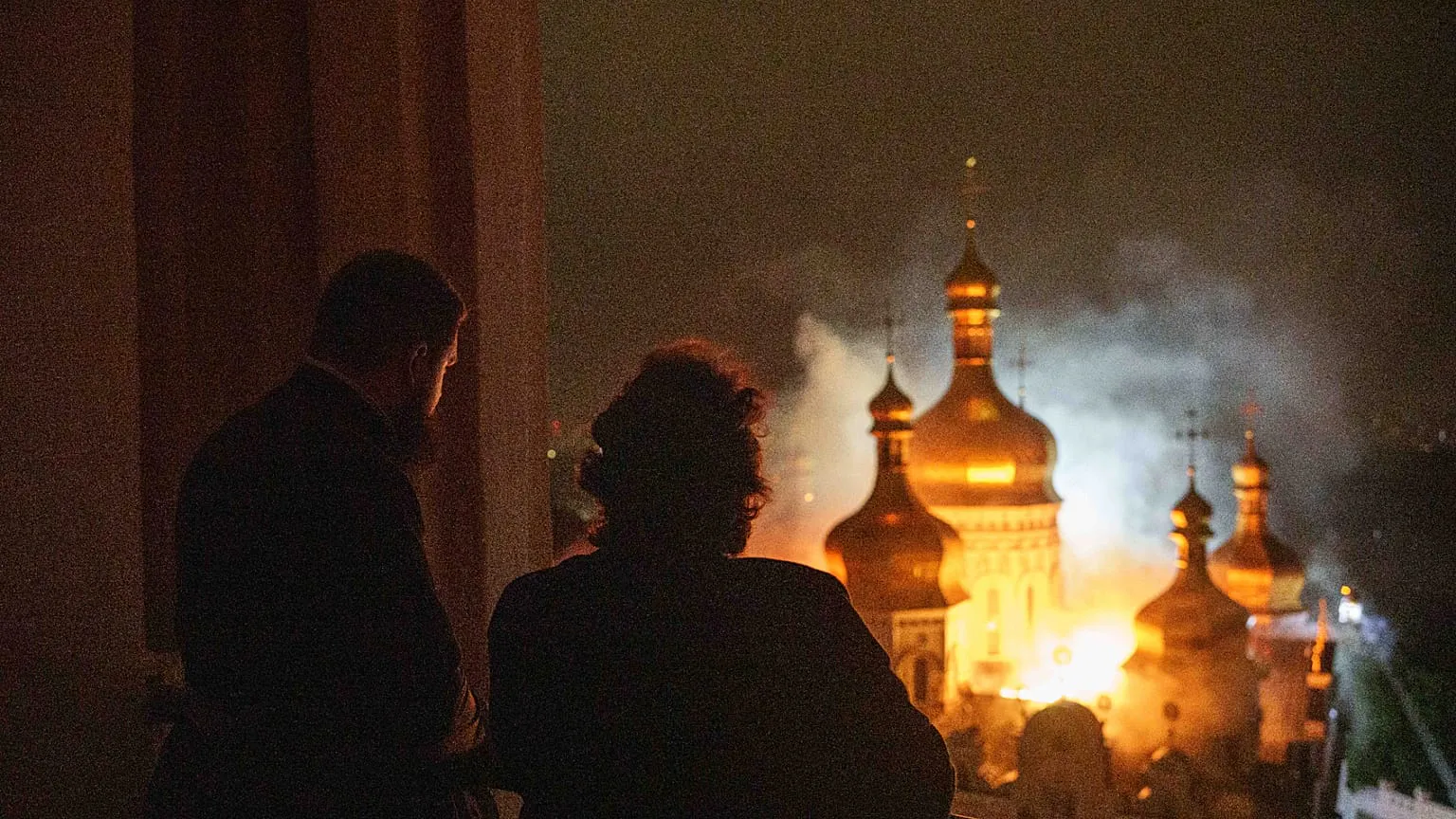
As Putin’s original war aim - the full subjugation of Ukraine - seems farther than ever, he is pursuing some of his secondary goals, which include the forced ungovernability of the Ukrainian state, and the erasure of its culture.
Moscow’s thinking goes something like this: if we cannot take over Ukraine, let’s destroy it. Make it be doomed forever, so it can never be a prosperous alternative Russians can look at, and think “maybe life could be better in a system different from what we live in”.
The strategic logic behind cultural erasure is to destroy Ukrainian national identity at its roots. First Russia tried to steal everything Ukraine has. Its land, people, and whatever is on the land. What they couldn’t steal, they will now try to destroy, with the emphasis on its heritage sites: churches, museums, and cultural infrastructure.
The implicit message is: there is no Ukraine distinct from Russia, so there is nothing to preserve. It is the manifestation of Putin’s “one people” thesis which he outlined in his essay (Opens in a new window) after he decided to invade Ukraine in 2021.
This bombing campaign along with his rhetorical posturing undeniably shows that he is not deterred by the shifting dynamics (Opens in a new window) on the frontline. He is determined to continue the war, and willing to squeeze (Opens in a new window) the Russian economy and population for as much as they let him get away with.
Terror Bombings and Their Futility
Bombings aimed at civilians and cultural sites have no military benefits. In fact, they are counterproductive. They activate a rally around the flag effect that only strengthens internal resolve. The photos and videos of these attacks will circulate in global news, and will likely fuel international support for Ukraine. Western leaders reluctant to provide more aid will face new pressures, while leaders who want to provide more aid can use them as a new excuse.
Attacking a UNESCO heritage location, and especially a church squares this effect. Nobody can argue against bombing a church that doubles as an important cultural sight being bad and must be stopped. It activates a visceral feel of outrage in masses of both people of faith, and those who care about history and culture.
Building and maintaining a church is among the best ways to mobilise humans. This is why we can often see exquisitely well-kept churches even in poorer regions, surrounded by neglected infrastructure and degrading buildings.
Continuing on this course has the potential to inspire support and sympathy from the world's Christian communities towards Ukraine. It also weakens Russia’s long-running propaganda claim that they are the protectors of Orthodox Christianity.
What works in air campaigns - to a limited degree - is bombing aimed at denying military capabilities like logistics, fuel, and industrial nodes. This is Kyiv’s current strategy with its long-range drone campaigns. In this, Ukraine has an advantage because it can repair these infrastructures faster with the help of Western resources than the ever-more sanctioned Russia.
Ukraine’s size is also an advantage. On a smaller territory, it can more effectively deploy air defence, while Russia cannot easily protect these assets on its full landmass. Especially since Putin prioritises the defence of his own private properties (Opens in a new window), and Moscow and Saint Petersburg, leaving the rest of the country exposed, where most of the oil and gas infrastructure and military production is located.
Horizontal Escalation
With the Russian advances ground to a halt and Western aid carrying on flowing, Putin will increasingly try to pressure Kyiv’s supporters through an escalation of hybrid warfare (Opens in a new window). The ultimate goal of these is to destabilise Europe, create disruption, sow fear, and undermine support for Ukraine while remaining below the threshold of direct military confrontation which he knows he cannot win.
Horizontal escalation will be most pronounced in three forms: subversion, coercion, and sabotage.
Subversion is the hidden form. It consists of information manipulation, election interference, and the funding of extremist groups.
Clear Russian election interference already happened - and failed - lately in Moldova, Hungary, and Armenia. Likely more to follow especially in Germany, and France. These two are the most essential countries for Russia to flip. If they ever managed to get leaders sympathetic to Putinism elected there, Moscow can have a reason to believe that it can turn the tide in the war by meaningfully undermining European support. If not, they still gain to benefit from the destabilizing effects of their misinformation campaigns.
My assessment is that putting Putinists in charge would still not work, but might make Ukraine’s situation much more difficult. There are enough countries that treat the war as an existential struggle, and would back Kyiv no matter what. It would put more burden on them but ultimately, they would have no choice but to increase support. Similarly, today Ukraine is much too intertwined (Opens in a new window) with European security and weapons production infrastructure. There is a growing hard limit as to what extent European capitals can back out from assisting Kyiv.
Then there is coercion. The use of threats of conventional military force to create psychological pressure and deter coherent responses.
Since the start of the full scale war there is an increase in Russian military activity near the EU's eastern borders. In 2025 alone NATO fighter jets conducted over 570 intercept missions, nearly three times as much as in 2023. The Kremlin has turned to the use of increased airspace and maritime violations. By staging Zapad-2025 drills that exceeded 100,000 troops, with the use of nuclear systems, Moscow sought to demonstrate its escalation dominance and to show that the EU’s frontline states remain vulnerable.
The primary objective is psychological and political. Putin’s aim is to convince European leaders - and voters - that providing more support for Ukraine risks triggering direct military conflict with Russia, thereby delaying much-needed aid. Europe’s overly cautious reactions to repeated Russian airspace violations by mostly drones combined with the absence of a unified EU-level approach reinforces this perception.
Lastly there are rising numbers of sabotage actions. These involve attacks on both civilian and military infrastructures.
These inexpensive and deniable efforts increasingly target logistics nodes, retail chains, defence-related supply chains, and critical civilian infrastructure to undermine European support for Ukraine while remaining below the threshold of direct military confrontation.
Russia’s shadow fleet has been used to damage Baltic Sea communications cables. Across Europe there have been a growing number of organised sabotage activities targeting railways, logistics hubs, and commercial infrastructure of supply chains related to Ukraine. Investigations in Poland, Germany, and Lithuania in 2025 uncovered overlapping networks linked to Russian military intelligence, often operating via proxies and criminal intermediaries to preserve deniability.
The Kremlin-affiliated agents and third-party proxies will likely further target defence production facilities, transport corridors, and commercial and defence supply chains to disrupt military aid to Ukraine and raise security and economic costs across Europe.
Why these are unlikely to achieve their goals
At the end of the day similarly to terror bombing campaigns, horizontal escalation will be counterproductive. The politicians, military, intelligence services, and the population will not react by getting scared and conclude that Ukraine must be supported less and we should just give in to Russian demands. That would only embolden Moscow, create a precedent that it works, endangering peace and deterrence for decades to come.
The natural reaction will be that supporting Ukraine is the right call because Russia is dangerous, and similarly it will help convince more people that increasing military spending and production, and modernizing defences is the correct policy. It is more likely to create political will instead of destroying it.
Summary
While terror bombings might be emotionally satisfying to Putin and his people prosecuting the war, they are militarily and strategically counterproductive. It is wasting ammunition on civilians and buildings that could be better used on the frontline or against military infrastructure. It reminds international audiences that there is still a brutal war going on, foreign supporters of Ukraine can use it as “propaganda” and proof that Kyiv needs more assistance.
Both the terror bombings and horizontal escalation are unlikely to bear fruit. On some level Putin must be aware of this. But it would be a mistake to conclude that they are only acts of desperation because of the battlefield situation.
These tactics serve several big picture strategies. One of them is cultural erasure, which is part of Putin’s original strategy of the destruction of Ukrainian statehood and national identity. Beyond that, he still believes that time is on his side, and eventually world events and favourable elections in the West will stop the flow of aid for Kyiv.
Even if he has to wait for a very long time, in his mind he still benefits from them. It makes Ukraine poorer and weaker in the long run, and the West more divided.
If Putin decides to escalate these attacks they will further traumatise the population, but will not make them turn against their leadership or the war efforts. Humans have a remarkable tendency to adapt and get used to even the harshest conditions. Ukrainians more than anybody proved this time and time again.
Sources:
https://www.globsec.org/what-we-do/commentaries/how-russias-hybrid-warfare-will-escalate-2026-and-what-europe-must-do (Opens in a new window)https://www.eurasiareview.com/12032026-hybrid-warfare-2026-russian-propaganda-destroying-europe-from-within-analysis/ (Opens in a new window)Recommended content:
Date
June 17, 2026
Topic
Ukraine


