For Cognitive Republic members — a paired review of a classic thriller and a monumental political biography.
I promised myself I’d sometimes pair a famous novel with a famous work of history when they’re genuinely in conversation with each other. This pairing happened almost by accident: I reread Frederick Forsyth’s The Day of the Jackal because I’d been living inside Julian Jackson’s vast biography of Charles de Gaulle. And the two books—very different in ambition and tone—circle the same question:
What happens when a single, determined human being tries to out-think, out-run, out-manoeuvre, the machinery of the modern state?
Frederick Forsyth, The Day of the Jackal (first published 1971; I read a Penguin Kindle edition)
Julian Jackson, A Certain Idea of France: The Life of Charles de Gaulle (Allen Lane, 2018; a Kindle edition)
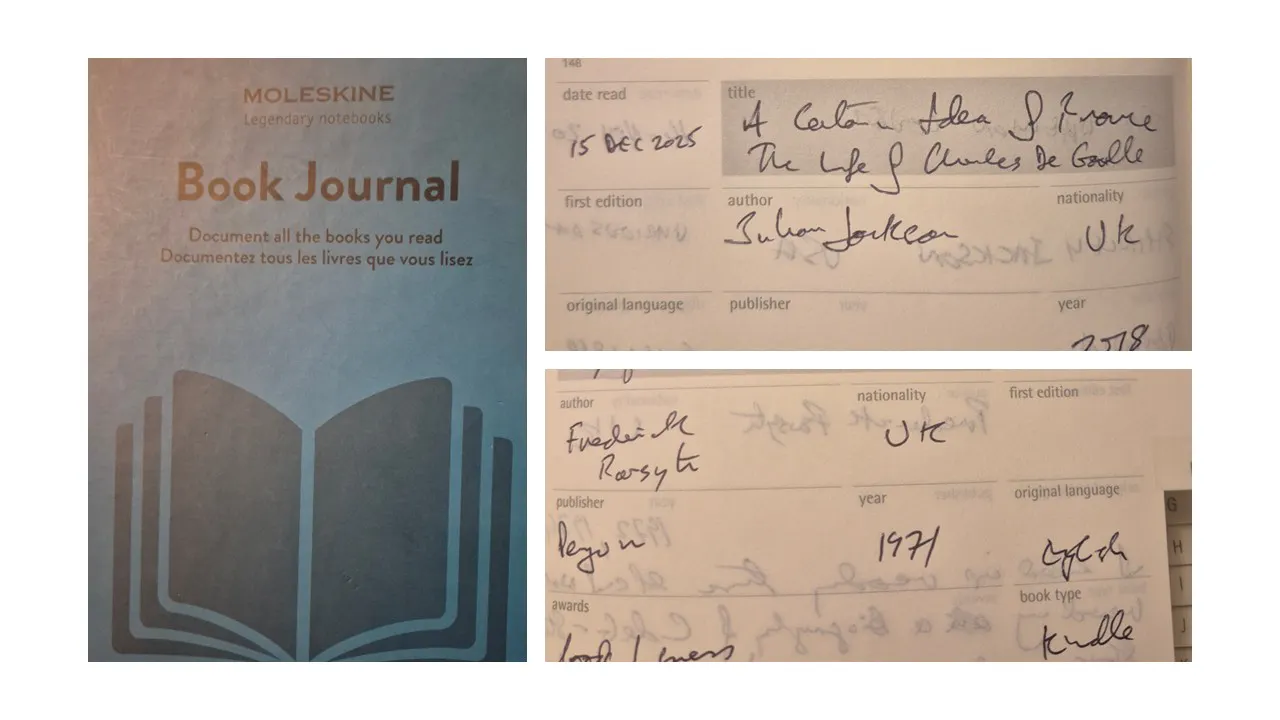
1) Frederick Forsyth — The Day of the Jackal (1971)
I first read The Day of the Jackal years ago. Coming back to it now, I was surprised by how well it holds up.
It’s a paradoxical book: a fast read that feels leisurely, because it luxuriates in method. Forsyth glories in the granular—roads and railway stations, hotels and border crossings, forged documents, timing, money, weaponry, the texture of a pre-digital Europe where systems are powerful but still clunky. The story regarding the procuring of a passport by the Jackel through impersonating a dead child seemingly led to a change in the law in the UK
The plot “fails” in the only sense that matters because history tells us it must: de Gaulle is not assassinated. So the suspense is never really Will de Gaulle die? It’s How close can the attempt get—and what does that proximity reveal about the effectiveness and capability of the state and its security services? The cat-and-mouse game becomes a guided tour of institutional cognition: how a security apparatus “thinks” through routines, coordination, files, human attention—and all the blind spots that come with those strengths.
The book has been described as a “documentary thriller,” and that’s exactly right: it’s procedural to its bones. What I enjoy most is that Forsyth makes bureaucracy dramatic, by removing glamour, and showing how power actually operates: through files, routines, coordination problems, small delays, assumptions, and missed signals.
Two lines I flagged capture the psychology and the institutional theory in miniature:
“Like most of us, Rodin could blind himself to facts with sheer belief.”
“The weakness of all dictatorships is that they are vast bureaucracies. What is not on file does not exist.”
The first is a pin-sharp note on motivated reasoning—belief as a solvent of inconvenient reality. The second is a brutal description of how organisations “see”: they see what their systems can register, and they treat the unregistered as if it were unreal.
Is it great literature? No. Is it a great read? Absolutely. It’s fun—fun, fun, fun—so go read it. You won’t regret it.
Become a member of the Cognitive Republic- just click here. (Öffnet in neuem Fenster)
A quick note on the film
Fred Zinnemann’s 1973 adaptation is (still) superbly watchable. The closing crowd sequence remains striking in its restraint: tension without excess explanation, and an atmosphere that keeps tightening right up to the end - de Gaulle attending and saluting the assembled soldiers while the hunt continues - leans into an almost unbearable tension without any dialogue: letting music do the work where you might expect dialogue helps preserve the feeling that the event is bigger than any single speaking character.
https://www.youtube.com/watch?v=C5SuA0EKY8M (Öffnet in neuem Fenster)[There’s a modern reimagining as a 2024 TV series (Eddie Redmayne, Lashana Lynch; created by Ronan Bennett), which I haven’t watched…]
2) Julian Jackson — A Certain Idea of France: The Life of Charles de Gaulle
Jackson’s book is—without exaggeration—one of the most extraordinary political biographies I’ve encountered. It is huge, patient, and intellectually fair, but it never loses narrative drive. You come away not with a saint or villain, but with a fully dimensioned human being: difficult, proud, brave, stubborn, intellectually serious, often infuriating, sometimes magnificent.
Jackson makes it hard to maintain easy caricatures: de Gaulle as mere anti-American contrarian, or as pure nationalist romantic. Instead you have a fully realised statesman with a “certain vision” of France—grand, yes, but also strategic: an instinct for leverage, symbolism, timing, and the psychology of nations.
One of Jackson’s great achievements is showing how de Gaulle could be both:
three steps ahead (in sensing where the tectonic plates were moving), and
oddly behind (in underestimating how others would interpret him, or how quickly contexts could shift).
Jackson’s biography is, without question, one of the best I’ve ever read—monumental, engrossing, and surprisingly humane given the scale of its subject. De Gaulle led a life on a canvas as large as can be imagined.
I’m writing here as an Anglophone (with poor spoken French), an Atlanticist (now mugged by reality), and a Europhile, and I found it a genuine eye-opener. Jackson gives us de Gaulle as a difficult, truculent, brave, intellectual, human being—driven by idealism and by a deep, uncompromising love of what he took to be the grandeur of France. De Gaulle was not some form of cartoon “strongman,” nor a convenient symbol for France at war and peace, but someone with a complicated, strategic, idealist mind with a taste for theatre and a profound feel for institutional leverage.
I kept finding myself awestruck by his prescience (see the quotes below). Some of his instincts—especially about European security and independence—read less as grandiosity and more as a long-range warning.
One of the most revealing recurring themes is something I only half-noticed until Jackson made it unavoidable: de Gaulle’s willingness to destabilise a stuck situation on purpose. When he didn’t know what to do—and when he sensed that nobody else knew either—he would throw something into the arena, not always as a finished plan, but as a shock to force action, to see what would happen, to maybe then grab an advantage or resolution. He shook things, said outrageous things, to see what moved, who reacted, where the real constraints were, and where the opportunities might be.
That can look like arrogance (and often was), but it’s also a kind of political experimentalism—an instinct for revealing information under uncertainty.
And because the Forsyth novel is in the background while I read Jackson, I couldn’t ignore a darker historical echo: assassination wasn’t merely a thriller’s device. The Petit-Clamart attack (22 August 1962) was real, and terrifyingly close-run; an ambush linked to the violent politics of the Algerian endgame and the OAS milieu.
Ireland, ancestry, and an unexpectedly resonant coda
I was amused—and pleased—to discover de Gaulle’s Irish connections: he had Irish ancestry through the McCartans, and after leaving office he spent time in Ireland (ncluding time in Kerry and Galway) and he was to met President Éamon de Valera in Dublin.
What the pairing reveals
Forsyth shows the state as a cognitive system: it “thinks” through paperwork, routines, distributed attention, and institutional blindness.
Jackson shows a singular political intelligence attempting to bend that system toward an historical project—sometimes triumphantly, sometimes disastrously, often theatrically.
There’s a lot more though
Institutions as cognition under constraint
Forsyth dramatises how the state “thinks”: through files, routines, procedural coordination, and distributed attention. Jackson shows how a singular leader tries to bend that machinery toward an historical project—sometimes successfully, sometimes at great cost.The gap between Anglophone assumptions and French political memory
I’ve found that asking questions in French means being answered in English in Paris: surface cosmopolitan ease can conceal deep differences in political self-conception. Jackson’s de Gaulle is saturated in France’s historical trauma and grandeur narratives—France as an idea that must be made real again.A shared theme: the fragility of modern order
The thriller’s excitement comes from how small failures and delays can tilt outcomes. The biography’s drama comes from how states can survive catastrophe—yet carry internal fractures forward for decades.If Forsyth is a love letter to procedure, Jackson is a study of legitimacy: how a nation persuades itself to obey, to endure, to re-found itself after collapse.
The Jackal fails because systems can learn fast enough—but the novel also shows how contingent that is: a different delay, a different assumption, a different file, and history might have turned.
De Gaulle’s prescience on Europe—especially security and sovereignty—feels less like dated grandeur and more like an early articulation of a problem Europe is still trying to solve: how to be allied without being dependent.
And together they nudge me toward a broader point I don’t think Anglophones always internalise: other democracies don’t necessarily experience the modern world the way we do, even when they speak our language back to us in a Paris café. The ease of the surface can hide real conceptual differences about legitimacy, sovereignty, the memory of revolution, the memory of occupation, and the uses of state power.
https://steady.page/en/cognitive-republic/about (Öffnet in neuem Fenster)A contemporary sting in the tail
De Gaulle’s insistence on strategic autonomy—especially on defence—also reads differently in today’s European debates. Historically, he pulled France out of NATO’s integrated military command (while remaining in the alliance politically), precisely to preserve freedom of action.
I made a lot of Kindle highlights; I’m going to group them into themes—because together they reveal the deep logic of de Gaulle’s mind.
1) Memory, grievance, and the long history of states
De Gaulle didn’t simply have opinions; he carried historical layers.
He “would hold many grudges against the British, some of them dating back hundreds of years” (Jackson, 2018, p. 140).
He carried “a longer history of France, where the Republic was only one of the forms assumed by the state” (Jackson, 2018).
That second line matters. It tells you why so many Anglophone readings of de Gaulle slip: if you assume “Republic” is the stable, sacred container, you miss that for him the container is France, and regimes are instruments.
2) The limits of solutions—and the limits of constitutions
De Gaulle was unusually frank about political uncertainty, and unusually sceptical about the belief that a text can overpower reality.
“The most common error of all statesmen is to believe firmly that there exists at any one moment a solution to every problem. There are in some periods problems to which no solution exists.” (Jackson, 2018)
“We know what constitutions are worth. We have had seventeen in one hundred and fifty years, and the nature of things is stronger than texts drawn up by politicians.” (Jackson, 2018)
I found these bracing, anti-fantasy lines: refusing the comforting idea that cleverness plus paperwork equals control.
3) Europe as a personality, not a province
A major through-line in Jackson’s portrait is de Gaulle’s insistence that Europe must be something more than a staging area for other empires.
“What is the point of Europe? The point is that one is not dominated by either the Russians or the Americans.” (Jackson, 2018)
“Only a multipolar world would permit Europe, and therefore France, to become a player in world politics again.” (Jackson, 2018)
He warned that if Europe failed to become itself, “American political administrators will come to colonize Europe with their primitive methods and overwhelming pride.” (Jackson, 2018)
And, more programmatically: to end the “American integration” implicit in the Atlantic alliance, “the Atlantic alliance must be founded on new bases. It is for Europe to propose them.” (Jackson, 2018)
Even if you disagree with the edge and swagger of the language, the underlying claim is clear: without strategic capacity, Europe becomes an object, not a subject.
4) A third way: wolves, sheep, and political economy
This is the quote that surprised me most, because it sounds like a man trying to escape the binary trap before the trap becomes a cliché.
“The social consequences of capitalism are not acceptable. It crushes the weakest. It transforms men into wolves. Collectivism is no better. It removes from people any desire to fight. It turns them into sheep. We need a third way between wolves and sheep.” (Jackson, 2018)
It’s not a policy programme, but it is a moral psychology of systems: incentives shape character; institutions generate types of people.
5) Dry humour and political theatre
Jackson also shows de Gaulle’s knack for performance—and for the kind of oblique manoeuvre that keeps everyone off-balance.
A cartoon in Le Figaro has him gazing into the distance: “I think I heard at the back someone not ask me the question to which I am now going to reply.” (Jackson, 2018)
6) Foresight—and the strange timing of de Gaulle
A comment Jackson makes feels exactly right:
“It was never entirely clear if he was a man of the day before yesterday or the man of the day after tomorrow.” (Jackson, 2018) (He was both, tbh!)
And then there are the prophecies—some of them almost eerie:
“The young Poles of today will shake off the Soviet yoke. It is written in the stars.” (Jackson, 2018)
In 1964 he predicted Yugoslavia would not last: it needed a Yugoslav nation, and “there isn’t one. There are just bits of wood stuck together with a piece of string.” (Jackson, 2018)
This is where the biography is more than a life story, becoming a study of how a political mind makes bets about the future—and sometimes gets them right.
7) The hardest discipline: knowing when to stop
This is the most human—and perhaps the most applicable—highlight of all. Yvonne de Gaulle said:
“People need to know how to give up, heads of state as much as artists… You become too old, little by little, and you don’t notice, and no one tells you. You don’t finish well. You finish badly.” (Jackson, 2018)
These book reviews will be members only in future - behind the paywall. (Öffnet in neuem Fenster)
Press this button to become a member (it might be blacked out, for reasons I don’t understand, but it still works):
The Cognitive Republic is: (Öffnet in neuem Fenster)
a book-length project written online, in public, building to a full length text:
Cognitive Republic: Building Societies That Experiment, Learn, and Evolve. (Öffnet in neuem Fenster)
Animating the Cognitive Republic is the idea that nothing is inevitable – nothing – no outcome is predetermined regarding our political futures. We can choose the world we want to live in.
Here’s a quick reminder regarding the last few posts:
I discussed the malaise afflicting our democracies (Öffnet in neuem Fenster) in ‘The Unfinished Contract — Our Democracies Must Learn or Die (Öffnet in neuem Fenster)’ (1771 words, published on 26/11/2025, and I also described the chapters to come)
Next I discussed ‘The conventional response to our democratic malaise (interlude):- tl,dr: “let’s do some incremental tinkering”’ (Öffnet in neuem Fenster) (3183 words, 8 Dec 25).
Currently, there are about >6100 subscribers to the Cognitive Republic (Öffnet in neuem Fenster). The open rates for each piece, delivered approximately every two weeks, are hovering close to 50% (way above average). Press this button to become a member (it might be blacked out, for reasons I don’t understand, but it still works):
Cognitive Republic - 2026
I will detail what a cognitive republic (Öffnet in neuem Fenster) is, and how it might function, developing the theme that liberal democracies must reinvent themselves as learning systems (deepening ‘the unfinished contract’, above.
Posts will average typically between 1000 and 3000 words, delivered approximately fortnightly, with a pause in August (because, well, you know…).
My rough plan for the coming year is that about half of the posts will be outside the paywall. The other posts will be paywalled; the paywall also goes up on older posts as well.
Datum
23.12.2025
0 Kommentare
Möchtest du den ersten Kommentar schreiben?
Werde Mitglied von Cognitive Republic und starte die Unterhaltung.