This post is part 1 of a 3-part series, exploring how to use Relationship Maps to make campaigns more interactive, engaging, and fun.
This essay focuses on analyzing party relationships to help players engage with other characters’ backstories, and to help the GM weave PC backstories into their campaign.
“So, welcome to game night. Your characters all meet at the Stonebreak Tavern to answer the call to adventure, just before the quest-giver conveniently arrives. Let’s go for a round of introductions, then we’ll jump right in!”
The premise is simple. It’s the first session of a campaign and you’ve got your exciting band of kitchen sink adventurers all in a room together. The GM has a fantastic episode lined up and everyone can’t wait to start rolling dice.
But… where’s the drama? What about everyone’s backstories?
It’s all too common. We’ve all been there. And, to be clear, it’s not bad to start in a tavern with a questgiver. But it runs the risk of treating the player characters like mere bodies devoid of personal backstory. Whoever they were before the player walked up to the table and the character stepped foot in the tavern, isn’t going to matter after a prompt like this.
Let’s continue the example. The party gives their introductions as such: the Elf comes from the Brightwoods, the Bard is a runaway noble from two castles to the west of here, and the Lizardfolk is a former space-pirate now grounded on this green rock.
It’s unlikely that these characters know each other, let’s be real here. Perhaps the Bard’s family does actually come from the Brightwoods, but the Lizardfolk is totally SOL. He doesn’t even come from this planet! But in the interest of letting every player design their own backstory — and who doesn’t want players to make backstories? that’s like the best part! — it’s often easier to just say, “come up with a reason for being here” and then shove all the messy bits under the rug.
For one-shots, often that’s just fine. And many times, it’s fine even for campaigns! But this technique ignores PCs motivations and robs them of connections with one another. In doing so, it becomes harder for them to bond or interact with other PCs, much less advocate for them. And that’s what we want more of.
What’s a Relationship Map?
Avid players of the 5th edition of Vampire: the Masquerade (or any of their other gamelines) are likely familiar with this concept. Relationship maps are covered by their own subheader on page 142 of the V:tM main rulebook, including a large visual example. The section comes in the character creation chapter, just before actually making a character sheet. This is because, in V:tM, who you know is often just as, if not more important than who you are.
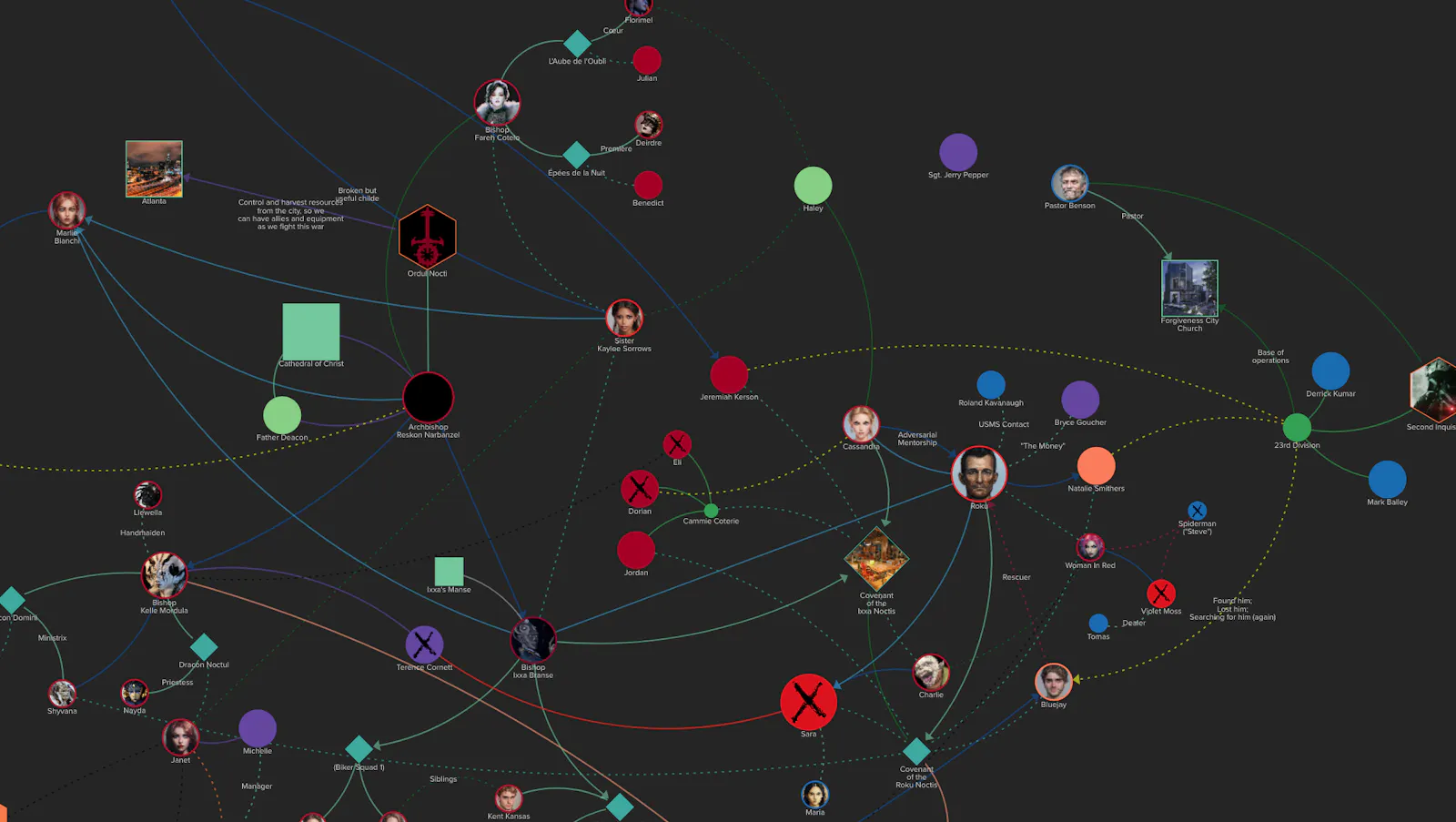
The concept is simple. Put the names of the party’s characters on a page and draw arrows between them. Write some words about what each arrow means, and you’ve just described a relationship. If you can, write the names of important NPCs in each of your lives. Put enough names and relationships together and you’ve got a drama everybody cares about.
Put enough names and relationships together and you’ve got a drama everybody cares about.
Consider the following:
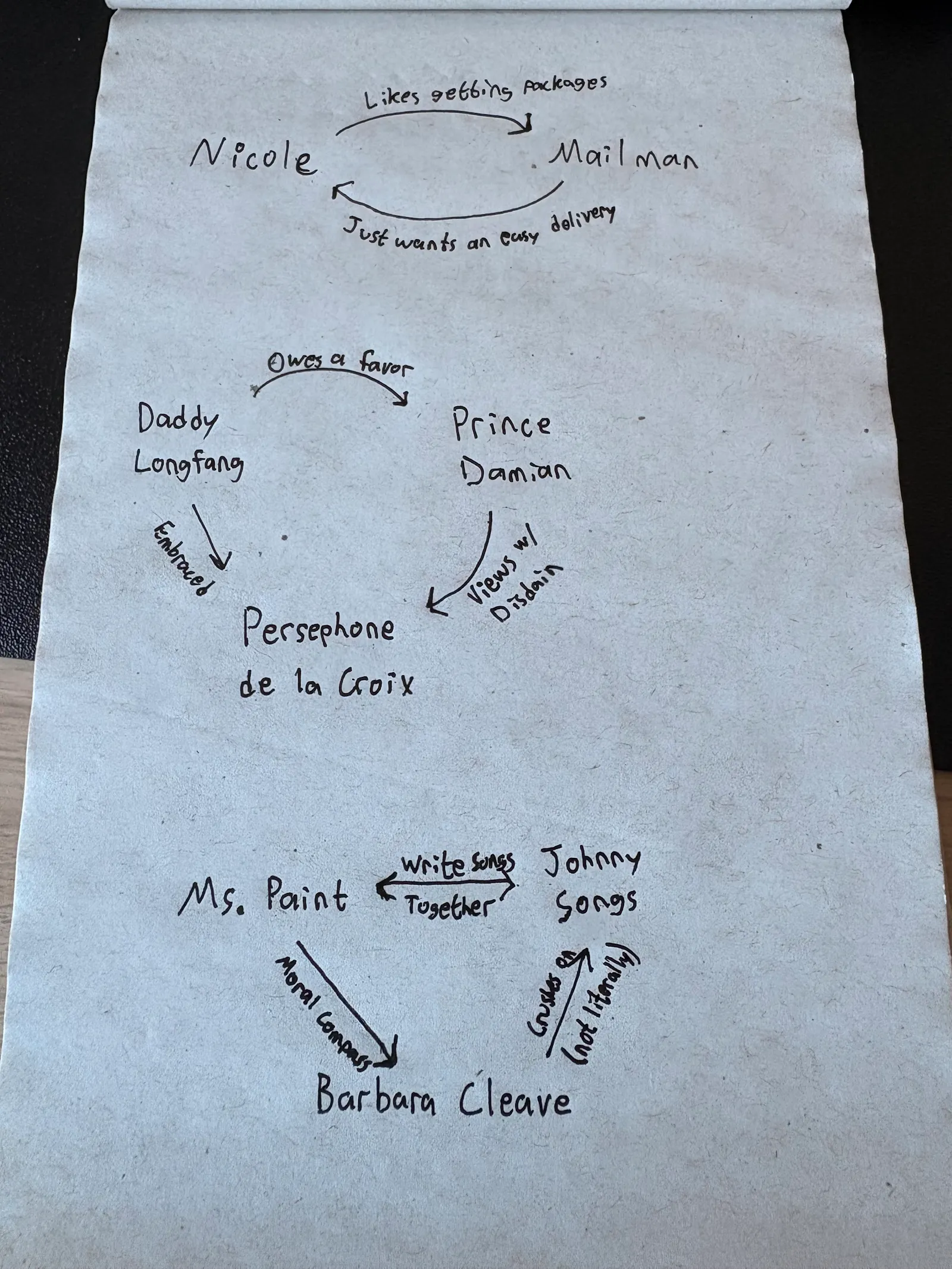
A relationship is just a connection that any two entities have.
Connections can go in one or both directions.
Two people can have different relations towards each other.
Perspective can be from the entity’s point of view, or from an outside POV.
Between any two people who know each other, they have ideas in their head that influence their interactions or motivations. Whether it’s true love or simple convenience, it doesn’t matter
I like seeing the mailman (because there’s at least a 20% chance he’s holding a box of dice, cards, etc), and in return, he probably likes that I’m quick to answer the door when he rings, which is why he always smiles while handing me a package. (I’m probably reading this entirely wrong, but the answer to “do you come here often?” is yes. Seriously he’s here like five times a week.)
In Vampire: the Masquerade, every relationship is a power dynamic: a sire exerts influence over their childer, both are expected to be subservient to the local Prince or Baron, and all of the above consider humans to be food (useful food, if they’re lucky).
In Pathfinder, a priestess of art, love, and beauty is likely to get along well with the bard, but will find herself disagreeing with the brutish barbarian who solves everything with an axe. Perhaps the barbarian wants to get better, and sees the priestess as a role model. Or perhaps the barbarian is at odds with the priestess. In either case, if they’re in a party together, there’s drama! (In the good way, I hope!)
How do Relationship Maps help?
Let’s return to the party mentioned earlier. Recall the composition:
an Elf from the Brightwoods
a Bard with noble heritage they’re running from
a Lizardfolk from outer space, stranded here
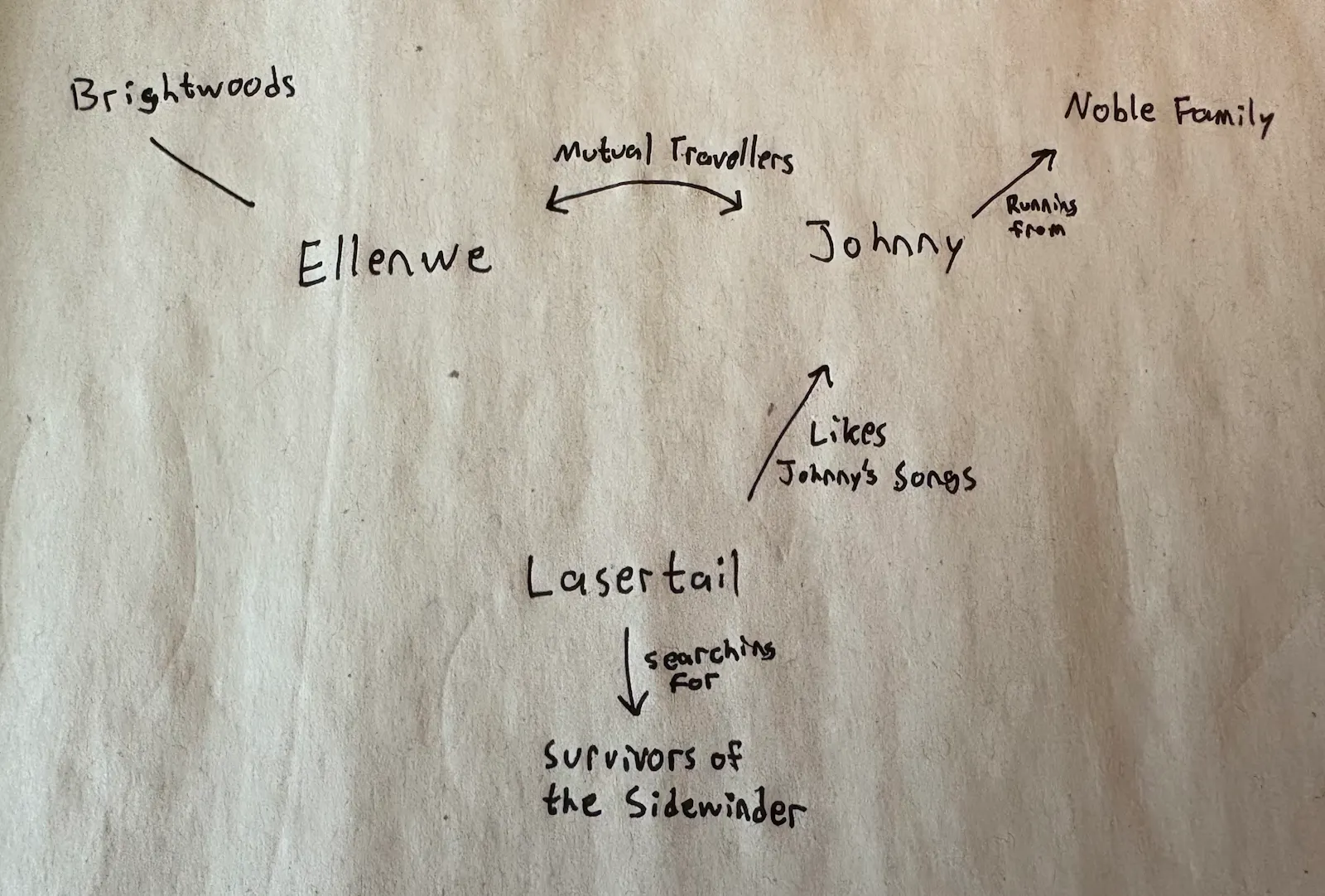
We’ll call them Ellenwe, Johnny, and Lasertail. We can probably some bonds starting to form in our head. Ellenwe and Johnny are mutual travelers. Lasertail probably doesn’t care about Johnny’s heritage but might appreciate his music, and perhaps he should be interested in Ellenwe’s geographic knowledge. Just like that, the players have interactive banter. Hooray!
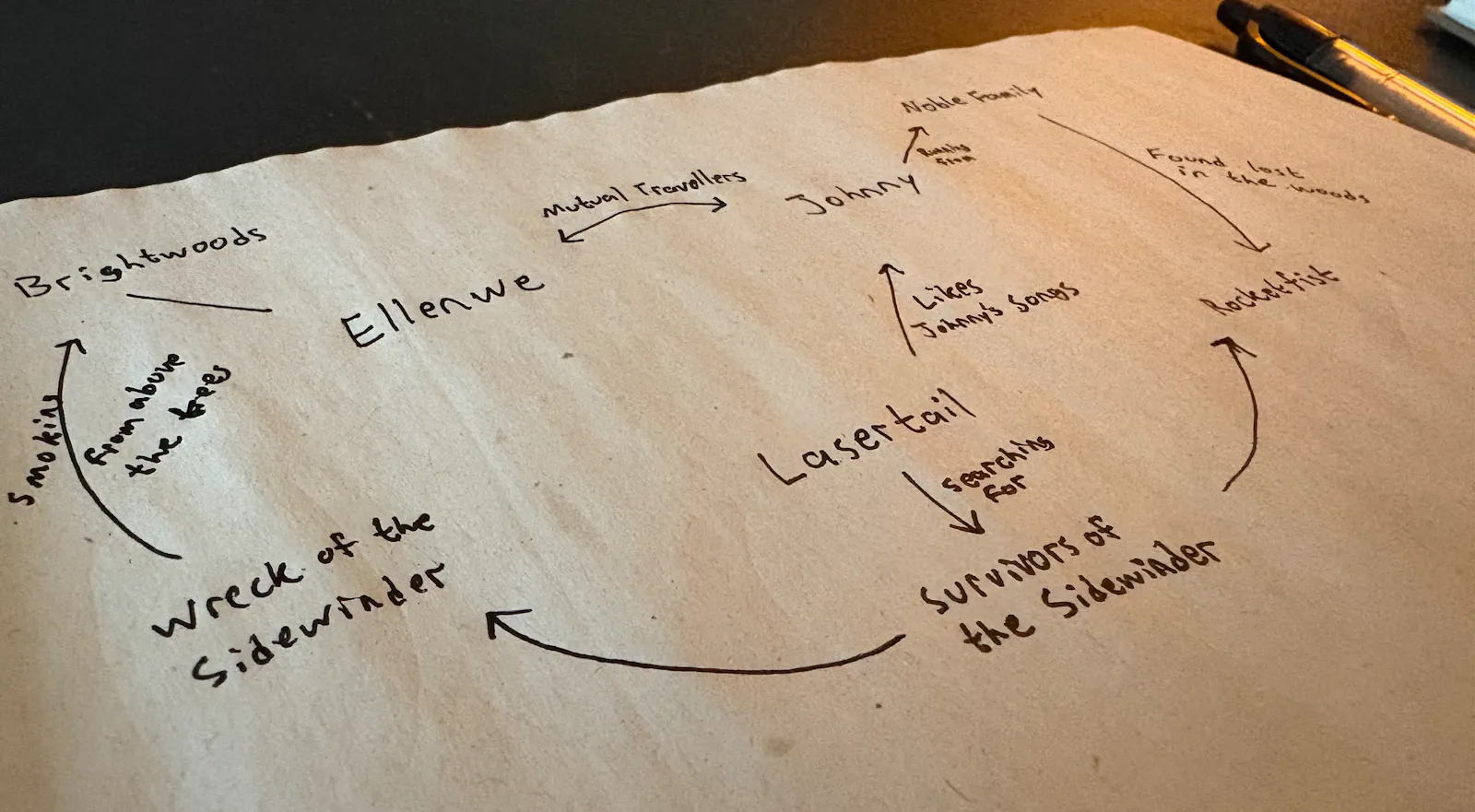
So far it’s still just surface-level engagement, but you can hopefully see where to go next. If you’re the GM, and you haven’t prepared your campaign to involve forests, angry nobles, or space pirates, it might feel difficult to weave their PC’s origin stories into the overarching quest. But while the Noble Family might not be directly related to the Sidewinder, perhaps in their search for Johnny, they found one of the old crew members…
And from a player’s perspective, it’s often difficult to remember the details of other people’s interactions and the nuances to their stories. Of course it’s polite and best practice to let other players have their moments to shine, but can you take it a step further and help them plan for success?
Next episode (hopefully next Friday), we’ll look at using Relationship Maps to identify and track key NPCs and add depth to your stories. And the episode after that will cover how you as a player can use R-Maps to follow multiple ongoing campaign threads, including the personal arcs of your character and those of your companions.
As always, please feel free to come visit us in the Play Brilliant Discord server (Öffnet in neuem Fenster), and if you want more of this content, please consider subscribing. Every bit helps as I get this gig off the ground.
Tot straks!
Datum
16.05.2025
Kategorie
Essays


