…. a ramble
Currently I am stuck. I don’t know what to write about, which is a lie because here I am writing things down.
I don’t remember who told me this, but think it had to do more with staving off panic attacks. I don’t actually suffer from these, but know that many people do. We were being advised to sit down and name what was around us. Name what we were doing. Like: I am sitting on a folding chair, it has a cushion on it. I have my hands on the key board and I am typing.
This same person, and now it is coming back to me, was a nutritionist I met in New York City. I had been advised to go to her because I was having difficulty eating. I could (or would) only eat blueberries and yoghurt, or ramen from the place on the corner of the street I was living at the time.
The danger of eating like this, for me at least, was that I would become bored with what I was eating and then it would take a while for me to find something else that I wanted to eat.
Understandably, I was very thin. A friend of mine, my neighbour when I lived on Seventh Avenue, advised me to go to this nutritionist, and I did. Food was not the nutritionist’s only interest. She also told me that in the times I felt I could not do anything to repeat what I was doing to myself, silently: I am swimming, I am walking, I am sitting. These statements serve to bring you into the present, and whatever you are doing becomes possible, because you are not putting what you want to be doing into the future. Such as: I will swim or I will walk.
Another thing she taught me, I used to suffer dreadful pain in my feet and legs, was to sit in an ice cold bath. I did this. The pain was so intense I thought I would not be able to bear it, and then suddenly the pain left. I think this pain was linked to walking on cement sidewalks, and hard, tiled floors. No escape when in New York, unless you are lucky enough to have an apartment with wooden floors that give a little under your step. I am suddenly reminded of dancing on sprung wooden floors at dance classes. There are innumerable dance classes in NYC.
Back to naming what is around you. This is also helpful if you are experiencing being blocked as a writer, or as a visual artist. When seeking to unblock myself, as a visual artist, I have found it helpful to draw whatever it is that is in front of me. A glass of water is a favourite subject, putting a spoon in the glass can make it more interesting. When writing, it is to do what I just did, write about what I am doing at the time of doing it. Of course you can delete what you wrote later if it has no relevance to what it is that you are wanting to be writing about.
Special moments
Now I want to tell you about a few encounters. It was last Sunday and I was talking to a person out by the horses. Suddenly we became aware of a russet fox slipping by hoping to be unnoticed. Lilly the calf-sized dog had seen it first and had started barking, which is the only reason we even looked in the direction Lilly was so focussed on, otherwise I think foxy would not have been seen.
I know there are foxes, bats, and badgers around here, because I have seen the bats and badgers when I used to take Lilly out for late night and early morning walks when she was a puppy. Now she does not want to be disturbed, until she asks. I have heard there are wolves not so far away, but have not seen the forestry guards for a while, who usually keep me updated on where the wolves, or passing bears or lynx may be.
Birds
On Friday evening I was standing in the paddock and a small bird, a grey wagtail I think, flew up from the ground and hovered in front of me at the level of my head. I felt I was being studied. This small bird, I suppose, was one of those human watchers.
This year I have seen the grey wagtails (ballerina or dancer in Italian) are fairly bold. They strut around on the ground beside the horses, which are very much aware of them. I notice the horses keep an ear and their eyes on these birds, possibly to avoid stepping on them as they come fairly close to the horses’ hooves.
I am not sure if there are more birds this year. I feel we have fewer swallows and swifts, but there seem to be more blackbirds. There are fewer sparrows, but this may have to do with the time of year. At some point I am usually followed as I walk down the road by a flock of at least twenty sparrows.
This year I hear the Eurasian kestrels, but have not seen them. Last year I would sit out and watch them hover in the air. They also used to meet on top of the tallest electricity pylon, but this has been re-possessed by the hooded crows.
In the early spring I found two ravens in the paddock that had no fear of me. I had never seen ravens up so close and was amazed at how big they are. On another day one raven flew close by my head, startling me with that swoosh, swoosh sound of its wings. I do not know if they are still around. I have read that once nesting they can become almost invisible.
The local vet told me that Eagles are nesting on Mount Rest this year. I saw one gliding, whirling and turning through the air when I was out by the paddock attempting to feed hay in a high wind.
Other birds I hear, but have not seen, include hoopoes, cuckoos, redstarts. I’ve been told we have goldfinches in the courtyard, but they are too quick for me to see. My companion sees them. He is an ex hunter and sees much that I may miss. In fact, my dog Lilly taught me to look around me, up at the sky, down at the ground. To take more notice of the world around me. I have had dogs in the past, but this dog, in particular, seems to be exceptionally attentive. It may be because she is a Maremanno Abruzzese sheep dog, and that is part of her nature: She will notice small changes on the road, and stop and look at me to make sure I have seen them as well. This may be a plastic bag that escaped in a high wind from the neighbour’s rubbish bin, or a windblown rainbow coloured umbrella. This large breed is attentive; protective, playful, but may decide to ignore the human when thought fit.
Bees
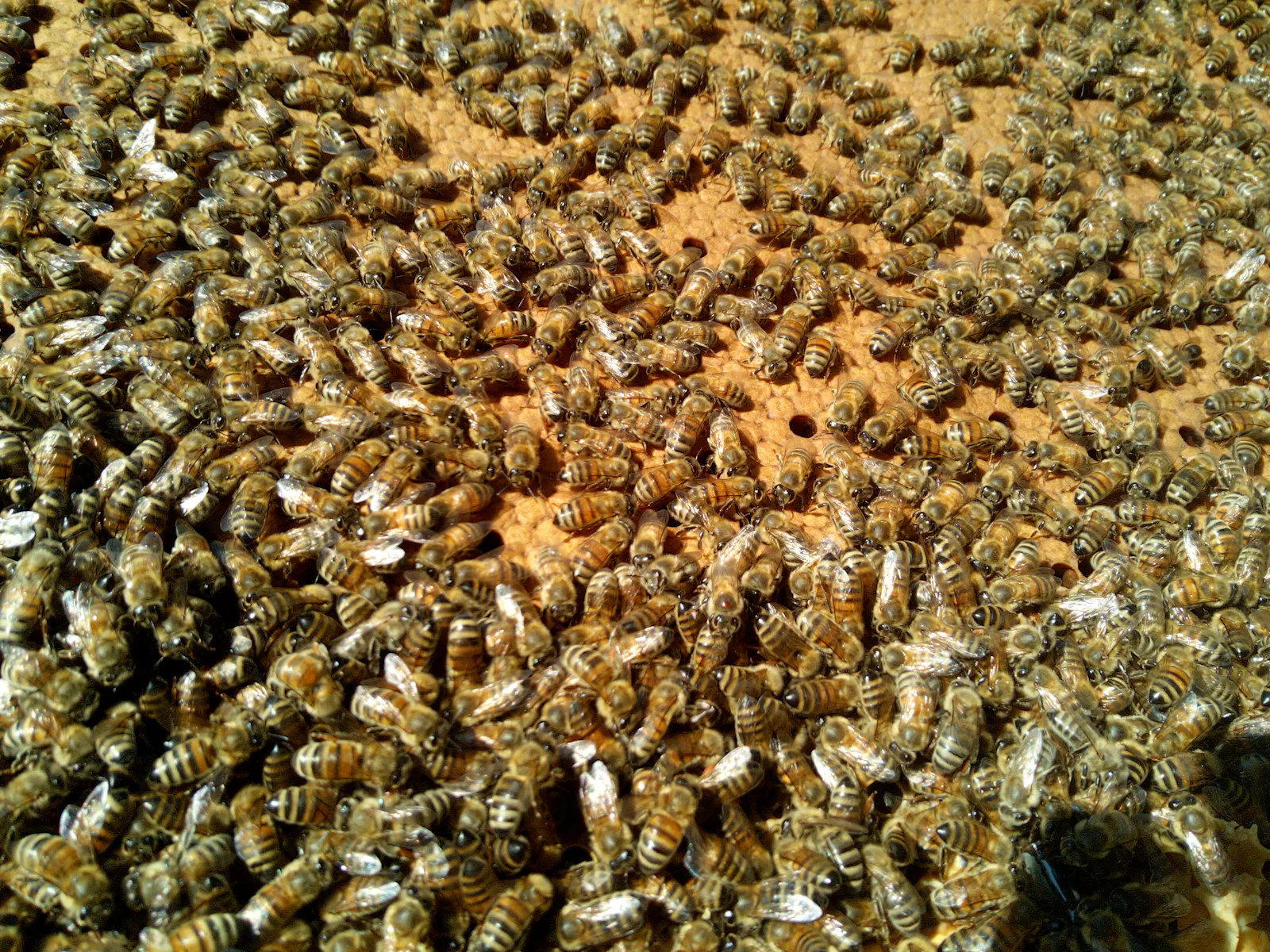
Another thing that happened is that we had been out checking on our two bee hives. We used to have twenty, which fell to two after a harsh winter a couple of years ago. Later in the day, as I came back from tucking the horses into eat their final hay of the day, I found my companion out in the courtyard. He said bees were attempting to break into the bedroom and they had woken him up from his nap.
It is swarming season, so this is not unusual. I had to go back out near the beehives and pick up one of those styrofoam nest boxes, or swarm catchers. I noticed that one of our empty hives was showing signs of activity. There were bees. Their movements reminded me of those folks who go look at property they may be thinking of buying. First check the outside, and then go inside and have a look around. The bees could have been carrying clip boards with pencils attached. A couple may have had video equipment and cameras. They were still there when I looked this morning, but seemed to be more settled.
My feeling is the bees that were attempting to break into the bedroom were, in fact, a part of the swarm that got left behind. This can happen. Some of the bees inside the bedroom window seemed drunk, or exhausted. Others had the energy to do one of those backflips, where they use their wings to turn themselves upright, as I gently guided them off the window glass towards freedom outside.
We have yet to visit the hive with the new bee tenants. I am not sure what we will find. Some of those hives were left with frames inside, and others were left empty. If the hive was empty it will be filled with comb quicker than you can imagine. I would like to leave the bees to do what they think best. I’ve read that the pre-made wax comb we buy for the hives is made so the cells are a little larger than they would be if they had been made by a bee. I am not in charge of the bees, so this decision will not be mine.
Some time ago I read that a smaller cell size (4.93 mm against 5.3 mm) may help in minimising infestation by varroa destructor, which is a parasite that can debilitate bees and their communities. I have just checked on this and the effect was found to be non-existent (Coffey, et al., 2010), . If you want to read more about this I have added the link below.
It is very hot now. The last time we had this type of heatwave the queen bees stopped laying. We learned they lay within a certain temperature range in the hive: 31 and 36 °C. I’ve added a link below from The Apiarist, which is interesting and contains more details.
Please remember to set out water for small creatures. Bees need rocks and stones in a shallow dish of water, which will need to be replenished repeatedly!
Thank you for reading. Please share.
Mary F. Coffey, John Breen, Mark J.F. Brown, John B. Mcmullan. Brood-cell size has no influence on the population dynamics of Varroa destructor mites in the native western honey bee, Apis mellifera mellifera. Apidologie, 2010, 41 (5), ⟨10.1051/apido/2010003⟩. ⟨hal-00892080
Link about timing and temperature in beehives: https://theapiarist.org/timing-is-everything/ (Öffnet in neuem Fenster)
Datum
27.05.2026
Kategorie
Memories


