March 2023
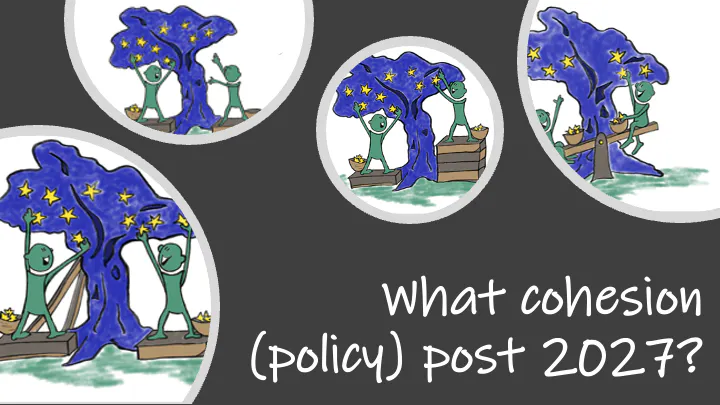
In February 2023, a group of high-level specialists has been tasked by the European Commission to reflect on the future of cohesion policy post 2027. Until early 2024, it will discuss needs and ideas to make sure cohesion policy can respond to cohesion challenges today and in future. More information is available on the website of the DG REGIO (Öffnet in neuem Fenster).
The work of the group includes also questions about the understanding of cohesion and subsequently the self-conception of cohesion policy, which has touched upon at the first meeting of the group.
To start with, the EU looks to ensure stability, security, prosperity and integration, increase citizens’ living standards and secure its global influence. In short, sustained inclusive (broad-based) growth should be experienced by the majority. This ambition is supported by the Single European Market and related EU policies concerning competition, economic growth, innovation, etc.
In this context, cohesion policy is a necessary but not sufficient ingredient to achieve cohesion. Cohesion policy sets out to support balanced economic development, correcting internal disparities through investments in public goods, innovation, digitalisation, human capital, the environment, climate, social integration and transport. Its investments also support the green and digital transition that is currently undergoing in Europe. The investments can accelerate regional development while contributing to sustainable growth across Europe, especially in less developed regions. The policy improves efficiency, equity, convergence and competitiveness, while also aiming to maximise growth along with continuous convergence of outcomes and productivity across Europe’s regions.
Cohesion, growth and development
Despite its role in promoting convergence while delivering EU priorities, including supporting investments during the economic crisis, the pandemic and the war, cohesion policy is often seen as a purely redistributive policy. This raises questions concerning the relation between growth, cohesion and sustainability, which should be compatible.
Europe needs to increase growth in terms of income per capita, albeit keeping income disparities limited and reducing the risks of people and places growing further apart. To strengthen its growth and also global competitiveness, Europe needs to attract innovation which creates rather than automates jobs. Europe also needs to increase labour force participation, which is a particular challenge in light of an ageing population and expected demographic decline.
The challenge is to avoid that all this leads to increasing imbalances between places and people. How can cohesion policy help to strengthen income per capita, labour augmenting innovation, so that growth and cohesion converge? How to stimulate development and growth, with greater equality and equality of opportunities, resilience, sustainability and a long-term perspective?
Turning the table, there is also another story to be told. Cohesion is a necessary precondition for growth and development. Growth without cohesion will further accelerate concentration tendencies leading to increasing spatial and social fragmentations. The people and places left behind and without positive future prospects, may turn against the political and economic players and thwart growth trajectories.
More than a flanking policy
This touches upon the relation between cohesion policy and other policies. Focusing on growth, cohesion policy is often considered a ‘flanking policy’ or ‘compensatory instrument’ to balance European integration and the Single European Market which can benefit some more than others. It is also seen as a means to enhance solidarity between member states by extending it to regions, by helping them to increase their ability to boost economic activity and benefit from technological change. The policy is often seen as an instrument to achieve inclusiveness while being central to the multifaceted relationship between competition, innovation and growth policies.
In addition to economic prosperity and the need to stay ahead of technological changes, the EU has started a long-term transition to a sustainable and digital Europe. This is encompassed in the objectives of the green and digital transitions. These are accompanied by the challenges of demographic change, and the objectives of just transition, with the aim of leaving no one behind and bringing Europe closer the citizens.
Does this mean, the objective of cohesion policy is merely to cushion the ‘negative’ effects of other policies? The EU objective of economic, social and territorial cohesion might actually require more than doing no harm to cohesion or cushioning non-cohesion effects of policies. Given the size of the cohesion challenge, there is no single EU policy which can do so. If cohesion is wanted in Europe, we need to mean it, as we have argued in earlier blog posts, e.g. about the Cohesion Spirit (Öffnet in neuem Fenster) and the meaning of cohesion (Öffnet in neuem Fenster). Cohesion is about structural issues and solidarity, i.e. understanding that we are in this together. Therefore, it requires policy responses which are supported by a wide range of policies at EU and national level, and cohesion policy which is more than flanking policy, or excuse that other policies do not care about cohesion.
Challenges to cohesion
Regardless the meaning of cohesion, current trends and challenges, as well as the green and digital transitions risk to further accelerate disparities between places and people.
The spatial and social dynamics of technological transition are a showcase how digitalisation and technological changes are expected to increase disparities in the short-term, before they work towards convergence in the long-run. The network effects of technological ‘revolutions’ often lead to economic and spatial concentration towards the innovative places where the drivers of change are located. Only later technology diffusion can be expected to bring convergence between economic players and places. That is when the new technology is widely diffused, copied and the benefits to the users come into play. What does this mean in a time of ever shorter cycles of technological innovations and breakthroughs?
There are considerable risks of increasing concentration to urban areas with growing territorial imbalances and inequalities, which may translate into social fragmentation and increasing discontent. This includes increasing dissatisfaction of people living outside prosperous urban areas, also so called ‘medium income people’. People in small and medium-sized cities and rural or remote areas increasingly feel they carry the burden of changes and are left behind. Prime examples of discontent are the gilets jaunes and Brexit.
Outlook
The debate on the future of cohesion policy post 2027 touches on fundamental issues rather than on technical issues of the delivery and control mechanisms of cohesion policy. This is very welcome as it may help to radically change and possibly also reinvent a cohesion policy which fits the development challenges and policy context of the next decades. Stay tuned at the website of the DG REGIO (Öffnet in neuem Fenster). To follow the discussions of the group of high-level specialists on the future of cohesion policy. They are, however, not the only game in town. Others are also active advocating the need for a cohesion policy fit for the future. Among them is the Cohesion Alliance, which just organised a high level event discussing cohesion as a bridge to a united and fairer Europe (Öffnet in neuem Fenster).
By Kai Böhme and Paola Marinović
https://steadyhq.com/en/spatialforesight/posts/0c45f6b7-e45c-4aae-a839-71e4aff5ca87 (Öffnet in neuem Fenster)
Datum
20.03.2023
Kategorie
Cohesion (policy)
0 Kommentare
Möchtest du den ersten Kommentar schreiben?
Werde Mitglied von spatialforesight und starte die Unterhaltung.