Feburary 2023
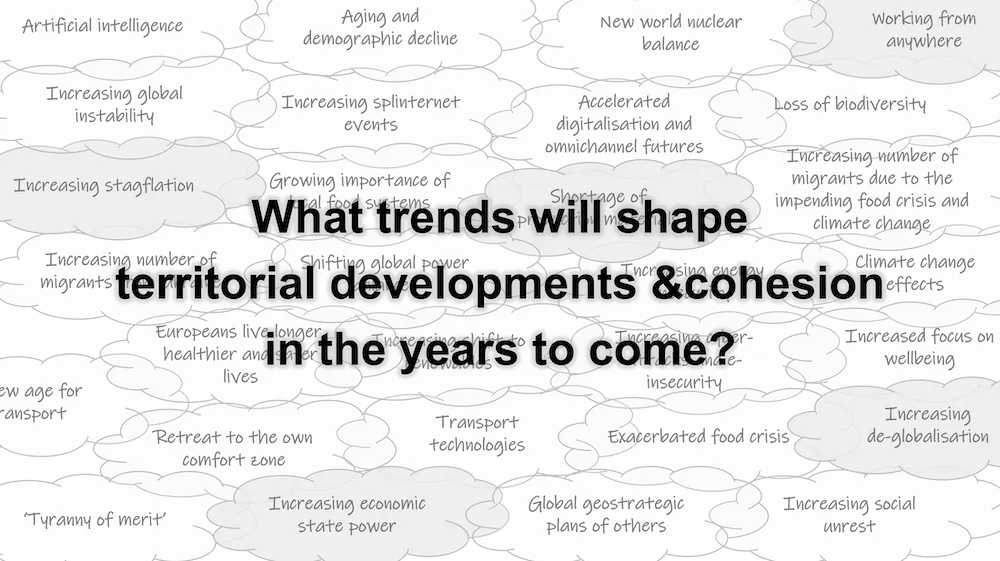
Following up on earlier blog posts addressing trends shaping territorial cohesion, this blog post addresses a collection of more economic trends. The collection is based on various studies addressing mega-trends which we have conducted during 2022, e.g. for the European Parliament (Opens in a new window), the European Committee of the Regions (Opens in a new window) or ESPON (Opens in a new window). Bringing together the various pieces of trend analysis provides a rich picture about possible developments which may shape territorial development and cohesion in Europe.
Trends considered to have the strongest impacts on territorial development and cohesion include exogenous technological (Opens in a new window) (e.g. digital society, post-carbon and circular economy), social (Opens in a new window) (e.g. migration, aging, fluid social institutions and shifts in values), environment (Opens in a new window) (e.g. adapting/mitigating climate change and managing scarce resources), and economic trends (e.g. slowbalisation, peak of everything, working from anywhere). Also, political trends play an important role, both political developments in Europe, as well as those in other parts of the world which affect development prospects in Europe.
The combined picture which emerges from this suggests that future trends are likely to exacerbate spatial and societal fragmentation, interdependencies and policy mismatches. In many regards the trends point to risks of increasing concentration on urban areas with growing territorial imbalances and inequalities, which may translate into social fragmentation and increasing discontent. This also risks increasing perceptions of uncertainty and vulnerability in a world of disruptive changes leading to ‘pervasive uncertainties’.
Economic trends
External and internal shocks and global interrelations are key characteristics of the economic mega-trends we have addressed in the various studies. While the pandemic and Russia´s war on Ukraine affected economic outlooks, key trends including de-globalisation or ‘slowbalisation’ have been in the discussion already before that. There are certainly also a range of technological trends which pave the way for economic activities, as addressed in an earlier blog post (Opens in a new window).
Still, the pandemic and Russia´s war on Ukraine have brought a shock to the global economic outlook, with commodity prices and global value chains being disrupted, lowering EU growth, increasing inflation and upsetting global markets.
Some of the trends which may affect territorial developments and cohesion in the medium to long term include:
Increasing de-globalisation. Technological developments that replace low-skilled staff, in combination with the gradual convergence of unskilled workers between Europe and Asia, as well as a potential U-turn of public opinion against globalisation, evident in protectionist choices, have made de-globalisation a current trend. Proposing to move towards a less connected world, with powerful nation states, deglobalisation became more popular after events such as Brexit and Trumpism. In other words, growing global tensions, the war and increasing competition have pushed companies to focus on specific economic blocs and shorten their supply chains. This has increased repatriation, onshoring, reshoring and nearshoring for strategic goods to make economies and societies more resilient. It implied also returning to the nation state as the key economic power. Already such effects were noticed during the pandemic, which accentuated the strategic importance of value chains for material such as medical equipment, microelectronics or batteries.
Increasing stagflation. Inflation in the euro area is expected to surge further, mainly due to surging energy and food prices, as well as supply and logistics bottlenecks. In addition, the war has magnified the slowdown in global growth with immense consequences for low- and middle-income economies. Such development risk to intensify stagflation for a longer period of time, as inflation peaks and growth decreases, risking a global recession.
Increasing economic state power. Tighter subsidy and monetary policies are among the tools at hand to counterbalance the economic risks of de-globalisation and stagflation. This may also lead to stricter national policies, with more involvement to ensure economic and political stability, social welfare and related benefits.
Shortage of production materials. For some time, the supply of several resources has clearly been depleting due to population growth, environmental stress, etc. The war on Ukraine affects agricultural products, but also materials necessary for industrial production, such as palladium and neon. For instance, shortages of wood have led to slowdowns in construction and a lack of microchips has affected car production. Temporary shortages of parts and raw materials may continue, and we may move towards a ‘peak of everything’ scenario.
Working from anywhere. Further effects on the economy may come from the changing nature of work. Working from home or teleworking is a trend that accelerated substantially during the pandemic. Demand has increased over the decades, with more than half of the workforce already in the 2020s looking for more opportunities to work from home. With the support of technology, some people can work from anywhere, anytime, putting a new geography of work in place. A ‘new balance’ it seems is still to be found as there are debates about the merits of office work in particular for more collaborative and creative jobs. Besides the debate about the importance of the workplace, there are also debates on the amount of hours to be worked. Linked to the debate about wellbeing (see blog on societal trends), some places test a 4-day workweek
All these trends will affect territorial development and cohesion from the local to the global scale. Growing possibilities to work from anywhere – so still taxation and social security issues are to be solved if that extends beyond national borders – may hold the potential to combat some spatial concentration to larger urban areas. Some people see even a possible boost of small and medium-sized towns due to this. In the same way, some people see the impacts of ´slowbalisation’ in terms economic increased repatriation, onshoring, reshoring and nearshoring as a potential for economic growth in lagging regions in Europe. However, the overall outlook might be more shaky as ´slowbalisation’, stagflation, shortage of production materials and increasing appetite for state intervention on the economies are more likely to turn out as shocks with spatial spurring spatial concentration. In a similar way as discussed for technological change in an earlier blog post (Opens in a new window).
by Kai Böhme
https://steadyhq.com/en/spatialforesight/posts/f75c6801-ded7-401e-a0a9-31d0f23c02b9 (Opens in a new window)https://steadyhq.com/en/spatialforesight/posts/81662208-b7b9-4956-b88d-9fe96b13042d (Opens in a new window)
Date
February 13, 2023
Topic
Trends
0 comments
Would you like to be the first to write a comment?
Become a member of spatialforesight and start the conversation.